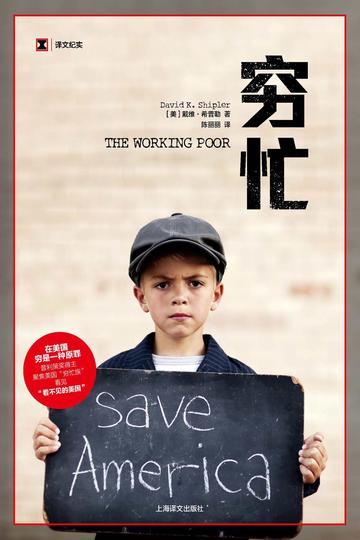
In America, poverty is an original sin.
Why do people get busier as they get poorer, and get poorer as they get busier?
Education, medical care and housing, employment, taxes and benefits, and even gender, region and culture.
Poverty is always a "system" problem.
Pulitzer Prize winner, focusing on the "working poor" in the United States and seeing the "invisible America".
This is the America that has been forgotten.
The car washer has no car to drive, the bank clerk's account only has US$2.02, And the income of a female medical textbook editor in ten years cannot keep up with that of a dentist.
This book tells the stories of some of them: their families, their dreams, their failures. And what failed more than them was their country. Although the United States is richer than ever before, and although the United States promotes the credo of "working to get rich," the problems of low-income people have made all this questionable.
For most of the people I write about, anger is a luxury. They are struggling, exhausted and unable to find a way out. Their wages did not improve their lives and lift them out of poverty. On the contrary, they were burdened by life. People often use the word "working poor" to describe them, and the word itself is an oxymoron.
In America, hard-working people should not be poor.
The U. S. Economy has had its ups and downs, and the latest statistics show that the lives of poor people have remained basically unchanged, except that they have become more difficult. The gap in net worth between the richest and poorest households has widened, creating a polarization. The resource gap between wealthy school districts and other school districts has further widened. More children are missing school due to asthma, more people do not have access to health insurance, more people are hungry, more people are in prison, and more illegal immigrants are working at the bottom of the workforce.
Americans generally do not understand the causes of poverty and, therefore, do not know how to solve it. They believe in the American Dream and believe that even people from the poorest backgrounds can live a happy life. But this also gives people an excuse to blame the poor: to some extent, low wages are the worker's fault, because low wages simply mean that the value of his labor is low. In the American context, poverty always carries the aura of original sin.
Indeed, being poor in a rich country is much more difficult than being poor in a poor country.
Reader comments
By reading books of this type from Japan and the United States, we can learn in advance about the problems we may encounter in the future. Although the national conditions are different, they are all human societies, and they are all people developing in a market economy. The problems they have encountered are more or less the same as ours.
And some things are indeed happening as I read in books about Japan and the United States.
It is a book with very practical significance. Many of the current situations in it actually overlap with the current employment environment and living environment. However, the last chapter is of little significance. Those are suggestions and corrections based on the situation in the United States, and have almost no reference significance.
"From the people in this book, we see that working-class poverty is composed of countless difficulties, one difficulty intensifying another: not only low wages, but also low education levels; not only dead-end jobs, but limited abilities; not only insufficient savings, but also unwise consumption; not only poor housing conditions, but also inappropriate childcare methods; not only no health insurance, but also unhealthy families."
This sentence almost summarizes the entire previous chapters of the book, and as a result, the gap between the rich and the poor has once again widened. Because of my thoughts, knowledge, vision, and various other things, I won't elaborate on this aspect because I hope everyone can read this book. However, I still don't want everyone to become more desperate about life after reading this book. I still hope that everyone should embrace life more actively. Like Kara.
When class is almost solidified and you see bank cards struggling, where should we go?
——It shouldn't just be confused. Better to find the answer.
It tells the tragedy of the poor in American culture and society. The gap between rich and poor in the United States is very large. And if you are almost poor, you will always live in the world of the poor. It is almost impossible to change your level through ordinary work. And there is also a saying in it that the busier you are, the poorer you will be. This is easy to understand. If the working people at the lower level refer to their work scope, it is almost a day-to-day cycle. And in American society, a poor person has to start a business. Compared with Asian countries, this is much more difficult.
Loving life requires finding the meaning of life. This is a self-help and inspirational book about life and work, designed to help people find ways to balance their busy lives. The author provides strategies and suggestions for coping with busyness through analysis and thinking about busyness and stress. After reading this book, I was attracted by the author's deep insights and positive attitude towards busy life. Through examples and cases, the book allows people to re-examine busyness and time management, so as to handle various matters in life more effectively.
A book that reflects real social life in the United States
The author is not only good at observing life, but also good at thinking and summarizing. By paying attention to the environment in which a group grows and lives, and combining it with their real situation, he seems to have drawn conclusions similar to the theme of this book, thus informing readers that poverty has common causes. Of course, if we really take "why we are poor" as the research theme, from a more objective and rational perspective, the poverty factors of some people cannot represent the real causes of poverty. Why poverty exists is an unexplainable truth, it just exists. However, looking at the common conditions manifested by poverty, laziness in thinking and behavior, complaining about society, low ability, low education level, social welfare environment, etc. Do exist. In short, I don't agree with the concept of using individual cases to extend the overall theme of this book, but I agree with the fact that the content in the book exists, and the author's narrative writing style also makes the book easy to understand, as if listening to a thoughtful person telling a real-life story, which is worth listening to.
This book allowed me to see the life of the "working poor" in the United States. They are really miserable! The author's writing is very real and made me feel their struggle and helplessness. However, this book also made me think, how should we help these people? I hope the US government can pay more attention to them!
Good books, stones from other mountains can attack jade.
An enlightening book.
Thought-provoking and thought-provoking
This book gives me the feeling that life in different countries is always full of hardships and setbacks. The difference lies in how we choose to deal with life.


By reading books of this type from Japan and the United States, we can learn in advance about the problems we may encounter in the future. Although the national conditions are different, they are all human societies, and they are all people developing in a market economy. The problems they have encountered are more or less the same as ours. And some things are indeed happening as I read in books about Japan and the United States.
It is a book with very practical significance. Many of the current situations in it actually overlap with the current employment environment and living environment. However, the last chapter is of little significance. Those are suggestions and corrections based on the situation in the United States, and have almost no reference significance. "From the people in this book, we see that working-class poverty is composed of countless difficulties, one difficulty intensifying another: not only low wages, but also low education levels; not only dead-end jobs, but limited abilities; not only insufficient savings, but also unwise consumption; not only poor housing conditions, but also inappropriate childcare methods; not only no health insurance, but also unhealthy families." This sentence almost summarizes the entire previous chapters of the book, and as a result, the gap between the rich and the poor has once again widened. Because of my thoughts, knowledge, vision, and various other things, I won't elaborate on this aspect because I hope everyone can read this book. However, I still don't want everyone to become more desperate about life after reading this book. I still hope that everyone should embrace life more actively. Like Kara. When class is almost solidified and you see bank cards struggling, where should we go? ——It shouldn't just be confused. Better to find the answer.
It tells the tragedy of the poor in American culture and society. The gap between rich and poor in the United States is very large. And if you are almost poor, you will always live in the world of the poor. It is almost impossible to change your level through ordinary work. And there is also a saying in it that the busier you are, the poorer you will be. This is easy to understand. If the working people at the lower level refer to their work scope, it is almost a day-to-day cycle. And in American society, a poor person has to start a business. Compared with Asian countries, this is much more difficult.
Loving life requires finding the meaning of life. This is a self-help and inspirational book about life and work, designed to help people find ways to balance their busy lives. The author provides strategies and suggestions for coping with busyness through analysis and thinking about busyness and stress. After reading this book, I was attracted by the author's deep insights and positive attitude towards busy life. Through examples and cases, the book allows people to re-examine busyness and time management, so as to handle various matters in life more effectively.
A book that reflects real social life in the United States The author is not only good at observing life, but also good at thinking and summarizing. By paying attention to the environment in which a group grows and lives, and combining it with their real situation, he seems to have drawn conclusions similar to the theme of this book, thus informing readers that poverty has common causes. Of course, if we really take "why we are poor" as the research theme, from a more objective and rational perspective, the poverty factors of some people cannot represent the real causes of poverty. Why poverty exists is an unexplainable truth, it just exists. However, looking at the common conditions manifested by poverty, laziness in thinking and behavior, complaining about society, low ability, low education level, social welfare environment, etc. Do exist. In short, I don't agree with the concept of using individual cases to extend the overall theme of this book, but I agree with the fact that the content in the book exists, and the author's narrative writing style also makes the book easy to understand, as if listening to a thoughtful person telling a real-life story, which is worth listening to.
This book allowed me to see the life of the "working poor" in the United States. They are really miserable! The author's writing is very real and made me feel their struggle and helplessness. However, this book also made me think, how should we help these people? I hope the US government can pay more attention to them!
Good books, stones from other mountains can attack jade.
An enlightening book.
Thought-provoking and thought-provoking
This book gives me the feeling that life in different countries is always full of hardships and setbacks. The difference lies in how we choose to deal with life.