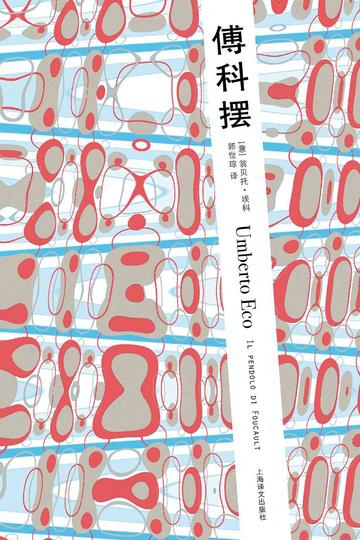
On the occasion of the twenty-fifth anniversary of the publication of "Foucault's Pendulum", author Umberto Eco has carefully revised the novel, added several illustrations, and rewritten one of the chapters. This book is based on "Foucault's Pendulum" revised by Umberto Eco in 2013. In Milan in the 1970s, Dr. Casaubon, a scholar proficient in medieval history, and his two friends, Belbo and Diotallevi, senior editors of Garamon Publishing House, were responsible for publishing a set of "Hermes Series" aimed at making profits. In the influx of manuscripts, and in the process of contact with occult enthusiasts, a repeated and ambiguous "Templar conspiracy theory" appeared repeatedly. The three partners claim to be knowledgeable and skilled, and in a playful spirit, they weave the many mysterious events, characters and associations circulating in history into a seamless "plan", almost "rewriting" and "rewriting" the entire world history. In order to make the "plan" more complete, they created a secret society: "Teleis". Unexpectedly, the mystics took all the orders and actually organized the "Teles" to track Casaubon and Belbo, and would search the world for the fictitious "secret map" in the "plan"...
Reader comments
This book is so wonderful! With his unique perspective and erudite knowledge, Eco constructed a world full of mystery and conspiracy. In the process of pursuing the truth, the characters in the book continue to fall into the fog, which makes people breathless. The sentence "Superstition brings bad luck" is even more thought-provoking.
Eco uses the Kabbalah tree of life as a structure, with ten chapters corresponding to the ten spherical substances, and weaves a labyrinth of knowledge with erudition and irony. The cowardly editor and the doctor obsessed with nothingness gradually fell into their own fictitious conspiracy plan. It is filled with a lot of occult references, but it is actually a profound irony of the "pursuit of meaning": seemingly real references and connections are actually an irony of intellectuals' obsession with explanation and desire for order. When fiction is given a system, people are willing to believe it, but the truth becomes nothing; the real secret may be that there is no secret.
Revealing "the secret itself is temptation" with a dazzling accumulation of knowledge. It mocks those obsessives who cannot accept "meaninglessness". In the end, Eco does not try to provide answers, but reveals human greed for "plans" in a literary way: once a seemingly perfect fictional system is given, people will blindly follow it. The characters in the book go from belief to loss, from fanaticism to nihilism, and finally become prisoners of their own lies. Sometimes the greatest madness is believing that everything has an answer. Being lost in pursuit is more terrifying than facing nothingness.



This book is so wonderful! With his unique perspective and erudite knowledge, Eco constructed a world full of mystery and conspiracy. In the process of pursuing the truth, the characters in the book continue to fall into the fog, which makes people breathless. The sentence "Superstition brings bad luck" is even more thought-provoking.
Eco uses the Kabbalah tree of life as a structure, with ten chapters corresponding to the ten spherical substances, and weaves a labyrinth of knowledge with erudition and irony. The cowardly editor and the doctor obsessed with nothingness gradually fell into their own fictitious conspiracy plan. It is filled with a lot of occult references, but it is actually a profound irony of the "pursuit of meaning": seemingly real references and connections are actually an irony of intellectuals' obsession with explanation and desire for order. When fiction is given a system, people are willing to believe it, but the truth becomes nothing; the real secret may be that there is no secret. Revealing "the secret itself is temptation" with a dazzling accumulation of knowledge. It mocks those obsessives who cannot accept "meaninglessness". In the end, Eco does not try to provide answers, but reveals human greed for "plans" in a literary way: once a seemingly perfect fictional system is given, people will blindly follow it. The characters in the book go from belief to loss, from fanaticism to nihilism, and finally become prisoners of their own lies. Sometimes the greatest madness is believing that everything has an answer. Being lost in pursuit is more terrifying than facing nothingness.