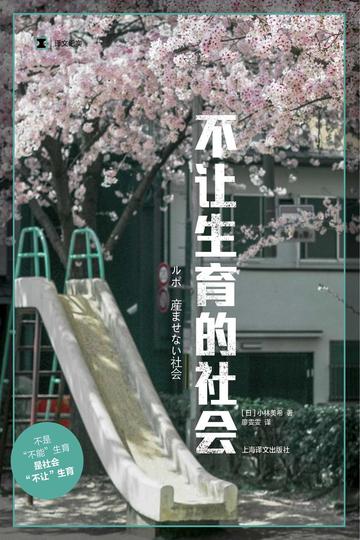
It's not that you "can't" have children, it's that society "doesn't allow" you to have children. The entire social environment is telling women: "If you are so worried about your children, let the mother stay at home." What is the fundamental reason why young people are unwilling to have children? How to change the social status quo of low desire for childcare?
From the perspective of women such as the unfair treatment of pregnant women in the workplace, the shortcomings of obstetrics and gynecology in hospitals, and the problems in child care institutions, the author deeply analyzes the social factors of low fertility rates; the author Miki Kobayashi won the Poverty News Reporting Award in 2013 for her "report on the structure of a 'child-free society' and a series of discrimination against pregnant women in the workplace"; in the last chapter, the author describes the ideal form of a "society capable of giving birth," but changing the status quo still requires the joint efforts of all social strata.
Reader comments
Japan now, China in the future. From the perspective of fertility, there are definitely corresponding places, and there are many places we can refer to. China's declining birthrate is already coming.
Taking this as a lesson, China, which also belongs to the Confucian cultural circle, faces social fertility problems that are different from those in Japan today, but have more in common. A country thrives because of its struggling people. Facing an aging population, we should look bigger and farther.
This book truly reveals the various social restrictions and injustices on childbearing, which makes people think deeply. The author's writing is concise and easy to understand, and through specific examples, we can feel the difficulties faced by women during the childbearing process. The behavior of the characters in the book is real and representative, allowing us to better understand their choices and dilemmas. I think this is a valuable book that everyone should read.
This book is about the situation in Japan around 2012. When I was reading it, I kept thinking about whether it could be of great use to China.
The book advocates breast-feeding and natural childbirth, but is somewhat controversial about painless childbirth. It is believed that children who have experienced pain are more likely to be cherished. The discussion in the book seems to be reasonable, but it is a bit contrary to today's mainstream ideas. But on second thought, I have not experienced it myself, so I can't make any assumptions.
In addition, on the topic of whether babies with defects should be born, the book takes a positive attitude to a certain extent on the grounds that "this is a life". From a macro perspective, this reason makes sense, but when it comes to micro implementation, we still have to start from the actual situation.
The family cases interviewed by the author really have their own hardships. In ordinary families, whenever someone gets a troublesome disease, a series of trivial and tiring things will follow. I really admire those who support a family.
In terms of resources and manpower in the medical field, it is known that there is a shortage of manpower but no longer recruits people in order to save costs, resulting in poor performance in all aspects, and thus falling into an endless cycle. However, the situation in our country seems to be that occupations such as hospital nurse assistants are already saturated, but there are not many top talents. The lack of medical resources is probably a common problem in many countries.
Most of the following content is about hospitals.
I was very moved by the "See You Tomorrow" community home written about at the end of the book, and it is a very creative act. People of different ages and situations have their own contributions and gains here. It may be small, but it can also fight against the voice in the heart that "I am of no use."
When I read the postscript, I felt a sense of joy of finally meeting the author and a touch of melancholy that I was about to be separated and embark on a new book journey. When we meet, we part.


Japan now, China in the future. From the perspective of fertility, there are definitely corresponding places, and there are many places we can refer to. China's declining birthrate is already coming.
Taking this as a lesson, China, which also belongs to the Confucian cultural circle, faces social fertility problems that are different from those in Japan today, but have more in common. A country thrives because of its struggling people. Facing an aging population, we should look bigger and farther.
This book truly reveals the various social restrictions and injustices on childbearing, which makes people think deeply. The author's writing is concise and easy to understand, and through specific examples, we can feel the difficulties faced by women during the childbearing process. The behavior of the characters in the book is real and representative, allowing us to better understand their choices and dilemmas. I think this is a valuable book that everyone should read.
This book is about the situation in Japan around 2012. When I was reading it, I kept thinking about whether it could be of great use to China. The book advocates breast-feeding and natural childbirth, but is somewhat controversial about painless childbirth. It is believed that children who have experienced pain are more likely to be cherished. The discussion in the book seems to be reasonable, but it is a bit contrary to today's mainstream ideas. But on second thought, I have not experienced it myself, so I can't make any assumptions. In addition, on the topic of whether babies with defects should be born, the book takes a positive attitude to a certain extent on the grounds that "this is a life". From a macro perspective, this reason makes sense, but when it comes to micro implementation, we still have to start from the actual situation. The family cases interviewed by the author really have their own hardships. In ordinary families, whenever someone gets a troublesome disease, a series of trivial and tiring things will follow. I really admire those who support a family. In terms of resources and manpower in the medical field, it is known that there is a shortage of manpower but no longer recruits people in order to save costs, resulting in poor performance in all aspects, and thus falling into an endless cycle. However, the situation in our country seems to be that occupations such as hospital nurse assistants are already saturated, but there are not many top talents. The lack of medical resources is probably a common problem in many countries. Most of the following content is about hospitals. I was very moved by the "See You Tomorrow" community home written about at the end of the book, and it is a very creative act. People of different ages and situations have their own contributions and gains here. It may be small, but it can also fight against the voice in the heart that "I am of no use." When I read the postscript, I felt a sense of joy of finally meeting the author and a touch of melancholy that I was about to be separated and embark on a new book journey. When we meet, we part.
Backed by data and reality