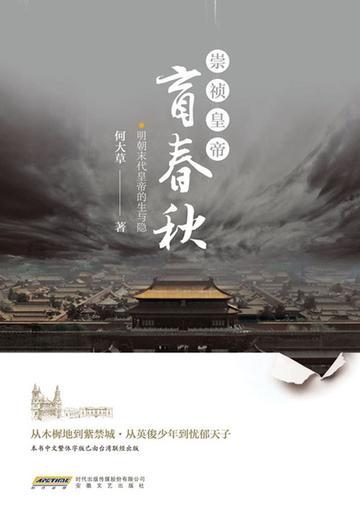
American sinologist Stephen King receives a fragmentary manuscript from his ninety-year-old great-uncle, the monk Simang. More than two hundred years ago, a missionary brought it from China to Europe, where it was secretly kept at the Pauleta Monastery in Portugal. Stephen invites He Dacao, a Chinese writer well versed in history, to help decipher, revise, and organize it. After twelve years of research, the manuscript is finally restored: amid the ruins of the fallen Ming Empire, a missionary rescues a young woman whose eyes have been burned blind. After living under an assumed name for forty-five years, she finally speaks, identifying herself as Zhu Zhu, the illegitimate daughter of the Chongzhen Emperor. She recounts a secret history of the late Ming to the young historian Ji Liuqi.
The late Ming was a mysterious era, and Chongzhen was the most enigmatic and tragic of its final emperors. Politics were dark and terrifying, yet the culture was dazzling, and intrigues swirled both inside and outside the Forbidden City. Chongzhen ascended the throne at seventeen. Brilliant by nature, he was cursed by the times. Through the eyes of his daughter, Zhu Zhu depicts her father hunting down and killing Wei Zhongxian in the imperial garden, secretly meeting Li Zicheng at Fahua Temple, and the palace being plagued by black cats, while relics of the late emperor seem to come back to life... Every detail is vivid and riveting, revealing the secrets behind the empire's collapse. The story is captivating, both accessible and profound. Its language is especially beautiful and varied, blending seamlessly with the era, the story, and its characters to form a rich, poignant elegy.
"This generation is no longer worth looking at with eyes." "The bad guys are the devils of the bad guys, and the good guys are the killers of the good guys." I admire the author's imagination and profound writing skills, and I am still unsatisfied after reading it.
You can see, it's a different history