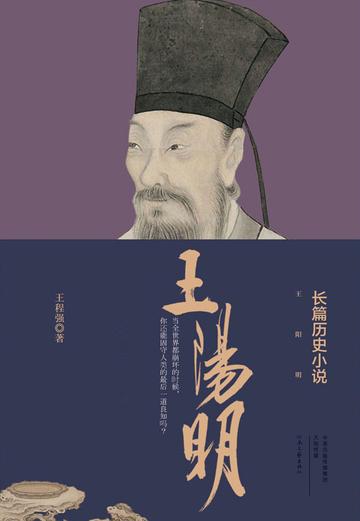
The life of Wang Yangming, the great Ming dynasty thinker, was a life spent pursuing profound wisdom, successfully putting that wisdom into practice, learning to become a sage, becoming a sage, and establishing virtue, achievement, and words that would endure.
The full-length historical biographical novel Wang Yangming is about 1.08 million characters long and is divided into three parts: Learning to Become a Sage, Enlightenment at Longchang, and Conscience in My Heart. It begins with Wang Yangming’s birth in Yuyao, Zhejiang, and ends with his death at Qinglongpu in Dayu, Jiangxi, at the age of fifty-eight. Drawing on the chronicle of Wang Yangming’s life compiled by his disciple Qian Dehong and others, as well as the poems, memorials, essays, and other materials in The Complete Works of Wang Yangming, the book also consults numerous historical records and research materials. Combining these sources with the author’s own practice of Confucianism and Buddhism, it centers on the pursuit and application of profound wisdom, and seeks to portray Wang Yangming’s life as a thinker, military strategist, politician, and poet.
The first part, Learning to Become a Sage, depicts the many places the young Wang Yangming went to study; the young adult Wang Yangming’s illness after investigating bamboo, his assignment in Junxian, and his reform of abuses in the Ministry of Justice prison; and the mature Wang Yangming’s imprisonment after remonstrating with the emperor, among other events.
The second part, Enlightenment at Longchang, depicts Wang Yangming’s enlightenment at Longchang and his career as magistrate of Luling, along with his experiences in officialdom and the wider world: lecturing to colleagues in Beijing, taking disciples and teaching while serving as a junior vice minister of the Court of the Imperial Stud in Chuzhou, and expounding the School of the Mind while serving as minister of the Court of State Ceremonial in Nanjing.
The third part, Conscience in My Heart, depicts a life of profound wisdom guided by the light of conscience: Wang Yangming repeatedly distinguished himself by suppressing bandits and quelling rebellions, and governed benevolently by promoting education, changing customs, and bringing peace to the people. In southern Jiangxi, he used brilliant stratagems time and again to suppress bandits; in Nanchang, he quelled a rebellion with an army of a million in spirit. Especially in his later years, he turned others’ strength to his advantage and, in just a hundred days, subdued two century-old bandit strongholds in Guangxi, Bazhai and Duanteng Gorge. The Instructions for Practical Living was completed in Ganzhou, the doctrine of conscience matured in Nanchang, and Wang Yangming preached it in Shaoxing, spreading it throughout the land.
As the story calls for, the novel also interweaves explanations of classics such as The Great Learning, The Doctrine of the Mean, The Analects, Mencius, The Book of Changes, The Essay on Understanding Benevolence, The Book of Settling the Mind, and the Tao Te Ching. It offers descriptions grounded in practical experience of the Confucian ideal of benevolence, the Daoist unity of humanity and nature, and the Buddhist concept of emptiness.






Good books worth recommending. Understand the sage's wisdom and ups and downs in life, and learn about the mind from the sage and the author. This will make your mind bright and your heart strong. Yangming Xinxue belongs to a strong culture, and a strong culture creates strong people. I'm sure you don't want to take a serious look at it.
In 17 days, I read the life of the "Almighty Confucian" Wang Yangming in a hurry. As a biography, it can only be said to be quite satisfactory, and the language is a bit boring, as if reading a huge "Biography of Wang Shouren". The chapter about suppressing bandits and counterinsurgency is even more tasteless, so I chose to skip it directly. What is remarkable is that the introduction to "Xin Xue" is very profound and comprehensive, and it reveals the mystery of "Yangming Xin Xue" that has been in my heart for many years. Although Confucianism seems to have a lot of dregs today, "Xinxue" still deserves to be widely publicized and studied. It's just that it's easy to break the thief in the mountain, but it's difficult to break the thief in the heart. "Heart Learning" is easy to say, but it is as difficult as climbing to the sky to do it. Continue to cultivate your body and mind, and spend your whole life to see if you can achieve the "unity of knowledge and action."
Anyone who has studied history is very familiar with Wang Yangming. He is a legendary and great figure. From his rebellion in his youth, to his promotion to officialdom in his youth, to his humiliating time in prison, and then his comeback, pacifying the bandits, and becoming famous, his spirit and thinking have left us with very precious spiritual wealth. His life path can't help but make people sigh. The road to life is so long. Don't give up the struggle. Seize the next opportunity and your destiny will change dramatically.
Through an in-depth study of the life of Wang Yangming, a thinker from the Ming Dynasty in China, his important contributions to the cultivation of character and moral ethics are revealed. We realized that Wang Yangming advocated the "unity of knowledge and action", and he emphasized that the true moral realm can be achieved through inner self-examination and practical action. This book is of great significance for understanding Wang Yangming's thought and his position in the history of Chinese philosophy. From his early military career to his later academic exploration, this book demonstrates his charisma of not fearing power and sticking to his beliefs. The theory of mind proposed by Wang Yangming profoundly influenced the development of Chinese culture and provided valuable inspiration to later thinkers. By reading this book, we can not only understand Wang Yangming's life and thoughts, but also draw strength from his wisdom to pursue self-transcendence and sublimation of moral realm.
The profound humanistic thoughts in China's excellent traditional culture are the foundation of Wang Yangming's thought. The main character in this book, Wang Yangming, is a representative figure of mind science. He proposed concepts such as "the unity of knowledge and action" and "the development of conscience". His thoughts play a decisive role in traditional Chinese culture. While reading this book, you can always feel Wang Yangming's peace and tranquility, as well as his strong inner strength. The author comprehensively and vividly interprets the historical figure Wang Yangming. After reading this book, we will gain some peaceful strength in the impetuous present.
Wang Yangming was a great thinker of the Ming Dynasty, who established his virtues and made meritorious deeds. This is a model of the perfect Confucian man. Yangming and Confucius are probably the perfect embodiment of these three words. Born in Yuyao, a poet and calligrapher, he was extremely talented since childhood. His poems under the Jinshan Temple shocked everyone; however, his infinite passion for knowledge did not stop there. The Yangming Mind Theory he pioneered was to find another way to finally reach the realm of the unity of nature and man when the Neo-Confucianism of studying things to achieve knowledge failed. Along the way, he studied with sages and traveled around. It can be said that he has traveled all over the country, and his official career has been bumpy throughout his life. He was demoted to Yunnan and Guizhou, and then took office in Chuzhou. What remains unchanged is his pursuit of learning and true knowledge. This book records Yang Ming's life in chapter-like writing style. The writing is smooth and the historical facts are clearly explained, and the details are well arranged. It is recommended for friends who appreciate Yang Ming's philosophy of mind to read.
Yes, there are many truths mixed between the lines, which make people learn about life unconsciously.
If today's online articles are like Malatang with mixed flavors, stimulating people's taste buds with fantasy, suspense, sensationalism and excitement, they will dissipate like fireworks after reading them, just killing time. This book is like porridge, which is dull when you first read it and tasteless when you eat it. However, when you taste it carefully, it has a mellow aroma and nourishes the heart and spleen. He did not create the legend of Wang Yangming, but his life is more rewarding than the legend. Worth reading.
It's really good to watch. After Wang Yangming went through many hardships, he finally came to enlightenment and gave us a lot of inspiration. It's super, super, super recommended.
Seeing him persistently pursuing the truth in the face of various difficulties reminds me of my father. He is also a very perseverant person and will never give up easily no matter what difficulties he encounters. This book made me understand that as long as we have firm belief, we will be able to overcome difficulties and realize our dreams. I think this book is not only suitable for children like me, but also for my parents. Everyone can learn a lot from it!