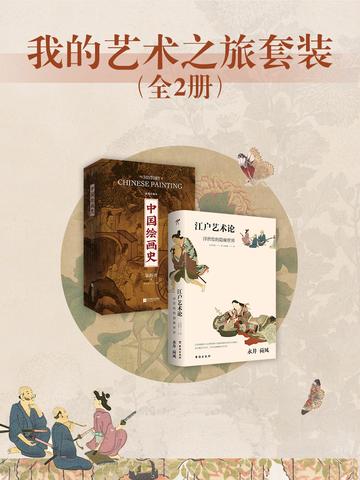
This set includes two volumes of books "History of Chinese Painting" and "Nagai Lotus Wind: Edo Art Theory". "History of Chinese Painting" is a transcript of Mr. Chen Shizeng's lecture on "A Brief History of Chinese Art" in Jinan in 1922. Starting from the origin of writing and painting in ancient times, the author sorts out the development of Chinese painting from the Pre-Qin Dynasty to the Qing Dynasty, the evolution of techniques, changes in themes, and important painting schools and painters. The content is outlined and the text is concise and to the point. "Nagai Karikaze: Essay on Edo Art" contains a number of Nagai Karikaze's introductions and comments on Ukiyo-e. It not only touches on the rise, decline and inheritance of Ukiyo-e, but also discusses the production methods, subject types, and even creators and schools of Ukiyo-e. From it, we can see how Nagai Karikaze refers to "painting", allowing readers to see the paintings before their eyes even though they do not see them.
Reader comments
In particular, the book mentions that "there are poems in paintings, and paintings in poems", which reminds me of my friend who loves painting, and his works are always full of poetry. "Nagai Karikaze: Essay on Edo Art" gave me a deeper understanding of Ukiyo-e. As the book said, "The art of Edo is the interweaving of reality and fantasy." This reminded me of the city we live in. Isn't it also so charming? This book allows me to find a peaceful artistic world in my busy work.
In particular, the book mentions that "there are poems in paintings, and paintings in poems", which reminds me of my friend who loves painting, and his works are always full of poetry. "Nagai Karikaze: Essay on Edo Art" gave me a deeper understanding of Ukiyo-e. As the book said, "The art of Edo is the interweaving of reality and fantasy." This reminded me of the city we live in. Isn't it also so charming? This book allows me to find a peaceful artistic world in my busy work.