Nan Huaijin recommends the collection of Chinese studies! Zeng Guofan, Liang Qichao, and Qian Zhongshu took turns to recommend it! Guwen Guanzhi is a must-read for advanced students to truly lay a solid foundation in ancient prose and improve article writing skills!
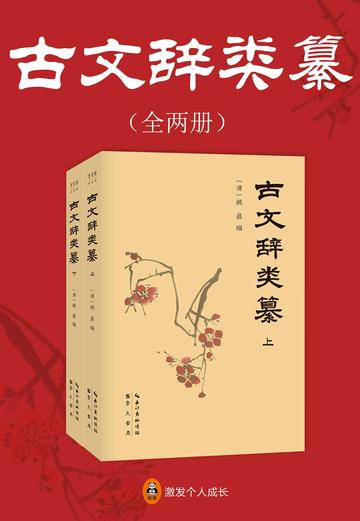
"Compilation of Ancient Chinese Ci Classification (two volumes)" is a collection of ancient prose compiled by Yao Nai in the Qing Dynasty. It embodies the ideas of Tongcheng School literature and is an important and influential anthology of ancient prose. This book selects more than 700 essays and poems by famous ancient writers from the pre-Qin period to the Qing Dynasty. According to the style, it is divided into thirteen categories: argumentation, preface and postscript, memorials, epistles, prefaces, edicts, biographies, epigraphs, miscellaneous notes, inscriptions, praises, poems, and mourning. Each article is slightly collated and commented.
Reader comments
A major feature of the compilation of ancient Chinese poetry is the selection of items. This book focuses on the articles of the eight great masters of the Pre-Qin Dynasty, the Han Dynasty, the Tang and Song Dynasties, Gui Youguang of the Ming Dynasty, and the Tongcheng School of the Qing Dynasty. It highlights the literary models admired by Yao Nai and embodies the "Tongcheng righteousness and law" that requires words to be meaningful and orderly. The comments Yao Nai added to each article are also unique. Whether it is pointing out the clues of the evolution of the article, revealing the origins and relationships between different writers, or conducting artistic analysis of the work, and correcting errors in sentences and words, there is no shortage of insightful insights. The compilation of ancient Chinese poetry was not published during Yao Nai's lifetime. During the Jiaqing and Daoguang years, Kang Shaoyong's printed edition based on Yao Nai's middle-aged edition and Wu Qichang's printed edition based on Yao Nai's later edition appeared one after another, but they were not complete. During the reign of Guangxu, Li Chengyuan obtained the encyclopedia of Yao Nai's later years, and collated the two editions of Kang and Wu, and compiled and published it, which was called the Li Shi Qiu Yaotang edition, which was the most refined.
"Compilation of Ancient Prose and Ci" is a collection of ancient prose compiled by Yao Nai according to the "Tongcheng Yifa" that speaks clearly and orderly. Lu Xun said: "There are many people who read "Compilation of Ancient Chinese Ci", but few people read "The Complete Works of Xibaoxuan". For any writer who has his own opinions on literary arts, the means he relies on to express and disseminate his opinions are not in the composition, rules, poems, and poetry, but in the selection of poems." The works selected in "Compilation of Ancient Chinese Ci" are mainly ancient prose by "Warring States Policy", "Historical Records", Han Dynasty essayists, the Eight Great Masters of Tang and Song Dynasties, Gui Youguang in the Ming Dynasty, Fang Bao and Liu Dakui in the Qing Dynasty, etc. There are more than 700 articles in 75 volumes, divided into 13 categories according to style. Ma Qichang commented on the accuracy of its classification: "The reason why Yao's books are important is because of their fine identification and rigorous analysis." In the preface to the collection, Yao Nai gave a concise explanation of the reasons for the selection, the method of selection, and the origin and characteristics of the thirteen categories of literary styles, giving readers a clear impression.
When it comes to Chinese studies, we all think of Zeng Guofan, Liang Qichao and other ancients. This is a book recommended by them. The Advanced Edition of Guweiguanzhi is a must-read to truly lay a solid foundation for classical Chinese and improve the writing skills of our articles. In this book, he embodies the ideas of Tongcheng Literature and And a very influential anthology of ancient prose, which records the prose of some famous ancient prose writers in the Ming and Qing Dynasties and the Pre-Qin Dynasty. It is rich in vocabulary and rich in content, including Debate Book on Zhao Ling, Ship-shaped Stele and many other articles, which provide us with the charm of ancient prose.
"Compilation of Ancient Prose and Ci" is a collection of ancient prose compiled by Yao Nai according to the "Tongcheng Yifa" that speaks clearly and orderly. Lu Xun said: "There are many people who read "Compilation of Ancient Chinese Ci", but few people read "The Complete Works of Xibaoxuan". For any writer who has his own opinions on literary arts, the means he relies on to express and disseminate his opinions are not in the composition, rules, poems, and poetry, but in the selection of poems." The works selected in "Compilation of Ancient Chinese Ci" are mainly ancient prose by "Warring States Policy", "Historical Records", Han Dynasty essayists, the Eight Great Masters of Tang and Song Dynasties, Gui Youguang in the Ming Dynasty, Fang Bao and Liu Dakui in the Qing Dynasty, etc. There are more than 700 articles in 75 volumes, divided into 13 categories according to style. Ma Qichang commented on the accuracy of its classification: "The reason why Yao's books are important is because of their fine identification and rigorous analysis." In the preface to the collection, Yao Nai gave a concise explanation of the reasons for the selection, the method of selection, and the origin and characteristics of the thirteen categories of literary styles, giving readers a clear impression.
I particularly like the biographies of some historical figures. The author describes their characters and experiences very vividly. Moreover, each article has collation and comments, which is very helpful for understanding ancient texts. I feel like after reading this book, my writing skills in ancient Chinese have improved!
The biggest feature of this "Compilation of Ancient Chinese Ci" is that it is compiled according to various stylistic classifications. Looks very convenient. Moreover, Yao Nai, who was a lecturer at the college in the Qing Dynasty, selected excellent articles from various eras from the Warring States Period to the Qing Dynasty. Some of the rhetoric is gorgeous, some of the language is simple, some of the writing style is vigorous, and the whole article is clear and beautiful. A teacher is the one who preaches the truth, receives karma and resolves doubts. As a teacher, you cannot be biased, so the book can be said to be a collection of words from hundreds of schools of thought, integrating a variety of thoughts. Confucianism, Taoism, management of the world, and escape from the world all exist.
A major feature of the compilation of ancient Chinese poetry is the selection of items. This book focuses on the articles of the eight great masters of the Pre-Qin Dynasty, the Han Dynasty, the Tang and Song Dynasties, Gui Youguang of the Ming Dynasty, and the Tongcheng School of the Qing Dynasty. It highlights the literary models admired by Yao Nai and embodies the "Tongcheng righteousness and law" that requires words to be meaningful and orderly. The comments Yao Nai added to each article are also unique. Whether it is pointing out the clues of the evolution of the article, revealing the origins and relationships between different writers, or conducting artistic analysis of the work, and correcting errors in sentences and words, there is no shortage of insightful insights. The compilation of ancient Chinese poetry was not published during Yao Nai's lifetime. During the Jiaqing and Daoguang years, Kang Shaoyong's printed edition based on Yao Nai's middle-aged edition and Wu Qichang's printed edition based on Yao Nai's later edition appeared one after another, but they were not complete. During the reign of Guangxu, Li Chengyuan obtained the encyclopedia of Yao Nai's later years, and collated the two editions of Kang and Wu, and compiled and published it, which was called the Li Shi Qiu Yaotang edition, which was the most refined.
"Compilation of Ancient Prose and Ci" is a collection of ancient prose compiled by Yao Nai according to the "Tongcheng Yifa" that speaks clearly and orderly. Lu Xun said: "There are many people who read "Compilation of Ancient Chinese Ci", but few people read "The Complete Works of Xibaoxuan". For any writer who has his own opinions on literary arts, the means he relies on to express and disseminate his opinions are not in the composition, rules, poems, and poetry, but in the selection of poems." The works selected in "Compilation of Ancient Chinese Ci" are mainly ancient prose by "Warring States Policy", "Historical Records", Han Dynasty essayists, the Eight Great Masters of Tang and Song Dynasties, Gui Youguang in the Ming Dynasty, Fang Bao and Liu Dakui in the Qing Dynasty, etc. There are more than 700 articles in 75 volumes, divided into 13 categories according to style. Ma Qichang commented on the accuracy of its classification: "The reason why Yao's books are important is because of their fine identification and rigorous analysis." In the preface to the collection, Yao Nai gave a concise explanation of the reasons for the selection, the method of selection, and the origin and characteristics of the thirteen categories of literary styles, giving readers a clear impression.
When it comes to Chinese studies, we all think of Zeng Guofan, Liang Qichao and other ancients. This is a book recommended by them. The Advanced Edition of Guweiguanzhi is a must-read to truly lay a solid foundation for classical Chinese and improve the writing skills of our articles. In this book, he embodies the ideas of Tongcheng Literature and And a very influential anthology of ancient prose, which records the prose of some famous ancient prose writers in the Ming and Qing Dynasties and the Pre-Qin Dynasty. It is rich in vocabulary and rich in content, including Debate Book on Zhao Ling, Ship-shaped Stele and many other articles, which provide us with the charm of ancient prose.
"Compilation of Ancient Prose and Ci" is a collection of ancient prose compiled by Yao Nai according to the "Tongcheng Yifa" that speaks clearly and orderly. Lu Xun said: "There are many people who read "Compilation of Ancient Chinese Ci", but few people read "The Complete Works of Xibaoxuan". For any writer who has his own opinions on literary arts, the means he relies on to express and disseminate his opinions are not in the composition, rules, poems, and poetry, but in the selection of poems." The works selected in "Compilation of Ancient Chinese Ci" are mainly ancient prose by "Warring States Policy", "Historical Records", Han Dynasty essayists, the Eight Great Masters of Tang and Song Dynasties, Gui Youguang in the Ming Dynasty, Fang Bao and Liu Dakui in the Qing Dynasty, etc. There are more than 700 articles in 75 volumes, divided into 13 categories according to style. Ma Qichang commented on the accuracy of its classification: "The reason why Yao's books are important is because of their fine identification and rigorous analysis." In the preface to the collection, Yao Nai gave a concise explanation of the reasons for the selection, the method of selection, and the origin and characteristics of the thirteen categories of literary styles, giving readers a clear impression.
I particularly like the biographies of some historical figures. The author describes their characters and experiences very vividly. Moreover, each article has collation and comments, which is very helpful for understanding ancient texts. I feel like after reading this book, my writing skills in ancient Chinese have improved!
The biggest feature of this "Compilation of Ancient Chinese Ci" is that it is compiled according to various stylistic classifications. Looks very convenient. Moreover, Yao Nai, who was a lecturer at the college in the Qing Dynasty, selected excellent articles from various eras from the Warring States Period to the Qing Dynasty. Some of the rhetoric is gorgeous, some of the language is simple, some of the writing style is vigorous, and the whole article is clear and beautiful. A teacher is the one who preaches the truth, receives karma and resolves doubts. As a teacher, you cannot be biased, so the book can be said to be a collection of words from hundreds of schools of thought, integrating a variety of thoughts. Confucianism, Taoism, management of the world, and escape from the world all exist.