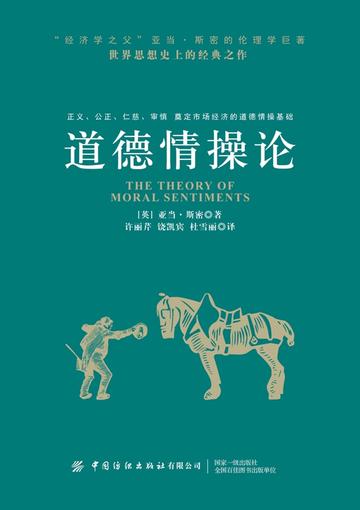
"The Theory of Moral Sentiments" is Adam Smith's ethical work. It was first published in 1759 and published six times before Smith's death. It mainly clarifies the nature of moral emotions, the nature of moral evaluation and his ethical thoughts aiming at "the happy life of citizens". Adam Smith took the emotion of sympathy in human nature as the basis for explaining morality. He used the principle of sympathy to explain the origin of human justice and all other moral emotions, to explain the nature of moral evaluation, and on this basis to show the characteristics of various basic virtues.
Reader comments
Our most common emotions were so brilliantly analyzed by Adam Smith. The theory of the whole book starts from the basic emotions of sympathy and empathy and uses this emotion as the basis to understand emotional judgment. Moreover, he also talks about ordinary emotional judgment. We can't help but assume that a biased bystander will judge his own moral behavior from the perspective of a bystander. This can be called conscience. In this way, all our emotional judgments have a more reasonable basis. There is a passage in the recommended book: "Concern for our own happiness requires us to have the virtue of prudence; and concern for the happiness of others requires us to have the virtues of justice and kindness. The former virtue prevents us from harming the happiness of others, and the latter virtue urges us to promote the happiness of others."
"In addition to friendship and hostility, there is actually an emotion among human beings that is self-interested but has nothing to do with others." This ground-breaking collection of essays describes human secular economic behavior by defining human emotions and moral ethics. It is a manifestation of the ethical thoughts of Adam Smith, the father of modern economics, that is, the happy life of citizens is the highest moral evaluation; in his view of moral sentiments of self-interest and not harming others, everyone is a free subject with pure morals. With its rich subject matter and diverse examples, this book is worthy of being listed as a masterpiece of British classical political economics.
Well worth reading! As Smith's ethical work, this book mainly explains to readers the nature of moral emotions, the nature of moral evaluation, and Smith's ethical thoughts aiming at "the happy life of citizens". The structure of the book is rigorous, the logic between contexts is smooth, and it is highly readable. In the specific discussion process, the author's language is concise, vivid and interesting, so that readers will not feel boring during the reading process. At the same time, the author has a thorough and comprehensive analysis of relevant knowledge and introduces many complex concepts to readers in a simple and easy-to-understand manner so that readers can understand.
Everyone knows that Adam Smith is the author of "The Wealth of Nations", but perhaps few non-professional researchers know that Smith also wrote another earlier and perhaps more important book, "The Theory of Moral Sentiments". If in "The Wealth of Nations", Smith proposed that technological progress and efficiency improvements brought about by division of labor and specialization can promote economic growth, the state should protect the expansion of the market to enhance the level of division of labor and specialization. At the same time, everyone operating in the market out of personal interests can maximize the overall social benefits. Then "The Theory of Moral Sentiments" explores how people can pursue personal interests without harming the interests of others based on human nature. Of course there has always been controversy about the connection between the two books and the possible differences between their views, which is by no means a matter that a brief book review can resolve.
The characters' personalities and experiences are also described in detail in the book, making it easier for us to understand their behaviors and moral choices. Adam Smith used "the happy life of citizens" to interpret ethical thoughts, which gave me a lot of inspiration on how to be a better person in family and society. All in all, this is an ethics book worth reading.







Our most common emotions were so brilliantly analyzed by Adam Smith. The theory of the whole book starts from the basic emotions of sympathy and empathy and uses this emotion as the basis to understand emotional judgment. Moreover, he also talks about ordinary emotional judgment. We can't help but assume that a biased bystander will judge his own moral behavior from the perspective of a bystander. This can be called conscience. In this way, all our emotional judgments have a more reasonable basis. There is a passage in the recommended book: "Concern for our own happiness requires us to have the virtue of prudence; and concern for the happiness of others requires us to have the virtues of justice and kindness. The former virtue prevents us from harming the happiness of others, and the latter virtue urges us to promote the happiness of others."
"In addition to friendship and hostility, there is actually an emotion among human beings that is self-interested but has nothing to do with others." This ground-breaking collection of essays describes human secular economic behavior by defining human emotions and moral ethics. It is a manifestation of the ethical thoughts of Adam Smith, the father of modern economics, that is, the happy life of citizens is the highest moral evaluation; in his view of moral sentiments of self-interest and not harming others, everyone is a free subject with pure morals. With its rich subject matter and diverse examples, this book is worthy of being listed as a masterpiece of British classical political economics.
Well worth reading! As Smith's ethical work, this book mainly explains to readers the nature of moral emotions, the nature of moral evaluation, and Smith's ethical thoughts aiming at "the happy life of citizens". The structure of the book is rigorous, the logic between contexts is smooth, and it is highly readable. In the specific discussion process, the author's language is concise, vivid and interesting, so that readers will not feel boring during the reading process. At the same time, the author has a thorough and comprehensive analysis of relevant knowledge and introduces many complex concepts to readers in a simple and easy-to-understand manner so that readers can understand.
Everyone knows that Adam Smith is the author of "The Wealth of Nations", but perhaps few non-professional researchers know that Smith also wrote another earlier and perhaps more important book, "The Theory of Moral Sentiments". If in "The Wealth of Nations", Smith proposed that technological progress and efficiency improvements brought about by division of labor and specialization can promote economic growth, the state should protect the expansion of the market to enhance the level of division of labor and specialization. At the same time, everyone operating in the market out of personal interests can maximize the overall social benefits. Then "The Theory of Moral Sentiments" explores how people can pursue personal interests without harming the interests of others based on human nature. Of course there has always been controversy about the connection between the two books and the possible differences between their views, which is by no means a matter that a brief book review can resolve.
The characters' personalities and experiences are also described in detail in the book, making it easier for us to understand their behaviors and moral choices. Adam Smith used "the happy life of citizens" to interpret ethical thoughts, which gave me a lot of inspiration on how to be a better person in family and society. All in all, this is an ethics book worth reading.
The ideas of that era are still bright today
This shouldn't be the sixth edition, right?