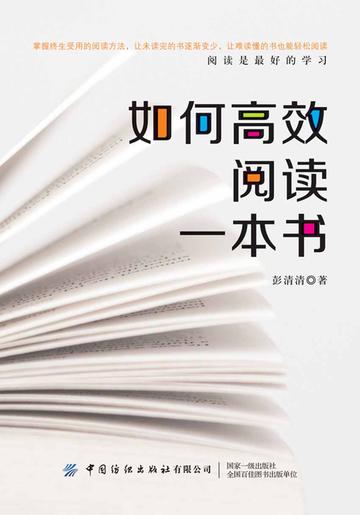
Reading can shape the soul and help us become better versions of ourselves, but reading is not without rules and requires us to master scientific reading skills. Only in this way can we achieve solid gains and benefit our body and mind.
This book is a reading guide, based on exploring how to help readers improve their reading methods and master scientific reading skills. The content is easy to understand, convenient and practical. I believe that through these methods, our readers can quickly establish a close connection with the books in their hands and truly understand reading.
Reader comments
Although it is an introduction to reading methods, it is very practical, but it must be determined according to your own situation. When I read this, I mainly read it selectively, to see if there is a method that suits me, and then see if there are any differences... In short, I don't directly regard any book as a guide. I look for the one that suits me, and I also have a certain attitude of scrutiny. I still have some gains haha.
The author Peng Qingqing teaches us how to read efficiently, such as how to take notes and how to understand the content of the book in a simple and easy-to-understand way. The book also mentions the reading problems we may encounter, such as being unable to remember the content of the book, which resonates with me. I think this book is very helpful for me when I am looking for a job. It allows me to obtain information faster and improve reading efficiency.
I feel like I have never been good at reading.
I am a slow reader. It's so slow that some words/paragraphs need to be read back to read and understand its meaning. So I have been looking for ways to read books efficiently. Look for books on this topic.
I finished reading this book in the middle of last month, but I haven't written a review yet.
I define it as a tool book. It is not simply a book that teaches efficient reading methods; it also introduces some basic grammar. In fact, I was not exposed to this area when I was in school, or it was not taught as a systematic course. In my impression, even English classes do not introduce the components of sentences in detail.
I prefer the four reading methods advocated in the book. 1. Jump reading. This kind of reading is suitable for reading some entertainment and leisure books. You can read key chapters and have fun; 2. Rough reading. This reading method is more suitable for current students, especially middle school students. When doing Chinese reading comprehension, this method is more suitable to focus on key readings; 3. Theme reading. This reading method is more suitable for high school students to enrich themselves. To improve your own literary literacy, read some extracurricular readings recommended by teachers, such as literary classics, history books, etc.; 4 Is intensive reading, that is, careful reading, which is suitable for two types of scenarios. The first type is exam-oriented, focusing on reading questions, especially prose, lyrical, argumentative essays, etc.; The second type is classics that appear in textbooks, such as Yueyang Tower, Xiaoshitan, Zhu Ziqing's Back, etc.
Reading is a process of input. The inspiration during the reading process needs to be recorded in time. A good memory is not as good as a bad writing. But at the same time, it is really necessary to check whether the knowledge is effectively absorbed or output. The so-called output means to break away from the book and express it with your own feelings/understanding, such as summarizing the logic and knowledge points of the book, solving problems in practice, etc.
You have to practice it yourself
There are a lot of reading skills in the book, which are eloquently explained and organized. However, I personally feel that the content is a bit repetitive. I personally feel that it is pretty good and you can learn knowledge.
Very teachable, learned a lot
Not bad, it works for me
There are a lot of useful information, very practical, five stars [like]
It's very detailed, with detailed explanations on how to read, how to read efficiently, how to write, and different methods of reading.
From Wang Guowei's life realm to the three realms of reading, the four-level theory of reading, and the three-stage speed reading, skimming and intensive reading theory are all explained in detail.
Especially at the end, different appreciation methods are given for different literary themes. The poetry section is particularly detailed and should be used in the next step.
It can be seen that this is a collection of many reading methods. The bibliography given at the end of the article explains everything.
Although it is an introduction to reading methods, it is very practical, but it must be determined according to your own situation. When I read this, I mainly read it selectively, to see if there is a method that suits me, and then see if there are any differences... In short, I don't directly regard any book as a guide. I look for the one that suits me, and I also have a certain attitude of scrutiny. I still have some gains haha.
The author Peng Qingqing teaches us how to read efficiently, such as how to take notes and how to understand the content of the book in a simple and easy-to-understand way. The book also mentions the reading problems we may encounter, such as being unable to remember the content of the book, which resonates with me. I think this book is very helpful for me when I am looking for a job. It allows me to obtain information faster and improve reading efficiency.
I feel like I have never been good at reading. I am a slow reader. It's so slow that some words/paragraphs need to be read back to read and understand its meaning. So I have been looking for ways to read books efficiently. Look for books on this topic. I finished reading this book in the middle of last month, but I haven't written a review yet. I define it as a tool book. It is not simply a book that teaches efficient reading methods; it also introduces some basic grammar. In fact, I was not exposed to this area when I was in school, or it was not taught as a systematic course. In my impression, even English classes do not introduce the components of sentences in detail. I prefer the four reading methods advocated in the book. 1. Jump reading. This kind of reading is suitable for reading some entertainment and leisure books. You can read key chapters and have fun; 2. Rough reading. This reading method is more suitable for current students, especially middle school students. When doing Chinese reading comprehension, this method is more suitable to focus on key readings; 3. Theme reading. This reading method is more suitable for high school students to enrich themselves. To improve your own literary literacy, read some extracurricular readings recommended by teachers, such as literary classics, history books, etc.; 4 Is intensive reading, that is, careful reading, which is suitable for two types of scenarios. The first type is exam-oriented, focusing on reading questions, especially prose, lyrical, argumentative essays, etc.; The second type is classics that appear in textbooks, such as Yueyang Tower, Xiaoshitan, Zhu Ziqing's Back, etc. Reading is a process of input. The inspiration during the reading process needs to be recorded in time. A good memory is not as good as a bad writing. But at the same time, it is really necessary to check whether the knowledge is effectively absorbed or output. The so-called output means to break away from the book and express it with your own feelings/understanding, such as summarizing the logic and knowledge points of the book, solving problems in practice, etc.
You have to practice it yourself
There are a lot of reading skills in the book, which are eloquently explained and organized. However, I personally feel that the content is a bit repetitive. I personally feel that it is pretty good and you can learn knowledge.
Very teachable, learned a lot
Not bad, it works for me
There are a lot of useful information, very practical, five stars [like]
It's very detailed, with detailed explanations on how to read, how to read efficiently, how to write, and different methods of reading. From Wang Guowei's life realm to the three realms of reading, the four-level theory of reading, and the three-stage speed reading, skimming and intensive reading theory are all explained in detail. Especially at the end, different appreciation methods are given for different literary themes. The poetry section is particularly detailed and should be used in the next step. It can be seen that this is a collection of many reading methods. The bibliography given at the end of the article explains everything.
Very practical, informative and worth learning