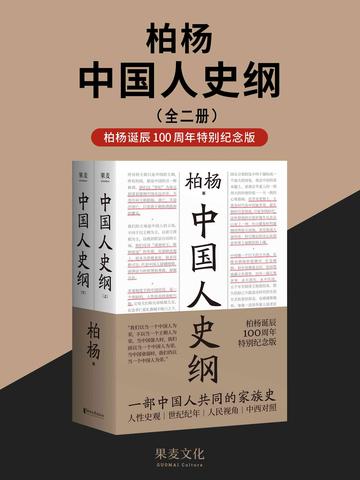
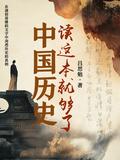
An Outline History of the Chinese People: Special Commemorative Edition for the 100th Anniversary of Bai Yang’s Birth
中国人史纲 : 柏杨诞辰100周年特别纪念版
- Status
- Completed
- Length
- 574k Words
- Genre
- Historical
- Updated
- 5y ago
- Source
- Fanqie
Synopsis
39Chapters
8.5Score
In booklists 3



Your No. 1 Favorite ❤️ Just One Book
Looking for books similar to "Quick Transmigration: The Villain Is So Devoted and Irresistible".
1.3kBooks373.2MViews8hUpdated
Historical Fiction Recommendations
I’m the history class representative. Are there any good books about history, historical literature, or real history?
459Books26MViews3dUpdated
Any Books That Could Help a Second-Year Middle Schooler Study History?
My second-year middle-school history textbook is giving me a headache. It is so dry.
88Books262.9kViews12dUpdated
Reader comments 33
Translated by Google Translate
Mr. Bai Yang knows the past and the present. After completing the description of the current physical geography of China, he turned directly to Chinese history, starting from the mythical era, and then ending with the legend, semi-faithful and historical eras, and then taking the first century as a time point, he carefully reviewed the important historical events that occurred in a hundred years. What is commendable is that Mr. Bo Yang completed this work in prison, focusing on the lives of ordinary people who have not been recorded in history books, rather than falling into the trap of traditional history books describing the family affairs of emperors, generals and ministers.
I read this "Outline of Chinese History" by mistake, thinking it was a list of historical events and a collection of major events. After reading it, I found that it is a very attitude book. It does not follow others' opinions, does not praise virtues, and is full of the author's own cultural output. This book starts from the mythical age of Pangu and ends with the Eight-Power Allied Forces' invasion of China. This ending point does not seem so serious, so I went back to read the author's introduction. It turns out that the author is the famous writer Bo Yang, which is disrespectful. Now I can understand the basis of the attitude of this book. I highly recommend everyone to read it, learn about history, and get to know Mr. Bo Yang.
This book was recommended by a friend from the history department. He said, "This is a history book with attitude and warmth. It is not boring or profound, and it is easy to read." So I opened this book and walked into a novel world. To be honest, I am not a history buff, I have no idea about this kind of books, and I even avoid them, but this book made me calm down and read it, and it was a very magical feeling. The passage that touched me the most was "The fall of the Tang Dynasty was not the fall of China, but the fall of the Tang Dynasty and the Tang government. The fall of the Qing Dynasty was not the fall of China, but the fall of the Qing Dynasty and the Qing government. China remains as strong as ever." This deep patriotism moved me deeply.
This is a historical book with an extremely broad scope. Mr. Bai Yang knows the past and the present. After completing the description of the current physical geography of China, he turned directly to Chinese history, starting from the mythical era, and then ending with the legend, semi-faithful and historical eras, and then taking the first century as a time point, he carefully reviewed the important historical events that occurred in a hundred years. What is commendable is that Mr. Bo Yang completed this work in prison, focusing on the lives of ordinary people who have not been recorded in history books, rather than falling into the trap of traditional history books describing the family affairs of emperors, generals and ministers.
This is a historical work with an extremely grand vision. The author compiled an outline of Chinese history in prison. It uses a hundred years as a narrative unit, starting from the mythical era when Pangu created the world, and ending with the Eight-Power Allied Forces launching a war of aggression against China in the early 20th century. It is a great history of China covering five thousand years. The author writes history personally and has a unique perspective. He focuses on the ordinary Chinese people who have been submerged by history, eulogizes humanity and respects human rights. It is a great work with the most attitude and human touch that I have ever read.
The author introduces to us: The Xiongnu Khanate was powerful enough, and the Han Empire's victory in the last century (first two years), including the seizure of its richest Hexi Corridor, could only damage it but not make it surrender. The wounded Huns Khanate was still a powerful enemy. In the last year of the last century (2 BC) (101 BC), Shanyu, the marquis of Tutan, came to the throne and expressed his willingness to reconcile with the Han Empire and sent all the envoys of the Han Empire who had been detained in the past back to Chang'an. In the first year of this century (100 BC), Han and Hungary restored diplomatic relations, and the Han Empire sent envoy Su Wu and deputy envoy Zhang Sheng to apply for employment in the Xiongnu Khanate.
It's a very nice book. The historical records and analysis give people a refreshing feeling. Moreover, the book writes extensively about the impact of the current situation on the people. This perspective is lacking in many history books written by the ruling class.
The only good book without lies and deception
A history of ups and downs How difficult it is for the people The sustainability of Chinese civilization and the road to rejuvenation should be based on history.
This book tells Chinese history from a unique perspective, giving me a deeper understanding of the characters and events in each period. Mr. Bo Yang respects human nature and pays attention to ordinary Chinese, making history more vivid. I have benefited a lot from his historical perspective. This is a good book worth reading again and again.