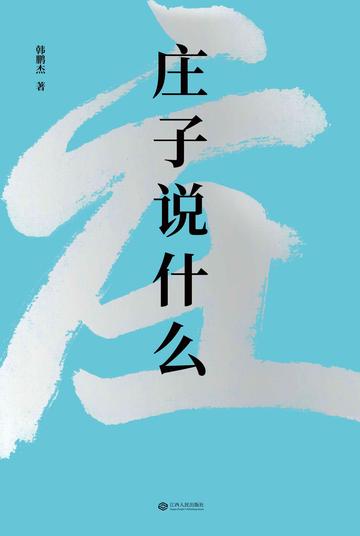
"Zhuangzi" is a collection of Taoist scriptures written by Zhuangzi, a representative figure of the Taoist school in the mid-Warring States Period, and his successors. It has rich and mysterious content and broad and profound thoughts. "What Zhuangzi Said" is a unique interpretation of the book "Zhuangzi" by Han Pengjie, a professor of philosophy at the School of Humanities of Xi'an Jiaotong University, taking us closer to Zhuangzi's life and writings. Han Pengjie selected 15 representative articles from the "Inner Chapters", "Outer Chapters" and "Miscellaneous Chapters" that reflect the essence of Zhuangzi's thoughts. He used the form of "original text + annotation + analysis" to explain the key points and difficulties to readers word by word. With plain language, rich examples and precise analysis, it introduces the essence of Zhuangzi's thoughts to readers and gives readers a high degree of philosophical life inspiration.
Reader comments
At a time when people's work and life pressures are increasing day by day, Zhuangzi's leisurely style and inaction are sought after by some people. Zhuangzi's thought emphasizes nature, rule by inaction, freedom, and a lifestyle that transcends convention. He advocated that people should pursue inner freedom and peace, transcend utilitarian pursuits and worldly constraints, and achieve inner peace and freedom through unity with nature. In this book, the author summarizes and describes Zhuangzi's thoughts in detail, hoping to bring more wisdom to everyone.
After Zhuangzi soared ninety thousand miles, what did he say in the clear blue sky? Whether he saw Kunpeng, or whether he saw the butterfly in his dream; I certainly don't need to go into details about the vastness of Zhuangzi's imagination, but the pain in his heart can no longer just be summarized by the thoughts of one school, but is inclusive of hundreds of schools of thought. There is a way to read Zhuangzi, first look at the human world and then look at Xiaoyaoyou, first see the dangers and inactions of the world, and then understand the ultimate meaning of Wu Shi. This is another way of saying useless knowledge in his words: it spreads for thousands of miles, but leaves no trace, and the sound is loud and clear.
In this book, Zhuangzi talks about the way to live in the world, freedom, the workplace, nature, health preservation, happiness, and life and death. It is very inspiring and worth reading. It can teach you a lot of truths and is not outdated even now. The ancients were really very wise. For example: it is easy to know the Tao, but it is difficult to achieve the Tao by keeping silent. Only by knowing the Tao and being silent can it be in line with nature. That means you have to watch your mouth and know what to say and what not to say. Zhuangzi is really wise, it is worth reading this book!
Nowadays, people attach great importance to health preservation. I feel that I agree with Zhuangzi's health preservation method, which is very good. He feels that the real way to maintain good health is to follow nature and not always get obsessed with this small health-preserving technique. I also feel that every time I'm in a bad mood or something, I should go out for a walk more often, hug big trees, and embrace nature to make myself feel better physically and mentally. It does not violate the laws of nature, just like there are tides and ebbs and sunrises and sunsets. Every time I read Zhuangzi, I feel happy. This book is also worth reading. It is like a spiritual sustenance in modern life.
Zhuangzi believes that all things in the universe are born from Tao, and Tao is the source and ontology that transcends all things. He emphasized that people should pursue unity with Tao, return to nature, and transcend worldly cumbersomeness and pursuits. He advocates that individuals should put aside their utilitarianism and desires and pursue governance by doing nothing. He believes that pursuing inaction, that is, not forcing or forcing anything, can achieve inner freedom and peace of mind. His views emphasized the individual's inner pursuit, transcending the worldly realm and a free and inaction attitude towards life, which had an important influence on the philosophy, culture and art of later generations.
As the book says, human suffering is largely a reflection of the inner way of thinking. I used to worry about this and that, but now I understand that I need to look at things from a different perspective. However, I didn't quite like some of the examples in the book, which felt a bit stilted. But overall, this book is well worth reading, especially for those who want to find inner peace in their busy lives.
Read Zhuangzi three times, and you will understand half of it. After reading this interpretation, you will understand half of it.
Live in compliance with nature, comply with the times, comply with laws, and use peace to achieve the ultimate goal
All in one go. Thanks for this book and Tomato
Zhuangzi explains the Great Way by telling stories
The author here explains things in a simple and profound way, allowing us to understand Zhuangzi and Laozi from different angles. This is a very good book.
At a time when people's work and life pressures are increasing day by day, Zhuangzi's leisurely style and inaction are sought after by some people. Zhuangzi's thought emphasizes nature, rule by inaction, freedom, and a lifestyle that transcends convention. He advocated that people should pursue inner freedom and peace, transcend utilitarian pursuits and worldly constraints, and achieve inner peace and freedom through unity with nature. In this book, the author summarizes and describes Zhuangzi's thoughts in detail, hoping to bring more wisdom to everyone.
After Zhuangzi soared ninety thousand miles, what did he say in the clear blue sky? Whether he saw Kunpeng, or whether he saw the butterfly in his dream; I certainly don't need to go into details about the vastness of Zhuangzi's imagination, but the pain in his heart can no longer just be summarized by the thoughts of one school, but is inclusive of hundreds of schools of thought. There is a way to read Zhuangzi, first look at the human world and then look at Xiaoyaoyou, first see the dangers and inactions of the world, and then understand the ultimate meaning of Wu Shi. This is another way of saying useless knowledge in his words: it spreads for thousands of miles, but leaves no trace, and the sound is loud and clear.
In this book, Zhuangzi talks about the way to live in the world, freedom, the workplace, nature, health preservation, happiness, and life and death. It is very inspiring and worth reading. It can teach you a lot of truths and is not outdated even now. The ancients were really very wise. For example: it is easy to know the Tao, but it is difficult to achieve the Tao by keeping silent. Only by knowing the Tao and being silent can it be in line with nature. That means you have to watch your mouth and know what to say and what not to say. Zhuangzi is really wise, it is worth reading this book!
Nowadays, people attach great importance to health preservation. I feel that I agree with Zhuangzi's health preservation method, which is very good. He feels that the real way to maintain good health is to follow nature and not always get obsessed with this small health-preserving technique. I also feel that every time I'm in a bad mood or something, I should go out for a walk more often, hug big trees, and embrace nature to make myself feel better physically and mentally. It does not violate the laws of nature, just like there are tides and ebbs and sunrises and sunsets. Every time I read Zhuangzi, I feel happy. This book is also worth reading. It is like a spiritual sustenance in modern life.
Zhuangzi believes that all things in the universe are born from Tao, and Tao is the source and ontology that transcends all things. He emphasized that people should pursue unity with Tao, return to nature, and transcend worldly cumbersomeness and pursuits. He advocates that individuals should put aside their utilitarianism and desires and pursue governance by doing nothing. He believes that pursuing inaction, that is, not forcing or forcing anything, can achieve inner freedom and peace of mind. His views emphasized the individual's inner pursuit, transcending the worldly realm and a free and inaction attitude towards life, which had an important influence on the philosophy, culture and art of later generations.
As the book says, human suffering is largely a reflection of the inner way of thinking. I used to worry about this and that, but now I understand that I need to look at things from a different perspective. However, I didn't quite like some of the examples in the book, which felt a bit stilted. But overall, this book is well worth reading, especially for those who want to find inner peace in their busy lives.
Read Zhuangzi three times, and you will understand half of it. After reading this interpretation, you will understand half of it.
Live in compliance with nature, comply with the times, comply with laws, and use peace to achieve the ultimate goal
All in one go. Thanks for this book and Tomato
Zhuangzi explains the Great Way by telling stories
The author here explains things in a simple and profound way, allowing us to understand Zhuangzi and Laozi from different angles. This is a very good book.