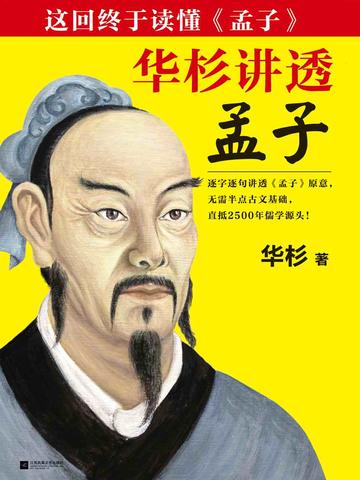
This time I finally understood "Mencius"! The new masterpiece by Hua Shan, the author of the best-selling book "Hua Shan Tells the Truth about Sun Tzu's Art of War"!
Mencius was honored as "the Lesser Sage" by later generations. He inherited and carried forward Confucius' thoughts and further integrated and systematized Confucianism. The ideal of "kingly way" in governing the country, the moral value of "theory of good nature", and the realm of life of "not being moved" have all become ideological treasures of Chinese culture. Together with Confucius, his thoughts are collectively known as the "Tao of Confucius and Mencius" and become the source of Chinese Confucianism.
The author of this book, Hua Shan, has studied Confucianism for more than thirty years. He understood the original meaning of "Mencius" thoroughly and was loyal to the classic interpretations of "Mencius" by Zhu Xi, Zhang Juzheng, Wang Yangming and other sages. He used language that is easy for modern people to understand and gave us an "authentic" explanation of Mencius' thoughts in simple and easy-to-understand terms. The whole book combines ancient and modern times, is popular and interesting, and you can read "Mencius" in a clear, friendly and interesting way without any basic knowledge of classical Chinese.
Open this book, read the original meaning of "Mencius" word for word, and go straight to the 2,500-year-old source of Confucianism!
Reader comments
Mencius is one of the great Confucians in ancient my country. His main thoughts are "theory of good nature", "theory of destiny" and "theory of benevolent government". On the basis of explaining these three aspects, other important views in "Mencius" are also introduced in detail, such as "a gentleman has three joys", "four ends and five constants", etc. Mencius believed that education can cultivate people's moral character and talents, and advocated comprehensive education, including moral education, wisdom education and physical exercise. He also proposed the "Mandate of Heaven Theory", which believed that the legitimacy of the monarch's rule came from the Mandate of Heaven, but the Mandate of Heaven also required the monarch to govern the country with benevolent governance.
"Mencius" is an important presence in my country's Confucian classics and plays a very important role in the cultivation of my country's Confucian thought. Mencius advocated that human nature is inherently good, emphasized the concept of cultivating one's family, governing the country, and bringing peace to the world. He advocated virtues such as benevolence, filial piety, and loyalty, and emphasized the interactive relationship between the monarch and his subjects. In this book, Hua Shan makes a main summary of Mencius' core thoughts to help readers better understand his main ideas and gain a deeper understanding of these philosophical principles.
This book explains thoroughly, explains the profound things in simple terms, and is easy to understand. It is a popular science reading that is very good for understanding Mencius' thoughts. The author has a high level of research on Confucianism. This book is based on the original meaning of "Mencius", supplemented by the classic interpretations of "Mencius" by Zhu Xi, Zhang Juzheng and other famous later generations. From a modern perspective, he systematically and comprehensively introduces Mencius' thoughts to readers, thereby helping readers to understand, understand and apply. There is no reading threshold for this book. Even if you don't have any basic knowledge of ancient Chinese, you will be able to understand "Mencius" clearly after reading this book.
Integrated with Teacher Hua Shan's life experience, it is familiar and easy to understand, and has profound meaning.
Worth reading again and again.
After reading The Analects of Confucius and Mencius, I feel that Confucius is a real person who says what he has to say, while Mencius is more eloquent and likes to make suggestions.
The explanations are profound and simple, with rich arguments and extensive quotations. When reading this book, you will suddenly feel like you can see the world from a glimpse.
Mencius is one of the great Confucians in ancient my country. His main thoughts are "theory of good nature", "theory of destiny" and "theory of benevolent government". On the basis of explaining these three aspects, other important views in "Mencius" are also introduced in detail, such as "a gentleman has three joys", "four ends and five constants", etc. Mencius believed that education can cultivate people's moral character and talents, and advocated comprehensive education, including moral education, wisdom education and physical exercise. He also proposed the "Mandate of Heaven Theory", which believed that the legitimacy of the monarch's rule came from the Mandate of Heaven, but the Mandate of Heaven also required the monarch to govern the country with benevolent governance.
"Mencius" is an important presence in my country's Confucian classics and plays a very important role in the cultivation of my country's Confucian thought. Mencius advocated that human nature is inherently good, emphasized the concept of cultivating one's family, governing the country, and bringing peace to the world. He advocated virtues such as benevolence, filial piety, and loyalty, and emphasized the interactive relationship between the monarch and his subjects. In this book, Hua Shan makes a main summary of Mencius' core thoughts to help readers better understand his main ideas and gain a deeper understanding of these philosophical principles.
This book explains thoroughly, explains the profound things in simple terms, and is easy to understand. It is a popular science reading that is very good for understanding Mencius' thoughts. The author has a high level of research on Confucianism. This book is based on the original meaning of "Mencius", supplemented by the classic interpretations of "Mencius" by Zhu Xi, Zhang Juzheng and other famous later generations. From a modern perspective, he systematically and comprehensively introduces Mencius' thoughts to readers, thereby helping readers to understand, understand and apply. There is no reading threshold for this book. Even if you don't have any basic knowledge of ancient Chinese, you will be able to understand "Mencius" clearly after reading this book.
Integrated with Teacher Hua Shan's life experience, it is familiar and easy to understand, and has profound meaning.
Worth reading again and again.
After reading The Analects of Confucius and Mencius, I feel that Confucius is a real person who says what he has to say, while Mencius is more eloquent and likes to make suggestions.
The explanations are profound and simple, with rich arguments and extensive quotations. When reading this book, you will suddenly feel like you can see the world from a glimpse.