Stats
5.8Score
46Chapters
Synopsis
Reader comments
In booklists 5
Classic Books About Stocks
28.5MViews347Books6dUpdated





The Heroine Is a Milk-Skinned White Deer (Bai Mengyan) Fan Fiction 😂😂
24.8MViews273Books1moUpdated




What Are the Most Awesome Stock Trading Articles on the Internet?
After reading this book [Urban: Get Rich from Stock Trading] by Xiao Ma, a stock investor, I feel like there are no other stock trading articles to read. Are there any similar ones?
16.7MViews292Books3dUpdated


The Stock Market Has Been Losing Money Recently. Is There Any Book on Stock Trading?
I really can't stand it anymore. Please give me advice.
9.8MViews328Books1dUpdated



Books Like This Involve the FBI, CIA, Congressmen, Politics, and US Police.
I want to read a book like "LAPD, My Girlfriends Are All Yanderes". Books like this involve the FBI, CIA, congressmen, politics, and US police.
9.7MViews141Books6dUpdated
The author's investment philosophy can still be applied to the Chinese stock market even after decades. I have found a stable and profitable stock selection method. Thank you very much [shy][shy][shy]
It should be a very valuable book for investors and people who specialize in stocks. The book's description of the changing trends of the market economy is very detailed and easy to understand. Then combined with the analysis of the classic laws of the market. It also emphasizes that you must pay enough attention to risk management. And self-awareness and positioning. At the same time, the author cited many practical application cases in the shopping mall to illustrate. In addition to theory, it also popularizes a lot of knowledge that needs to be designed when operating debt time. Such as economics, psychology, political science, etc. In particular, we can find that the application of psychology is very wide in investment and financial management. Even if we don't have any job requirements in this area, it's still good to read to expand our knowledge.
The author has a profound understanding of the economic cycle and a thorough study of Dow Theory. The 1-2-3 rule and 2B rule in the book are simple and easy to understand, and the technical analysis indicators are also explained clearly. The sections on risk management and self-awareness were also enlightening. I feel that the author is not only teaching speculation, but also teaching a philosophy of life. All in all, this is a good book worth reading again and again!
This is the first book I read to learn stock trading. Originally I just wanted to learn technical analysis, but after reading it I realized that this book is far more than just technical analysis. In the author's words, he integrates various aspects of knowledge, including: odds, markets and trading tools, technical analysis, statistical probability, economics, political science, and human psychology. The speculators referred to in this book refer to market players who participate in the mid-term trend, and there is no derogatory meaning. In fact, while speculators make profits through buying and selling, they also provide the market with unobtainable liquidity, promote the smooth transfer of financial assets, and allow financial assets to play a greater role through asset allocation. Any topic the author talks about is not a simple sharing of experience, but a layer-by-layer expansion from theory to method to application. For example, when talking about technical analysis, the author does not directly throw out a few fixed formulas, but first explains the Dow Theory in detail, then talks about the theory of trends, then talks about the advantages and disadvantages of technical analysis, and finally gets to the specific technical analysis methods and applications. So reading this book feels like having a trading master sitting across from you, telling you the speculative philosophy he has formed over decades.
I have concluded a unique method to condense relevant knowledge in all fields into principles that can be directly applied to the market. Complex systems can be reduced to relatively simple and easy-to-operate basic ideas. When reading a book in any field, I always ask that the author of the book or the person being discussed have a proven track record of achievement. Even the best traders have downturns. Knowledge itself is definitely not a guarantee of success. You also need a management plan to implement knowledge and the psychological quality to strictly abide by the plan, so as to avoid emotional disturbance.
The author believes in neoliberal economics, quotes Mises' theory many times, and clearly opposes Keynes' theory. But to understand China's macroeconomics, we must learn Keynes' theory. Keynes advocated government intervention when markets failed. In the past, China had a planned economy with strong government intervention. From a planned economy to a market economy, Keynesianism is the best choice. Therefore, when it comes to understanding macroeconomics, don't listen to the author. It's not that the author is wrong, but that's the trend. As the author said, follow the trend, even if the trend is wrong. Currently, there is government intervention in both China and the United States, it just depends on the degree of intervention.
The word speculation, in the context of China's modernization, is actually a word with a certain derogatory and ironic connotation. When we say that a person is a speculator, we actually mean that he does not work hard and does not like to work, but only wants to make money through cleverness. This book's professional speculation is different. It includes a large amount of professional market knowledge, as well as a large amount of psychology, economics, and political science content to teach readers to grasp the macroeconomic context and calmly carry out speculation activities.
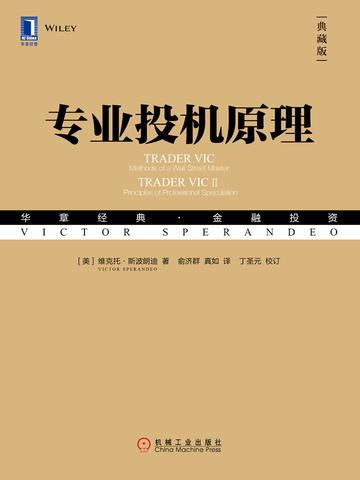
The author, nicknamed "Trader Vic" by Wall Street financial circles and "The Terminator of Wall Street" by Barron's Magazine, has written his own investment experience and unique secrets in this book. The book contains a lot of psychological analysis and economic discussion, and is an interdisciplinary business and management book. The book introduces the three principles of Victor's speculative philosophy: capital protection, consistent profitability, and the pursuit of excellent rewards. After reading this book, I gained a lot.
Super beautiful, real market, not only explains how to operate, but also a spiritual healing for investors.
A must-read for stock and futures.
Look how many hours I've been reading I've read Chapter 10. Chapters 9 and 10 of this book are obscure and difficult to understand.
After reading the whole book, in addition to basic trading knowledge, I also have unique insights into psychology.
Yes, I bought this book many years ago. After reading it for a while, I kept it on my bookshelf for decoration [laughing]
Yes, I understand the Taoist theory
Good book, keep reading/reviewing~keep working hard A classic and good book ~ I regret meeting you so late! ! !
Learned a lot
Not bad, worth recommending
Good book, worth reading!
Learned useful knowledge
Tell us the essence of speculation
Very useful, I plan to read it several times.
Classic never goes out of style
Good. Worth a look.
Very good. It has improved a lot after seeing it.
Learn to trade stocks, or learn to see yourself through the market
A useful book, especially for investors or speculators with certain experience and psychological quality.
It's pretty good. I fell asleep after reading some of the economics chapters. Maybe it's because I can't understand it. I'll look at it again later.
Detailed cases, strict logic and practicality
A very helpful book. A must read for investors.