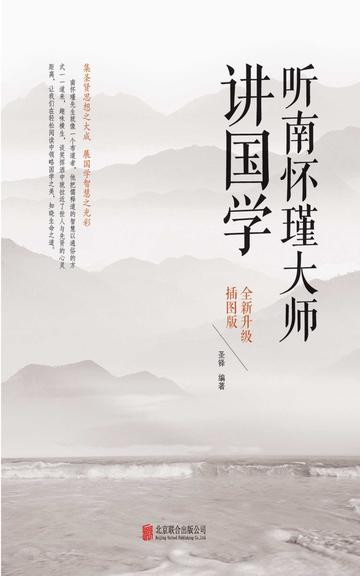
This book covers the essence of concepts and explanations in Mr. Nan Huaijin's works on Laozi, Zhuangzi, Confucius, Mencius, and Zen Buddhism. It selects the original words from Mr. Nan Huaijin's classic Chinese studies as the title and theme of each chapter, and adds fresh cases that are relevant to people's lives today to illustrate. It strives to interpret obscure and difficult Chinese studies knowledge in easy-to-understand terms, and at the same time reproduces Mr. Nan Huaijin's classic interpretations.
Reader comments
"Don't mention your own bravery, let alone the lack of courage of others." This sentence in the book is very suitable for today's society. After going through a special period, many people's mentality has undergone tremendous changes, and they are more or less full of hostility. If you use other people's bad things to set off other people's bad things, there is no guarantee that some people's pain points will not be aroused and they will do irreversible evil things. "Don't do to others what you don't want others to do to you." If you don't want others to poke your sore spots, don't disrespect each other when interacting with others and make others unhappy without any scruples.
This book interprets the wisdom of Chinese traditional culture in an easy-to-understand way, which resonates with me. As the book says, the wisdom of traditional Chinese culture is the spiritual wealth of us Chinese people. I think of a friend of mine who likes to study Confucianism, which has a great influence on his life. And I especially hate those who are self-righteous and disrespectful of traditional culture. Master Nan Huaijin is really great. His research covers a wide range of topics and explains it in simple terms, allowing us to better understand the essence of Chinese studies. I think this book can not only help us find our spiritual home, but also inspire our life wisdom.
It is a kind of enjoyment to listen to the master explain the master. In this kind of text, we can gain threefold gains: first, an in-depth understanding of the original text and the author, second, an understanding of the attitude and thoughts of the interpreter, and third, building our own cognitive structure based on critical thinking of the first two. The interpretation of Confucian classics by Nan Huaijin, a master of traditional Chinese culture, gave me a better understanding of my attitude towards things. For example, when it comes to learning, don't think that you are better than others in everything. A true wise man discovers what others are better at than himself and then learns from them to complement himself.
"There is hardly anything in the world that is satisfying but not overturning." Don't be arrogant about anything, and always be humble, open-minded, and tolerant of everyone and everything. In fact, you don't have to express yourself too much in your work and life. You think that expressing yourself will gain the admiration and recognition of others. Always showing your abilities to others will only make others feel repulsive and annoying. The reason why the sea can become a sea is because it can accommodate all things. The more profound knowledge everyone has, the broader their mind will become, and the more things they will gain.
The wisdom of Chinese studies is not only displayed in the elegance of intellectuals, but the way we ordinary people live also shows the intelligence and wisdom of our ancestors. As such a philosophical and cultural person, Mr. Nan Huaijin wants to take the initiative to break this barrier and let traditional culture penetrate into ordinary people. In life, the profound and obscure become ordinary; presenting classics such as The Analects of Confucius, Laozi, and Zhuangzi in front of contemporary readers, allowing us to have a dialogue with the soul, allowing us to get closer to nature, and understand that in life, we should abandon delusions and desires, and let the ordinary have its own strength.
"Listening to Master Nan Huaijin's Lectures on Chinese Studies" explains the explanation of ancient sages such as Laozi, Zhuangzi, Confucius, Zhuangzi and their famous works by Nan Huaijin, a master of Chinese studies. It contains thoughts on the lives of the sages and their high standards. The in-depth analysis of Ping's moral character is in line with our real life, making the originally obscure and difficult-to-understand Chinese studies lively and interesting, improving readers' readability, and at the same time allowing them to appreciate Master Nan Huaijin's understanding of ancient sages.
No sign of good deeds, no confusion, no worries
This book is really good. It has pictures and stories. It understands the principles of being a human being. It feels like it can be read by any age.
"Don't mention your own bravery, let alone the lack of courage of others." This sentence in the book is very suitable for today's society. After going through a special period, many people's mentality has undergone tremendous changes, and they are more or less full of hostility. If you use other people's bad things to set off other people's bad things, there is no guarantee that some people's pain points will not be aroused and they will do irreversible evil things. "Don't do to others what you don't want others to do to you." If you don't want others to poke your sore spots, don't disrespect each other when interacting with others and make others unhappy without any scruples.
This book interprets the wisdom of Chinese traditional culture in an easy-to-understand way, which resonates with me. As the book says, the wisdom of traditional Chinese culture is the spiritual wealth of us Chinese people. I think of a friend of mine who likes to study Confucianism, which has a great influence on his life. And I especially hate those who are self-righteous and disrespectful of traditional culture. Master Nan Huaijin is really great. His research covers a wide range of topics and explains it in simple terms, allowing us to better understand the essence of Chinese studies. I think this book can not only help us find our spiritual home, but also inspire our life wisdom.
It is a kind of enjoyment to listen to the master explain the master. In this kind of text, we can gain threefold gains: first, an in-depth understanding of the original text and the author, second, an understanding of the attitude and thoughts of the interpreter, and third, building our own cognitive structure based on critical thinking of the first two. The interpretation of Confucian classics by Nan Huaijin, a master of traditional Chinese culture, gave me a better understanding of my attitude towards things. For example, when it comes to learning, don't think that you are better than others in everything. A true wise man discovers what others are better at than himself and then learns from them to complement himself.
"There is hardly anything in the world that is satisfying but not overturning." Don't be arrogant about anything, and always be humble, open-minded, and tolerant of everyone and everything. In fact, you don't have to express yourself too much in your work and life. You think that expressing yourself will gain the admiration and recognition of others. Always showing your abilities to others will only make others feel repulsive and annoying. The reason why the sea can become a sea is because it can accommodate all things. The more profound knowledge everyone has, the broader their mind will become, and the more things they will gain.
The wisdom of Chinese studies is not only displayed in the elegance of intellectuals, but the way we ordinary people live also shows the intelligence and wisdom of our ancestors. As such a philosophical and cultural person, Mr. Nan Huaijin wants to take the initiative to break this barrier and let traditional culture penetrate into ordinary people. In life, the profound and obscure become ordinary; presenting classics such as The Analects of Confucius, Laozi, and Zhuangzi in front of contemporary readers, allowing us to have a dialogue with the soul, allowing us to get closer to nature, and understand that in life, we should abandon delusions and desires, and let the ordinary have its own strength.
"Listening to Master Nan Huaijin's Lectures on Chinese Studies" explains the explanation of ancient sages such as Laozi, Zhuangzi, Confucius, Zhuangzi and their famous works by Nan Huaijin, a master of Chinese studies. It contains thoughts on the lives of the sages and their high standards. The in-depth analysis of Ping's moral character is in line with our real life, making the originally obscure and difficult-to-understand Chinese studies lively and interesting, improving readers' readability, and at the same time allowing them to appreciate Master Nan Huaijin's understanding of ancient sages.
No sign of good deeds, no confusion, no worries
This book is really good. It has pictures and stories. It understands the principles of being a human being. It feels like it can be read by any age.
Easy to understand and full of fun
Very good. I am a loyal listener. Thank you!
Not bad, the content is brief and concise,