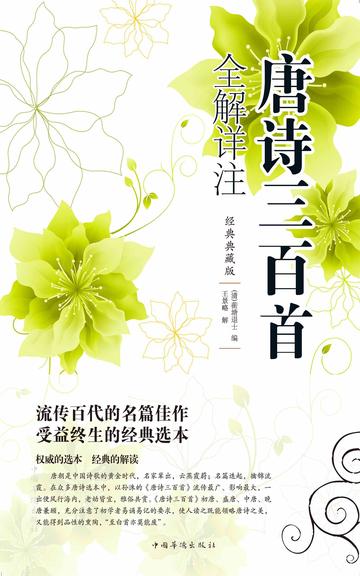
"Three Hundred Tang Poems Complete Explanations and Detailed Annotations" selected 77 poets from the Tang Dynasty, with a total of 310 poems, including five-character ancient poems, Yuefu, seven-character ancient poems, seven-character rhymed poems, five-character quatrains, seven-character quatrains, etc. In terms of the selection of poets, the early Tang Dynasty, the prosperous Tang Dynasty, the middle Tang Dynasty and the late Tang Dynasty were all selected, showing the essence of Tang poetry in each period. In addition to annotating, translating, and appreciating the selected works of Sun Zhu, "Three Hundred Tang Poems with Detailed Annotations" also conducts "comparative reading" of many works, and adds a small column of common knowledge of Tang poetry, either from the perspective of meter or meaning, so that readers can not only understand deeply, but also expand their reading, so that readers will not be biased when learning poetry.
Reader comments
This book has detailed annotations, in-depth appreciation, and extended reading, which gave me a more comprehensive understanding of Tang poetry. I especially like Zhang Jiuling's "Feelings", which uses the vitality of orchid leaves and sweet-scented osmanthus to express a noble sentiment that does not seek fame and wealth. This book made me feel the charm of Tang poetry, and also gave me more insights in my study.
His poems take pastoral landscapes as the main themes, and their style is close to that of Wang and Mencius. He is good at using concise and concise brushwork to express his emotions.
This book has detailed annotations, in-depth appreciation, and extended reading, which gave me a more comprehensive understanding of Tang poetry. I especially like Zhang Jiuling's "Feelings", which uses the vitality of orchid leaves and sweet-scented osmanthus to express a noble sentiment that does not seek fame and wealth. This book made me feel the charm of Tang poetry, and also gave me more insights in my study.
His poems take pastoral landscapes as the main themes, and their style is close to that of Wang and Mencius. He is good at using concise and concise brushwork to express his emotions.