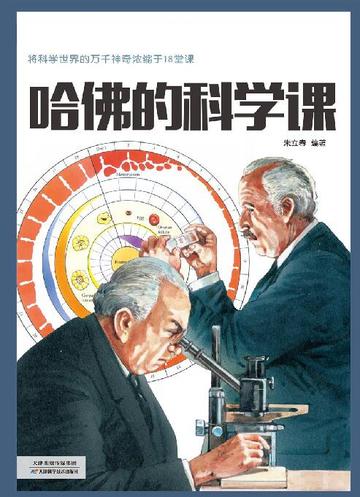
This book absorbs the essence of Harvard University's scientific education thoughts for more than 300 years. In the form of a popular science lecture, it tells the scientific common sense that teenagers should understand and master, from material cycle to energy conservation, from subatomic particles to cosmic objects, from gravity to space-time tunnels, from ecosystems to the evolution of life, from the history of the earth to the future of the universe, involving various disciplines such as physics, chemistry, biology, life medicine, astronomy, earth geography, mathematics, etc.
Reader comments
These basic and comprehensive scientific popularization knowledge are worth reading.
The content of this book is really rich! It uses an easy-to-understand way to explain scientific knowledge in a very interesting way, and it feels like listening to a popular science lecture. Moreover, the examples in the book are very close to life, which made me understand the complex scientific principles at once. I especially like this relaxed way of learning, and I feel that science is not that difficult😄. The author's writing style is also very friendly, just like chatting with friends, which makes people feel comfortable reading😆.
Understanding natural phenomena from a systematic perspective is more logical. However, the knowledge used is mostly old.



These basic and comprehensive scientific popularization knowledge are worth reading.
The content of this book is really rich! It uses an easy-to-understand way to explain scientific knowledge in a very interesting way, and it feels like listening to a popular science lecture. Moreover, the examples in the book are very close to life, which made me understand the complex scientific principles at once. I especially like this relaxed way of learning, and I feel that science is not that difficult😄. The author's writing style is also very friendly, just like chatting with friends, which makes people feel comfortable reading😆.
Understanding natural phenomena from a systematic perspective is more logical. However, the knowledge used is mostly old.