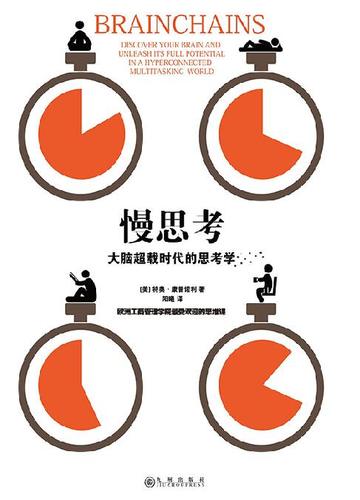
Slow Thinking: Thinking in the Age of Brain Overload
慢思考:大脑超载时代的思考学
- Status
- Completed
- Source
- Fanqie
Stats
9.0Score
23Chapters
Tags
Synopsis
Reader comments
In booklists 4





Full of Useful Information: All-Round Learning Book
41.8MViews650Books1dUpdated





The Protagonist Is the God of the Last Era, Crushing the Main God, the System, the King of Soldiers, and Returning.
11MViews312Books1dUpdated





Are There Any Novels About Brain Development?
I remember it was a book written around 2004. You can also recommend similar books.
2MViews103Books8dUpdated



Books to Improve Thinking
I want to read a book similar to "A Guide to Cheating in Life". Ordinary people can read this book and improve their thinking
761.5kViews434Books4dUpdated
The focus of this book is to describe how the human brain works, so that people can understand how to use their brains rationally, so that mental workers can get twice the result with half the effort at work. It is a book you will not regret after reading it.
In the book "Thinking Fast and Slow", you can learn fast thinking and slow thinking. Through this book, you can find the connection point with modern life. Three kinds of brain Thinking brain: Inability to multitask and can only focus on one thing at a time. If you constantly switch tasks, it will take longer to complete the work, and may lead to information loss and reduced efficiency. Reflective brain: The reaction speed is fast and can help the thinking brain handle routine matters, such as instinctive reactions when encountering danger. It also takes shortcuts and creates biases and habits that sometimes prevent us from making good decisions. Storage brain: Responsible for organizing and updating information in the brain. Only when the thinking brain is idle can it run efficiently and summarize information into knowledge and insights. Four major questions Always online: Modern technology allows people to be online at all times, resulting in information overload, making it difficult for the brain to process and store information, and making thoughtful decisions, which will reduce information processing efficiency in the long term. Multi-tasking parallelism: The thinking brain cannot truly handle multiple tasks at the same time. Multi-tasking parallelism will interfere with each other, prolong the completion time of a single task, damage the quality of work, and even cause safety hazards. Low-level stress: Prolonged exposure to stress and a lack of relaxation can cause brain performance to decline, affecting physical and mental health. Stress that should promote progress can instead become a negative factor. Insufficient sleep: Adequate sleep is crucial for intelligence and productivity. Insufficient sleep can damage brain potential and affect concentration, creativity and judgment. Four secrets Offline thinking: Find out the time period when your thinking brain is most active, take it out to keep quiet, turn off electronic devices, and engage in focused reading and important thinking. Reading before going to bed, arranging key points in the morning, and regular weekly summary are my three most important magic weapons. Batch processing: Reduce the number of task switches and complete one task or a relatively complete part at a time. Divide related tasks into the same batch for processing, and focus on irrelevant trivial matters at a specific time. Stay asleep: Get enough sleep and set wake-up and bedtime alarms. Reasonable stress reduction: Reasonably arrange tasks to reduce the duration of stress, and improve stress tolerance through the interactive method of "coping with stress - rest and recovery".
This book is like a key, opening the shackles of my thinking. I like the "Four Chains of the Brain" mentioned in the book. It makes me understand why we are always easily distracted. The cases in the book are also very interesting, allowing me to see my own reflection in life. My favorite character is the author himself. He is like a kind mentor, teaching us how to focus in a simple and easy-to-understand way. This book makes me regret not reading it earlier. I recommend it to you. I hope we can all learn to think slowly and get rid of the trap of busyness.
Let me first state that this represents only my personal opinion. This book is suitable for people who use mobile phones heavily and people who want to improve their work and study efficiency. Of course, it is also suitable for people who want to broaden their cognitive boundaries. This book first talks about several layers of the brain: thinking brain, reflective brain, etc., And lists some professional research proof, showing that the human brain is actually just a single-core processor and cannot perform multi-threaded tasks. Then it explains some consequences and possible causes when some people encounter certain multi-threaded tasks in their daily lives. Finally, the book proposes some feasible methods for the problems pointed out, in order to suggest how people can improve work efficiency and avoid some multi-threaded tasks.
Explain the differences and connections between the reflective brain, thinking brain and memory brain, and how to save time, effort, simplicity and efficiency
Three brains, intuitive reflection, thinking, and memory.
Very detailed explanation
Some aspects are very useful, but eight hours of sleep a day is really difficult to achieve. . .
Use time, respect time, use time efficiently
This book uses a lot of scientific evidence and psychological knowledge to explain the working mechanism of the brain, and how most people use their brains incorrectly. Before reading this book, I was very afraid of in-depth learning of a skill, thinking that it was not something I could master. My slow-thinking brain couldn't learn such a difficult thing! Moreover, I often feel inferior to myself that my brain thinks slower than others, and laugh at myself that my brain is a "single-core processor". I even make mistakes and think painfully in order to improve efficiency. The author divides the brain's working system into three categories: the fast and primitive reflection brain, the slow and mature thinking brain, and the storage brain that is always waiting for free time. The reflexive brain handles routine tasks, i. E. Habitually, subconsciously. Such as reading, writing, driving, and even surgery. This is the so-called practice makes perfect, and you can respond quickly without thinking. It is a brain system that is commonly used by humans throughout the day. It consumes low energy and is fast. The thinking brain is responsible for decision-making and deep thinking. It is a single-core processor that can only handle one task at a time. All the multi-parallel use of the thinking brain is wrong! Thinking about brain-switching tasks requires additional overhead, and if you switch between tasks for a short period of time, some information is lost. The thinking brain is the protagonist of this book, and it is also your conscious thinking. It consumes a lot of energy, is slow but mature. The storage brain is responsible for organizing, classifying, storing a day's information, discarding useless information, and establishing link nodes for new information. The working time of the thinking brain and the storage brain are "opposed" to each other. You work, I rest. You rest, I work. According to the operating logic and relationship of the three brain systems. The authors identified four "chains" that limit brain performance: 1. Always online: distracts concentration and causes chronic stress. 2. Multi-tasking: Wrong use of thinking brain. 3. Low level stress: Both too low and too high pressure will have negative effects 4. Lack of sleep: storage brain, not enough time to work. The entire book begins in the middle period and revolves around these four chains, explaining the dangers and solutions.