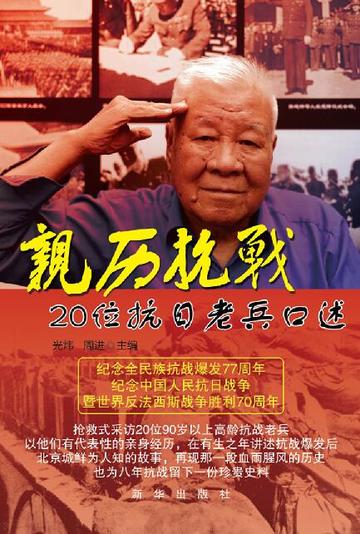
This year marks the 77th anniversary of the outbreak of the entire nation's Anti-Japanese War, and next year will mark the 70th anniversary of the victory of the Chinese People's War of Resistance Against Japanese Aggression and the World Anti-Fascist War. The Japanese militaristic war of aggression and colonial rule brought unforgettable trauma to Beijing, and the people with lofty ideals who stood up in the baptism of blood and fire will forever be remembered in history.
"Experiencing the Anti-Japanese War: Oral Accounts of 20 Anti-Japanese Veterans" uses oral narration to reproduce the history of Beijing's Anti-Japanese War, truly and vividly recording that tragic but glorious process.
Reader comments
The Chinese People's War of Resistance Against Japanese Aggression and the Anti-Fascist War is an epic with an iron-blooded color in the history of New China. This history is full of passion but also conceals heroism, and is full of responsibility but also leaves behind tragedy. The author uses highly contagious words and borrows the words of 20 anti-Japanese veterans to truly and vividly describe that magnificent and turbulent history that cannot be forgotten, a history that has forged glory and glory, but also shed blood and tears.
The Chinese People's War of Resistance Against Japanese Aggression and the Anti-Fascist War is an epic with an iron-blooded color in the history of New China. This history is full of passion but also conceals heroism, and is full of responsibility but also leaves behind tragedy. The author uses highly contagious words and borrows the words of 20 anti-Japanese veterans to truly and vividly describe that magnificent and turbulent history that cannot be forgotten, a history that has forged glory and glory, but also shed blood and tears.
History is too long, and veterans are gradually being forgotten. A peaceful and peaceful life can easily numb people's souls. We often forget the crisis of national subjugation a hundred years ago, and the bloody heroic battles to save the nation from danger. This book collects the oral histories of 20 anti-Japanese veterans to once again remember that on July 7, 77 years ago, the struggle by the Marco Polo Bridge in Beijing kicked off the entire nation's war of resistance. Hengdao was on the horse, and from then on there was a hail of bullets, and he sacrificed his life to chase the Japanese invaders. He only used his own flesh and blood to prop up New China again, and in exchange for today's peace, we should remember it.
By reading this book, I saw what the author knew about the anti-Japanese war and his own attitude: On the occasion of the 77th anniversary of the outbreak of the Chinese nation's anti-Japanese war, I was fortunate to get to know several anti-war veterans of the Kuomintang and the Communist Party. The youngest among them is already 90 years old. 77 Years ago, they left their families and relatives and embarked on the road of resisting Japan and saving the country. It is their sacrifices that brought us the comfortable life we have today. We should pay tribute to these veterans.
I share his attitude.
This book was published to commemorate the 77th anniversary of the outbreak of the Anti-Japanese War. It is a work of oral history. When I was in school, I learned about oral history and participated in related recording work. I deeply understood the difficulty of writing this book and found it very precious. This book reproduces the history of the Anti-Japanese War in Beijing in an oral way, truly and vividly recording that tragic but glorious process. It is very touching. I hope more people will read this book and make oral history research better and better.

The Chinese People's War of Resistance Against Japanese Aggression and the Anti-Fascist War is an epic with an iron-blooded color in the history of New China. This history is full of passion but also conceals heroism, and is full of responsibility but also leaves behind tragedy. The author uses highly contagious words and borrows the words of 20 anti-Japanese veterans to truly and vividly describe that magnificent and turbulent history that cannot be forgotten, a history that has forged glory and glory, but also shed blood and tears.
The Chinese People's War of Resistance Against Japanese Aggression and the Anti-Fascist War is an epic with an iron-blooded color in the history of New China. This history is full of passion but also conceals heroism, and is full of responsibility but also leaves behind tragedy. The author uses highly contagious words and borrows the words of 20 anti-Japanese veterans to truly and vividly describe that magnificent and turbulent history that cannot be forgotten, a history that has forged glory and glory, but also shed blood and tears.
History is too long, and veterans are gradually being forgotten. A peaceful and peaceful life can easily numb people's souls. We often forget the crisis of national subjugation a hundred years ago, and the bloody heroic battles to save the nation from danger. This book collects the oral histories of 20 anti-Japanese veterans to once again remember that on July 7, 77 years ago, the struggle by the Marco Polo Bridge in Beijing kicked off the entire nation's war of resistance. Hengdao was on the horse, and from then on there was a hail of bullets, and he sacrificed his life to chase the Japanese invaders. He only used his own flesh and blood to prop up New China again, and in exchange for today's peace, we should remember it.
By reading this book, I saw what the author knew about the anti-Japanese war and his own attitude: On the occasion of the 77th anniversary of the outbreak of the Chinese nation's anti-Japanese war, I was fortunate to get to know several anti-war veterans of the Kuomintang and the Communist Party. The youngest among them is already 90 years old. 77 Years ago, they left their families and relatives and embarked on the road of resisting Japan and saving the country. It is their sacrifices that brought us the comfortable life we have today. We should pay tribute to these veterans. I share his attitude.
This book was published to commemorate the 77th anniversary of the outbreak of the Anti-Japanese War. It is a work of oral history. When I was in school, I learned about oral history and participated in related recording work. I deeply understood the difficulty of writing this book and found it very precious. This book reproduces the history of the Anti-Japanese War in Beijing in an oral way, truly and vividly recording that tragic but glorious process. It is very touching. I hope more people will read this book and make oral history research better and better.