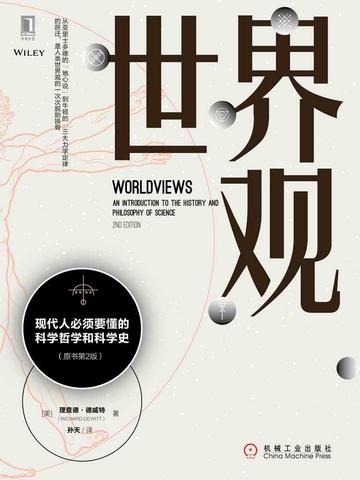
Worldview: the Philosophy and History of Science That Modern People Must Understand (2Nd Edition of the Original Book)
世界观:现代人必须要懂的科学哲学和科学史(原书第2版)
- Status
- Completed
- Length
- 307k Words
- Updated
- 5y ago
- Source
- Fanqie
Stats
109Reads
9.1Score
37Chapters
11Listens
34.5kReads · all time
Tags
Synopsis
Reader comments
In booklists 6




Looking for a Study List for OC People
I would like to read a book similar to "Jungian Psychology". Are there any OC references or books to study? I prefer Jungian psychology/personality typology. Others can also be recommended. Religion, writing skills, mysticism, psychology, and design can all be recommended.
11.6MViews543Books1dUpdated




Fate Gu Has Been Destroyed, Unruly Stories Have Appeared Frequently, It's the Old Dragon and I'm Incompetent Ah Ah Ah
I want to read a book similar to "My Twenty-Six-Year-Old Female Gu Immortal".
5.9MViews223Books2dUpdated




Books to Improve Awareness
5.2MViews161Books4dUpdated





Philosophy, the Kind of Masterpiece That Is Enough to Burn Your Brain and Make You Forget About Food and Drink (Regardless of Sects)
Confucianism, Taoism and Buddhism
3.6MViews567Books7dUpdated



Nice Historical Novel
2.1MViews367Books22hUpdated

Books About Philosophy. Very Meaningful.
About Taoism or Buddhism.
1.4MViews548Books2dUpdated
If you read books you can understand every day, you will only know the known world view." It's not that the world is changing too fast, it may be that your world view hasn't had time to refresh. The so-called growth is to use the "world view" to upgrade your cognition.
What is this world like? Before I opened the book, I had the answer in my mind. After reading the book, I felt at a loss. Most of our understanding of the world comes through experience and learning. If we hadn't been told in school that the earth is round and revolves around the sun, how long would it have taken for us to discover the "truth" about the world? What if the school lied to you? What if the limitations of cognition allow us to only have the current level of technology, just like the ancient people thought that the earth was the center of the universe, but in fact the truth is not like this? Or is there no world at all, just a brain in a jar filled with tubes, and all perceptions are signals from a machine? In my original understanding, ancient people were not very smart. The earth is flat, if you go to the edge you will fall. Some people say that the earth is round, and they will be asked how the opposite person stands. I finally felt that the earth was round and all the stars revolved around the earth. Look at Copernicus, he came up with the heliocentric theory and overturned the geocentric theory. How great. Is the church a cult when it persecutes intellectuals? Newton was so powerful that he had to memorize all kinds of formulas and solve problems when he went to school. If you do it right, you will be in the normal world; if you do it wrong, you will be in a fantasy world, and the coffin board will not be able to hold it down. The above is my original understanding. After reading this book, I realized that I am a fool. In fact, the knowledge that the earth is spherical has been known since 300 to 400 BC. The geocentric theory is not a fallacy full of loopholes, but a complete logical and self-consistent system. Even if I ask myself to travel back in time, I cannot refute it. Copernicus proposed the heliocentric theory not for the sake of science, but for the sake of religion.
A must-read general humanities textbook. I often feel that I don't have enough knowledge and education. The book introduces fundamental issues in the history and philosophy of science, such as what is truth, philosophical conceptual facts, etc. Covers historical events and philosophical themes in the history of science that have impacted the worldview. Science brings us not only knowledge, but a new cognitive system, such as the change from the Aristotelian worldview to the Newtonian worldview. The author discusses the impact and challenges brought to the worldview by the development of modern science, especially the theory of relativity, quantum mechanics, and evolution. Very useful.
How to understand the world and reconcile the world with ourselves is a proposition that each of us should think about. It is particularly important to familiarize yourself with past history and understand how the world works, and to master the philosophy of science and the history of science. From the historical perspective of scientific development, this book introduces technological and social changes since the Renaissance, such as the controversy between geocentrism and heliocentrism, Newtonian mechanical revolution, Darwin's theory of evolution, Einstein's theory of relativity, quantum mechanics, etc. It is suitable for readers who are interested in the philosophy of science and the history of science. Through understanding of scientific thought and history, you can better understand the nature and value of scientific knowledge and provide references for solving practical problems.
From fundamental issues in the philosophy of science to historical events in the history of science, it is all about the formation of a worldview. A worldview is a view and perspective on the world. Here we simplify the complex and deeply dissect the fundamental issues, and explore the development of modern science and the process of modern philosophy, especially the impact of the evolution of relativity, quantum mechanics, etc. On the worldview. It not only brings knowledge, but also a new cognitive system. This helps us reshape our worldview.
A clear worldview brings a clear life. World view A worldview is not a simple collection of opinions, but a system of beliefs that are interrelated and supportive of each other like a puzzle. Take Aristotle's worldview as an example. It takes the earth as the center of the universe, and many viewpoints fit together to form a self-consistent whole. In this system, teleology and essentialism are important concepts, and everything has its inherent essence and purpose. For example, a stone falls because its nature causes it to move toward the center of the universe—the Earth. Science Science, as we often call it, is the current mainstream way of understanding the world. Science also has limitations, and existing theories are not absolute truth; Science continues to evolve and change as evidence accumulates and new research is conducted; Science is a continuous process of exploration and revision. Critical Thinking It is necessary to maintain a critical attitude towards understanding the world. Do not blindly accept any theory, but evaluate its rationality by analyzing evidence and thinking about logical relationships. Evidence is the basis for building a worldview, and we form opinions based on evidence such as observation and experience; At the same time, the emergence of new evidence may cause old views to be revised or abandoned, which is the key to critical thinking. Summary We live in a huge belief system. These beliefs are intertwined and support each other, forming our cognitive framework of the world. Scientific theories are not produced in a vacuum, but developed in a certain historical and cultural background. Science is the tool we use to describe and predict the universe. This tool, like our daily tools, needs to be constantly iterated and improved according to our needs. Science is constantly developing and changing, and our understanding of the universe is constantly being updated. Therefore, no scientific theory can be regarded as absolute truth, and all theories are only tentative and relative.
From Aristotle's world view to Ptolemaic astronomy and geocentric theory to Copernicus' heliocentric theory to Newton's world view to Einstein's theory of relativity to quantum theory. Feel the world with real experience, explain science with popular language, explain philosophy with science (integrating physics, astronomy, and biology), analyze instrumentalism, realism, evolution theory, teleology... Understand the diversity of the world, focus on the present is dangerous and fascinating, and focus on the future is hopeful and achievable. Empirical facts are facts based on observation, conceptual facts are the induction of experience, and philosophy is the summary of history and the abstract explanation of thinking that cannot be explained by science. This is a fact inferred through the way we understand the world, not an empirical fact that we directly observe. Evolution is not based on purpose and probability, but rather on preserving choices that are beneficial to survival. Confirmatory reasoning - induction, disconfirmation reasoning - deduction, the two correspond to each other, but induction and deduction cannot produce 100% correct results. New discoveries are also forcing us to reevaluate some of our usual views about the world.
It can be said that it is the cornerstone of science that supports our modern society. Whether it is electronic equipment or transportation such as high-speed trains and airplanes, they are all based on the use of scientific theories. This book combs the philosophy of science and the development history of science, introduces some basic propositions in the history and philosophy of science, discusses the transformation from the Aristotelian worldview to the Newtonian worldview, explores the challenges that recent scientific developments bring to the Western worldview, and focuses on the theory of relativity, quantum theory, and evolution.
This is a general reading that everyone should read, and it is a regrettable fact that most people I meet lack basic general knowledge or have not received a complete general education.
It gives me the feeling that an old world is being dismantled and a new world is being established. It is worth reading, but reading to the later stages will require you to have some theoretical foundation.
Although some of the content was a bit difficult for me, the author, Professor Richard DeWitt, was like a guide and gave me a deeper understanding of science. I thought about my cousin who likes to study science and he would definitely like this book. It not only allows people to understand the development of science, but also triggers thinking about how to treat science. It is worth reading!
The missing one does not mean that the author's writing is not good. I hope that the author's writing will be more informative. I am a greedy reader. Hehe.
It is very good and worth reading. It can exercise abstract thinking and logical reasoning thinking, and give you a more comprehensive summary of what the world view is.
Review conflicts with concepts from different angles [Learned]
The feeling of absorbing knowledge is so wonderful
Break the inherent understanding of many common sense
An interesting book, easy to understand and with a unique perspective