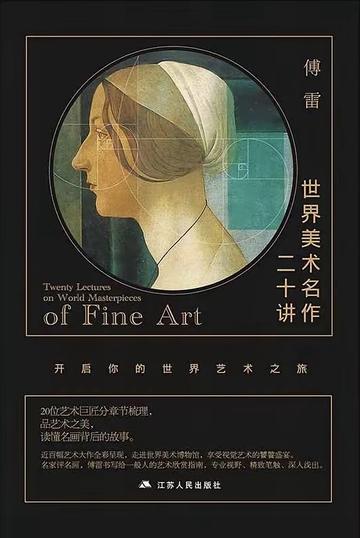
"Twenty Lectures on Masterpieces of World Art" is a masterpiece by Mr. Fu Lei. It is an introductory book and a must-read for learning art appreciation and Western art history. It is known as the "Chinese version of "The Story of Art"".
"Twenty Lectures on Masterpieces of World Art" revolves around 20 art masters and their masterpieces since the Western Renaissance, starting from Giotto and ending with Corot, as well as painting masters from the Renaissance, Baroque and Romantic periods, such as Botticelli, Leonardo da Vinci, Raphael, Rembrandt, Velazquez, Poussin, Gainsborough, etc.
In "Twenty Lectures on Masterpieces of World Art", while providing precise analysis of the art works involved, Mr. Fu Lei's writing also touches on philosophy, literature, music, historical background, etc., Which can comprehensively enrich readers' artistic accomplishment.
In order to facilitate readers to enter the world of art more intuitively, "Twenty Lectures on World Art Masterpieces" is equipped with nearly a hundred high-definition illustrations and full-color printing, giving readers a visual feast.
Reader comments
This book is really great! Mr. Fu Lei's analysis of each art master and his works was very thorough, which gave me a deeper understanding of the history of Western art. Moreover, the book also touches on philosophy, literature, music and other fields, which enriches my artistic accomplishment. Just like Giotto mentioned in the book, his murals are full of the spirit of the Franciscans, which made me feel people's new understanding of religion in that era. This reminds me of Dan Brown's "The Da Vinci Code", which also has wonderful interpretations of religion and art. In short, "Twenty Lectures on Masterpieces of World Art" is a good book worth reading again and again!
When he was young, Mr. Fu Lei was employed as a professor of art history at Shanghai Academy of Fine Arts. This was revised and supplemented on the basis of his lecture notes. In a book completed in 1934, he focused on introducing nearly twenty great masters and their masterpieces since the Renaissance, vividly and concisely explained artistic styles and moral integrity, and integrated literature, music, philosophy, society, and the times into one, explaining the profound and fascinating things in a simple and easy-to-understand manner. Mr. Fu did not list numerous schools and works in the book, but only selected representative ones to comment on. In addition to commenting on the characteristics of the works and the life experiences of the artists, he also mentioned some difficult aesthetic issues caused by artistic practice and put forward his own opinions. The whole book's commentary is subtle and eloquent, making it a rare masterpiece among art history books.
Appreciating art and beauty can cultivate our temperament and sentiment, allowing us to feel more happiness in life. The author explains the theme with twenty representative works of art. These works cover art works from different periods, styles and genres, including paintings, sculptures, architecture and other forms. Each work will be interpreted and analyzed in detail to help readers better understand and appreciate the aesthetic value and artistic significance of these works of art.
Fu Lei, Chinese translator, writer, educator, and art critic. Fu Lei had studied art history in his early years and was familiar with the "theory of form and spirit" in my country's classical aesthetics and painting, poetry and prose, so he borrowed it to discuss literary translation issues. Fu Lei compared translation with painting, allowing translators to maximize their creativity when translating. Fu Lei had two sons, Fu Cong and Fu Min. He was very strict in their upbringing and loved his father deeply. His family letters were later compiled by Fu Min into Fu Lei's family letters, which has a profound influence to this day.
It has broadened my vision of world aesthetics. The world is really so big. The more I study, the more I feel that I have a lot to learn.
The writing and words are like a natural landscape painting, which is popular and natural without losing the beauty of talent.
Good article,
Even people who are not art students can watch it.
There are many famous works of art in the world. The author Fu Lei takes us step by step into the art world of Michelangelo, Leonardo da Vinci, Raphael and others. These works represent outstanding works of different periods, different styles and different artists. These works have important artistic value and cultural significance, and have had a profound impact on the art of later generations. Among them, Leonardo da Vinci's "Mona Lisa" is a hurdle we cannot get around. Mona Lisa's facial expressions and smile are widely interpreted as mysterious and attractive. Her gaze seems to follow the viewer, giving it an intimate and personal feel.



This book is really great! Mr. Fu Lei's analysis of each art master and his works was very thorough, which gave me a deeper understanding of the history of Western art. Moreover, the book also touches on philosophy, literature, music and other fields, which enriches my artistic accomplishment. Just like Giotto mentioned in the book, his murals are full of the spirit of the Franciscans, which made me feel people's new understanding of religion in that era. This reminds me of Dan Brown's "The Da Vinci Code", which also has wonderful interpretations of religion and art. In short, "Twenty Lectures on Masterpieces of World Art" is a good book worth reading again and again!
When he was young, Mr. Fu Lei was employed as a professor of art history at Shanghai Academy of Fine Arts. This was revised and supplemented on the basis of his lecture notes. In a book completed in 1934, he focused on introducing nearly twenty great masters and their masterpieces since the Renaissance, vividly and concisely explained artistic styles and moral integrity, and integrated literature, music, philosophy, society, and the times into one, explaining the profound and fascinating things in a simple and easy-to-understand manner. Mr. Fu did not list numerous schools and works in the book, but only selected representative ones to comment on. In addition to commenting on the characteristics of the works and the life experiences of the artists, he also mentioned some difficult aesthetic issues caused by artistic practice and put forward his own opinions. The whole book's commentary is subtle and eloquent, making it a rare masterpiece among art history books.
Appreciating art and beauty can cultivate our temperament and sentiment, allowing us to feel more happiness in life. The author explains the theme with twenty representative works of art. These works cover art works from different periods, styles and genres, including paintings, sculptures, architecture and other forms. Each work will be interpreted and analyzed in detail to help readers better understand and appreciate the aesthetic value and artistic significance of these works of art.
Fu Lei, Chinese translator, writer, educator, and art critic. Fu Lei had studied art history in his early years and was familiar with the "theory of form and spirit" in my country's classical aesthetics and painting, poetry and prose, so he borrowed it to discuss literary translation issues. Fu Lei compared translation with painting, allowing translators to maximize their creativity when translating. Fu Lei had two sons, Fu Cong and Fu Min. He was very strict in their upbringing and loved his father deeply. His family letters were later compiled by Fu Min into Fu Lei's family letters, which has a profound influence to this day.
It has broadened my vision of world aesthetics. The world is really so big. The more I study, the more I feel that I have a lot to learn. The writing and words are like a natural landscape painting, which is popular and natural without losing the beauty of talent. Good article, Even people who are not art students can watch it.
There are many famous works of art in the world. The author Fu Lei takes us step by step into the art world of Michelangelo, Leonardo da Vinci, Raphael and others. These works represent outstanding works of different periods, different styles and different artists. These works have important artistic value and cultural significance, and have had a profound impact on the art of later generations. Among them, Leonardo da Vinci's "Mona Lisa" is a hurdle we cannot get around. Mona Lisa's facial expressions and smile are widely interpreted as mysterious and attractive. Her gaze seems to follow the viewer, giving it an intimate and personal feel.
Super beautiful, super awesome