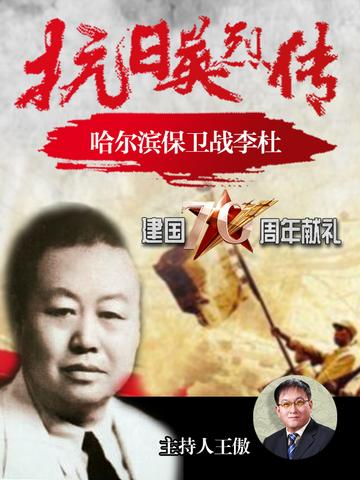
Li Du (1880-1956), named Zhichu, was born in Yixian County, Liaoning Province. He graduated from the Northeast Lecture Hall and served successively as company commander, regimental commander, division commander and other positions in the Fengjun Army. When the September 18th Incident broke out in 1931, he served as the garrison envoy of Yilan. He was also the commander of the 24th Brigade of the Northeastern Army. In January 1932, Japan instigated Xiqia to send Yu Chencheng, the "Commander of the Bandit Suppression Army" of Jilin Province, to lead an army to Harbin. Zhang Jinghui, the chief executive of the Eastern Province Special Region, secretly colluded with Japan to wait for an opportunity. After the surrender, Harbin was in danger for a while. Li Du resolutely led the main force to march westward and arrived in Harbin on January 16. He contacted some patriotic generals to organize the Jilin Self-Defense Force, served as commander-in-chief, and issued an anti-Japanese and uprising policy. The telegram and letter to the people stated that on this day of serious situation, when our soldiers are serving on the battlefield, I hope that my fathers, elders and children will remember the danger of our country and the tragic loss of our country, unite as one, and fight against the national calamity together. We share the same hatred against the enemy and will never look back. After that, he led his troops to fight against the Japanese invaders in Harbin, Fangzheng, Yilanmishan and other places. On February 3, the Japanese army approached Harbin with heavy troops. In order to defend Harbin, Li Du personally went to the front line to command. The battle lasted until the early morning of February 5. Under the enemy's continuous attacks, the Self-Defense Forces suffered serious losses and the defense line After losing ground one after another, Li Du was heartbroken and unable to save the situation. He evacuated Harbin on February 5 and led his troops to retreat to Yilan. In January 1933, after the Self-Defense Forces failed, Li Du led his troops to retreat to the Soviet Union. In May of the same year, he returned to China via Europe to participate in the anti-Japanese and national salvation movement organized by Soong Ching Ling.
After the founding of New China, he was elected as a member of the National Committee of the Chinese People's Political Consultative Conference and a member of the Sichuan Provincial Committee of the Chinese People's Political Consultative Conference.




Poor ink marks