The Record of Panic is a collection of late essays by Portuguese writer Fernando Pessoa, all of which are fragments of "fake diaries"... The author is hailed by contemporary critics as "the core figure of European modernism", as well as "an outstanding classic writer", "the most moving", "the most touching writer" and "the writer who can best deepen people's hearts", etc.
Reader comments
"I feel like I'm always on the eve of waking up, in the last breathless moment of confusion, struggling desperately in a shell that serves as me."
As soon as I saw these words, I understood how good he was at describing people's psychology. Those elusive emotions were embodied in his writing, making them clearer and more intensified than what we can say.
Pessoa is a man who lives in one room, but his soul moves in the wind. His philosophy is very complex in his writings. Sometimes the soul is above everything else, and sometimes reality is everything. I saw in him a free man—free in his own country.
It is poetry and prose worth reading, but you should not indulge in it, because many times what I feel is loneliness, emptiness and nothingness, although these emotions are also particularly beautiful.
——Punch in on January 12, 2022
Excluding sleep, there are only more than 10,000 days in a person's life. The difference between people is whether you really lived for more than 10,000 days, or whether you only lived for one day but repeated it more than 10,000 times. This sentence comes from the author of this book, Portuguese writer Fernando Pessoa. "The Record of Panic" is a fragment of a "fake diary" that records some of his random notes and words. This book excerpts many of Pessoa's famous sayings, many of which are familiar to us. He who holds a rose needs no god.
Pessoa's collection of essays, unique form, and elegant writing make this book a wonder in the history of literature. From this book, I saw a genius. God gave him a delicate and sensitive heart, allowing him to write about the world from his own perspective and bring readers a different experience. At the same time, it also made him more fragile, easily injured and depressed. Such a genius struggled to write this collection of essays. This book is both his observation of life and a portrayal of his own soul. Very good!
I found the second person to accompany me on the lonely island.
The author's life is similar to that of many people, but his identity as a writer gives him the ability to describe these feelings. He can use language to express various feelings and personal reveries in life in a wonderful way. This is the difference between ordinary people and writers.
The disquiet book is the author's creation of his own confusion and uneasiness; he is searching for the meaning of life in nothingness. What is meaning? Creation is meaning, and existence itself is meaning. Since Descartes proposed that I think, therefore I am, Western philosophy has begun to raise the most profound questions about human existence itself. The question about the existence of God and the torture of soul and life have been lashing Pessoa. The Mr. V in his article is a part of everyone, longing for wealth, rights, glory and other worldly things, and at the same time being exploited in a state of ignorance. Mr. V is capital, but in fact it can also be many seemingly pure beliefs.
The essay record of a wanderer and observer... He was unknown during his lifetime, never married, and died young. In the winter when he was forty-seven years old, he was sent to the hospital due to fever and abdominal pain. There, he wrote his last words in English: "I don't know what tomorrow will bring." His life was dull and boring, just going to and from work step by step every day like tens of thousands of clerks living on the earth. However, he turned his short life into art. The night is the muse of inspiration, the light is the companion of the beauty, and the tip of the pen is the weapon of thought... In short, I would like to call him "the philosopher of art".
The book "The Record of Panic" is very special. It is like the author's diary, recording many interesting thoughts and fragments. I think the author must be a very talented and thoughtful person, and his words resonate a lot with me. Moreover, I especially like some sentences in the book, such as "Once I write this sentence, it is like an eternal prophecy to me", which is very profound. I recommend that you also read this book, you will definitely gain something different.
This book is like the author's diary, recording what he sees and feels, and a spiritual dialogue with himself. There is almost no communication between the author and others in the whole book. He has been thinking about himself, thinking about the meaning of life, death, and existence. I feel that the author is a person with a rich inner world but a lonely one. People must learn to get along with themselves and seek internally rather than externally.
My heart is slightly larger than the universe. ——Pessoa
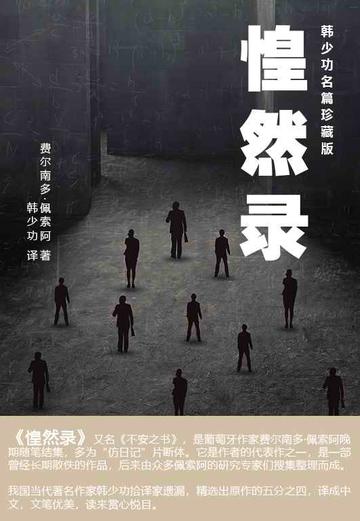


"I feel like I'm always on the eve of waking up, in the last breathless moment of confusion, struggling desperately in a shell that serves as me." As soon as I saw these words, I understood how good he was at describing people's psychology. Those elusive emotions were embodied in his writing, making them clearer and more intensified than what we can say. Pessoa is a man who lives in one room, but his soul moves in the wind. His philosophy is very complex in his writings. Sometimes the soul is above everything else, and sometimes reality is everything. I saw in him a free man—free in his own country. It is poetry and prose worth reading, but you should not indulge in it, because many times what I feel is loneliness, emptiness and nothingness, although these emotions are also particularly beautiful. ——Punch in on January 12, 2022
Excluding sleep, there are only more than 10,000 days in a person's life. The difference between people is whether you really lived for more than 10,000 days, or whether you only lived for one day but repeated it more than 10,000 times. This sentence comes from the author of this book, Portuguese writer Fernando Pessoa. "The Record of Panic" is a fragment of a "fake diary" that records some of his random notes and words. This book excerpts many of Pessoa's famous sayings, many of which are familiar to us. He who holds a rose needs no god.
Pessoa's collection of essays, unique form, and elegant writing make this book a wonder in the history of literature. From this book, I saw a genius. God gave him a delicate and sensitive heart, allowing him to write about the world from his own perspective and bring readers a different experience. At the same time, it also made him more fragile, easily injured and depressed. Such a genius struggled to write this collection of essays. This book is both his observation of life and a portrayal of his own soul. Very good!
I found the second person to accompany me on the lonely island.
The author's life is similar to that of many people, but his identity as a writer gives him the ability to describe these feelings. He can use language to express various feelings and personal reveries in life in a wonderful way. This is the difference between ordinary people and writers.
The disquiet book is the author's creation of his own confusion and uneasiness; he is searching for the meaning of life in nothingness. What is meaning? Creation is meaning, and existence itself is meaning. Since Descartes proposed that I think, therefore I am, Western philosophy has begun to raise the most profound questions about human existence itself. The question about the existence of God and the torture of soul and life have been lashing Pessoa. The Mr. V in his article is a part of everyone, longing for wealth, rights, glory and other worldly things, and at the same time being exploited in a state of ignorance. Mr. V is capital, but in fact it can also be many seemingly pure beliefs.
The essay record of a wanderer and observer... He was unknown during his lifetime, never married, and died young. In the winter when he was forty-seven years old, he was sent to the hospital due to fever and abdominal pain. There, he wrote his last words in English: "I don't know what tomorrow will bring." His life was dull and boring, just going to and from work step by step every day like tens of thousands of clerks living on the earth. However, he turned his short life into art. The night is the muse of inspiration, the light is the companion of the beauty, and the tip of the pen is the weapon of thought... In short, I would like to call him "the philosopher of art".
The book "The Record of Panic" is very special. It is like the author's diary, recording many interesting thoughts and fragments. I think the author must be a very talented and thoughtful person, and his words resonate a lot with me. Moreover, I especially like some sentences in the book, such as "Once I write this sentence, it is like an eternal prophecy to me", which is very profound. I recommend that you also read this book, you will definitely gain something different.
This book is like the author's diary, recording what he sees and feels, and a spiritual dialogue with himself. There is almost no communication between the author and others in the whole book. He has been thinking about himself, thinking about the meaning of life, death, and existence. I feel that the author is a person with a rich inner world but a lonely one. People must learn to get along with themselves and seek internally rather than externally.
My heart is slightly larger than the universe. ——Pessoa
Super good! Favorite Pessoa
The editing is very nice.
Very beautiful and thought-provoking
Where is the toolbox
Very beautiful and wonderful
Very beautiful and wonderful
Very beautiful and wonderful
Authentic and trustworthy, very good