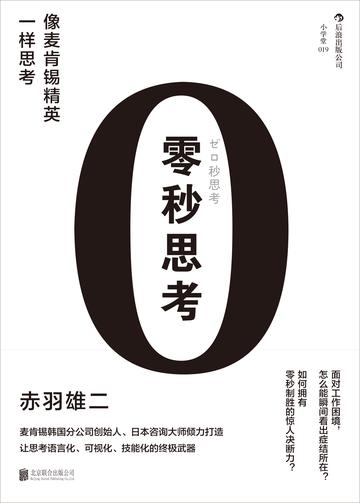
The deadline is approaching, are you still wandering in circles? You can't get to the point of your work, and you're back to square one after a lot of trouble? The words are on your lips but you can't say them out? Are you full of vague ideas but still unable to put pen to paper? Many people will face this kind of work dilemma, but they can't always find a good way to change it.
What this book teaches you is the specific method of putting your thoughts into language and practice - zero-second thinking.
During the 14 years at McKinsey & Company, the author participated in the business reform of enterprises. He knows that the combat effectiveness of employees will greatly affect the future of a company, so he attaches great importance to a person's ability to think deeply, formulate solutions, and implement them thoroughly. The zero-second thinking described in this book is what he summarized from many years of practice. To put it simply, use A4 paper to sort out the fragments of thinking, focus on one minute to perform "mental gymnastics", and start from three feasible solutions to efficiently collect target information.
I believe this book can help you say goodbye to blindness and procrastination, make thinking more effective, and solve work problems easily!
Reader comments
I read it quickly, but it was quite touching. At any stage of life, as long as you are willing to change yourself and implement the methods provided in the book, everyone will gain more or less. Zero-second thinking can not only be applied to our daily work and study, but can also be extended to the education of our next generation. It uses a simple, simple, and effective method to enable those who study it seriously to develop habits that will benefit them throughout their lives. I have decided to re-read it and immediately start implementing the methods taught in the book.
This book starts with why people cannot think deeply, and discusses the truly useful methods of training thinking ability that no one has introduced so far. This method is based on the view that how much people's innate thinking ability is hindered and what should be done to bring it into full play.
This book is more practical than theoretical. It repeatedly emphasizes how to record and use notes, and finally achieves the ultimate dream of thinking about ways of thinking - zero-second thinking. It is a rare and good book.
After introducing the importance of thinking and expression, this book refutes some misunderstandings and stereotypes about thinking, such as "longer thinking does not mean deep thinking and higher efficiency." The longer you think, the slower your thinking will be. Since quick thinking is so important, what should we do to solve the problem of slow thinking?
The author introduces and recommends the note-taking method, describing in detail what should be done before taking notes, taking notes, and after taking notes, as well as points that need to be paid attention to, such as "write whatever comes to mind" and the "1 minute" principle. He also explains and demonstrates why we should do this and what impact these points have on us. Finally, the application and processing methods of notes are introduced. We can classify notes, write planning books based on notes as the center, etc.
In general, this is a highly practical book that centers on practical methods and is supplemented by explanations of reasons and verifications. The methods in it can be tried once
The employees at McKinsey Consulting are an elite group by social standards. After the author resigned from McKinsey & Company, he sorted out and summarized his work experience in the company, as well as the work attitudes and working methods of his colleagues he observed, and finally compiled this book. The content in the book is logically clear and the language is beautiful and fluent. The author uses specific cases and practical skills to help readers think more flexibly and efficiently in complex business environments. This book is a recommended practical guide for readers who want to improve their thinking and problem-solving skills.
Zero-second thinking is summarized by the author from many years of practice. To put it simply, it is to use A4 paper to sort out the fragments of thinking, focus on one minute to perform "mental gymnastics", start from a feasible solution, and efficiently collect target information. What is zero-second thinking and what are its advantages?
What is zero second thinking? The ability to quickly recognize the current situation, sort out the problems, consider solutions, and finally decide on the action plan, grasp the essence of the problem, and solve the problem with high quality.
Develop quick thinking: Continuously convert ideas in the brain into language output.
What this book recommends is the note-taking output method. Write down the ideas in your brain on paper within a time limit and without reservation. If you stick to it, you will get results.
It's very good. I feel that it has been written to the point. Many of the problems I have encountered so far are solved one by one by reading this book and insisting on taking action. I believe it will definitely improve the reaction speed and make the brain more and more flexible.
The book's method of doing "mental gymnastics" with A4 paper is very interesting! I feel like it can help me get rid of my wandering thoughts and procrastination. I especially like the part about focusing on thinking in the book, it's very practical. However, I don't like that the author always emphasizes the McKinsey elite, which is a bit anxiety-mongering. Overall, it's still worth reading!
In our society, everything is subject to high requirements and standards. We must not only think deeply, but also think quickly. How to think efficiently, deeply and quickly is very important. The author of this book combines his many years of observation experience at McKinsey & Company to summarize the effective ways of thinking commonly used by the company, helping us to think deeply, improve our abilities, and even ultimately reach the state of "zero-second" thinking, so that we can be more outstanding in work and life.
Nowadays, various information causes the ability of deep thinking to become weaker and weaker. This book will tell us how to gradually increase deep thinking and clear logic in a simple and practical way. Very practical! ! !
Not bad, it's operable, it just depends on the individual's execution ability
Record your feelings and thoughts at any time, happiness, pain, joy and sorrow - all your thoughts, desires and feelings, etc. If you continue to keep in touch, you will definitely gain something.




I read it quickly, but it was quite touching. At any stage of life, as long as you are willing to change yourself and implement the methods provided in the book, everyone will gain more or less. Zero-second thinking can not only be applied to our daily work and study, but can also be extended to the education of our next generation. It uses a simple, simple, and effective method to enable those who study it seriously to develop habits that will benefit them throughout their lives. I have decided to re-read it and immediately start implementing the methods taught in the book.
This book starts with why people cannot think deeply, and discusses the truly useful methods of training thinking ability that no one has introduced so far. This method is based on the view that how much people's innate thinking ability is hindered and what should be done to bring it into full play. This book is more practical than theoretical. It repeatedly emphasizes how to record and use notes, and finally achieves the ultimate dream of thinking about ways of thinking - zero-second thinking. It is a rare and good book.
After introducing the importance of thinking and expression, this book refutes some misunderstandings and stereotypes about thinking, such as "longer thinking does not mean deep thinking and higher efficiency." The longer you think, the slower your thinking will be. Since quick thinking is so important, what should we do to solve the problem of slow thinking? The author introduces and recommends the note-taking method, describing in detail what should be done before taking notes, taking notes, and after taking notes, as well as points that need to be paid attention to, such as "write whatever comes to mind" and the "1 minute" principle. He also explains and demonstrates why we should do this and what impact these points have on us. Finally, the application and processing methods of notes are introduced. We can classify notes, write planning books based on notes as the center, etc. In general, this is a highly practical book that centers on practical methods and is supplemented by explanations of reasons and verifications. The methods in it can be tried once
The employees at McKinsey Consulting are an elite group by social standards. After the author resigned from McKinsey & Company, he sorted out and summarized his work experience in the company, as well as the work attitudes and working methods of his colleagues he observed, and finally compiled this book. The content in the book is logically clear and the language is beautiful and fluent. The author uses specific cases and practical skills to help readers think more flexibly and efficiently in complex business environments. This book is a recommended practical guide for readers who want to improve their thinking and problem-solving skills.
Zero-second thinking is summarized by the author from many years of practice. To put it simply, it is to use A4 paper to sort out the fragments of thinking, focus on one minute to perform "mental gymnastics", start from a feasible solution, and efficiently collect target information. What is zero-second thinking and what are its advantages? What is zero second thinking? The ability to quickly recognize the current situation, sort out the problems, consider solutions, and finally decide on the action plan, grasp the essence of the problem, and solve the problem with high quality.
Develop quick thinking: Continuously convert ideas in the brain into language output. What this book recommends is the note-taking output method. Write down the ideas in your brain on paper within a time limit and without reservation. If you stick to it, you will get results.
It's very good. I feel that it has been written to the point. Many of the problems I have encountered so far are solved one by one by reading this book and insisting on taking action. I believe it will definitely improve the reaction speed and make the brain more and more flexible.
The book's method of doing "mental gymnastics" with A4 paper is very interesting! I feel like it can help me get rid of my wandering thoughts and procrastination. I especially like the part about focusing on thinking in the book, it's very practical. However, I don't like that the author always emphasizes the McKinsey elite, which is a bit anxiety-mongering. Overall, it's still worth reading!
In our society, everything is subject to high requirements and standards. We must not only think deeply, but also think quickly. How to think efficiently, deeply and quickly is very important. The author of this book combines his many years of observation experience at McKinsey & Company to summarize the effective ways of thinking commonly used by the company, helping us to think deeply, improve our abilities, and even ultimately reach the state of "zero-second" thinking, so that we can be more outstanding in work and life.
Nowadays, various information causes the ability of deep thinking to become weaker and weaker. This book will tell us how to gradually increase deep thinking and clear logic in a simple and practical way. Very practical! ! !
Not bad, it's operable, it just depends on the individual's execution ability
Record your feelings and thoughts at any time, happiness, pain, joy and sorrow - all your thoughts, desires and feelings, etc. If you continue to keep in touch, you will definitely gain something.