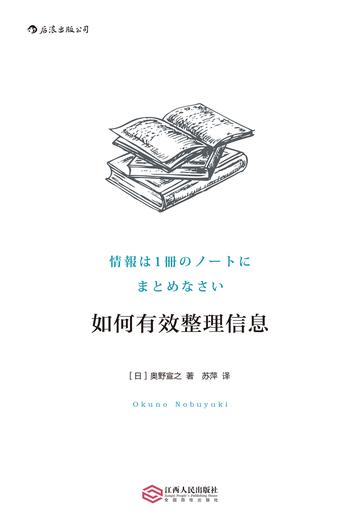
This book introduces how to use notebooks to collect and organize information in daily life. As long as you follow three simple rules - unification, sequencing and indexing, you can freely play with your notebook and brew your own ideas.
The author divides the process of taking notes into generating ideas into five steps: collection, chewing, fermentation, epiphany and concreteness, and provides a large number of practical and useful note-taking techniques for the first three steps. The author also introduces the tips for improving notebooks that he invented during long-term practice, as well as optional stationery that can make recording more effective with half the effort. Note-taking is not only a means of accumulating materials, but also represents a positive attitude of loving thinking, never forgetting to absorb knowledge, taking life seriously, and attaching importance to self-cultivation.
This book is based on the experience of media people who have been working in the media for more than ten years. It is also suitable for all readers who hope to gain something in thinking, writing and creativity.
Reader comments
A paradox is that in an information age with increased information capacity, high-speed flow, and easy access, we still cannot obtain enough and effective information to optimize our decision-making. The key to this is that our mental level has not evolved accordingly, so it is difficult for humans to find truly useful information in the ocean of information. At the same time, because we are exposed to too much information, we do not know what to believe. Collecting and organizing information has become a rare but necessary skill.
The role of notes is not to write after thinking, but to think better and innovate better after writing! Thinking while writing is the real charm of notes. I also hope that I can develop a good habit of writing notes every day to accumulate knowledge and information, and continue this habit throughout my life!
Organizing effective information is very helpful for our study, life and workplace. Whether we are making reports in the workplace or studying and reviewing for exams, concise information and effective summaries are very effective and essential. This book introduces how to use notebooks to collect and organize information. This book explains the need to follow three simple rules - unify, sequence, and index. The author divides the process of taking notes into generating ideas into five steps: collection, chewing, fermentation, epiphany and concreteness, and provides a large number of practical and useful note-taking techniques for the first three steps.
This book provides a simple and practical way to organize information, perfect for those of us who tend to be overwhelmed by information. Okuno Nobuyuki emphasizes unification, sequencing and indexing to make notes more free and efficient. He also shares lots of fun tips, like how to use notebooks to spark creativity. I particularly like a sentence in the book: "Notes are not only a means of accumulating materials, but also represent a positive attitude towards life." This book is like a caring friend, giving me a lot of practical advice.
Information in modern society bombards our brains every day. In this information age, the ability to integrate information has become very important. How to quickly find useful information among a lot of information and integrate it into the information in your own mind is a skill that each of us must learn. And this skill will bring huge benefits to your life. You will obtain information faster than others, form an information gap, and achieve final success.
"Concise information is practical." This book is moderate in length, fast in language, and relaxed in pace, making it very suitable for reading before bed. There are 6 chapters in the book, including how to use notebooks to build a knowledge production system, how to record efficiently, how to cultivate a creative life diary, the three rules of a unified note-taking method, etc. It is a very in-depth exploration of information organization. For modern people who are busy with work and have a lot of information, it is an excellent read to improve their ability to organize information.
Real knowledge comes from practice, and you still have to experiment by yourself before you can know the pros and cons or whether it is suitable. Take action if necessary.
Useful, I want to record it like this
Needless to say how great this book is.
Friends who want to read it recommend the actual book. In fact, the book in Tomato is missing some content.


A paradox is that in an information age with increased information capacity, high-speed flow, and easy access, we still cannot obtain enough and effective information to optimize our decision-making. The key to this is that our mental level has not evolved accordingly, so it is difficult for humans to find truly useful information in the ocean of information. At the same time, because we are exposed to too much information, we do not know what to believe. Collecting and organizing information has become a rare but necessary skill.
The role of notes is not to write after thinking, but to think better and innovate better after writing! Thinking while writing is the real charm of notes. I also hope that I can develop a good habit of writing notes every day to accumulate knowledge and information, and continue this habit throughout my life!
Organizing effective information is very helpful for our study, life and workplace. Whether we are making reports in the workplace or studying and reviewing for exams, concise information and effective summaries are very effective and essential. This book introduces how to use notebooks to collect and organize information. This book explains the need to follow three simple rules - unify, sequence, and index. The author divides the process of taking notes into generating ideas into five steps: collection, chewing, fermentation, epiphany and concreteness, and provides a large number of practical and useful note-taking techniques for the first three steps.
This book provides a simple and practical way to organize information, perfect for those of us who tend to be overwhelmed by information. Okuno Nobuyuki emphasizes unification, sequencing and indexing to make notes more free and efficient. He also shares lots of fun tips, like how to use notebooks to spark creativity. I particularly like a sentence in the book: "Notes are not only a means of accumulating materials, but also represent a positive attitude towards life." This book is like a caring friend, giving me a lot of practical advice.
Information in modern society bombards our brains every day. In this information age, the ability to integrate information has become very important. How to quickly find useful information among a lot of information and integrate it into the information in your own mind is a skill that each of us must learn. And this skill will bring huge benefits to your life. You will obtain information faster than others, form an information gap, and achieve final success.
"Concise information is practical." This book is moderate in length, fast in language, and relaxed in pace, making it very suitable for reading before bed. There are 6 chapters in the book, including how to use notebooks to build a knowledge production system, how to record efficiently, how to cultivate a creative life diary, the three rules of a unified note-taking method, etc. It is a very in-depth exploration of information organization. For modern people who are busy with work and have a lot of information, it is an excellent read to improve their ability to organize information.
Real knowledge comes from practice, and you still have to experiment by yourself before you can know the pros and cons or whether it is suitable. Take action if necessary.
Useful, I want to record it like this
Needless to say how great this book is. Friends who want to read it recommend the actual book. In fact, the book in Tomato is missing some content.
Very good, very useful
Okay, you can take a look