Stats
9.3Score
20Chapters
Tags
Synopsis
Reader comments
In booklists 4




Archaea, Eubacteria, Viruses, Fungi, Cancer Cells
The first two absorb light energy, viruses copy themselves by others, fungi use radiation synthesis, and cancer cells are mucus organisms. From the perspective of molecular biology, they are animals, but smaller than bacteria. They may be organisms that evolved from cancer in ancient times.
35.4MViews152Books11dUpdated





Fanfic of "I'm Not a Drama God"
I want to read a book similar to "I'm Not a Drama God". As long as it's fan fiction, I really want it.
2.4MViews72Books2dUpdated




Looking for the Kind of Novel That Has a Lot of Knowledge About Mathematics, Physics and Chemistry (Except for the Three-Body Problem)
1.3MViews216Books4dUpdated



Decipher Nature, Supernatural Powers, Myths, Universe, Stars, Etc. from a Scientific Perspective
785.3kViews223Books5dUpdated
I saw "endosymbiosis" a long time ago and I agreed with it. Later, I came across "alkaline hydrothermal vents" compared to "black smokers" in "A Brief History of Life on Earth in 4 Billion Years". Osmosis was mentioned in biology books, and I also heard about mitochondrial inheritance. I just didn't expect that these combinations would produce such a refreshing argument. It is really exciting! Mitochondria, tiny but vital existence. The first prokaryotes, bacteria and archaea, separated and developed independently. Energy is the motivation and basis for evolution, and the birth of eukaryotes. Aging and apoptosis, threshold, lifespan and fecundity, mitochondrial-nuclear gene compatibility, etc. Only by understanding it can we predict and see through some specious misunderstandings. I'm just curious, why do mature red blood cells discard their nuclei? Do they retain their mitochondria? Do heterogametes appear to be taller? For example, human males are XY and bird females are ZW, but why are they so different? Why does male and female dimorphism occur? If we say that birds are the descendants of dinosaurs, and if we work backwards, does it mean that the female dinosaurs were also taller than the males? But not all birds seem to behave this way. They also lay eggs, so why do reptiles determine their gender based on temperature? Prokaryotes live longer, approximately how long? Etc. In addition, I discovered that I had read the author's other two books before, "The Leap of Life Evolution" and "A Brief History of Life on Earth in 4 Billion Years". No wonder, haha.
Somehow, bacteria and archaea never directly developed structures as complex as those of eukaryotes. In terms of cell volume, prokaryotic cells are generally smaller than 1/15,000 of eukaryotic cells (there are some very telling exceptions, which we will talk about below). In terms of genome capacity, prokaryotes and eukaryotes are about the same size, but there is still a huge gap overall. The largest known bacterial genome has approximately 12 million base pairs. The human genome has about 3 billion base pairs, and the genomes of some eukaryotic organisms can be as large as more than 100 billion base pairs. The most amazing thing is that after 4 billion years of evolution, bacteria and archaea have barely changed at all.
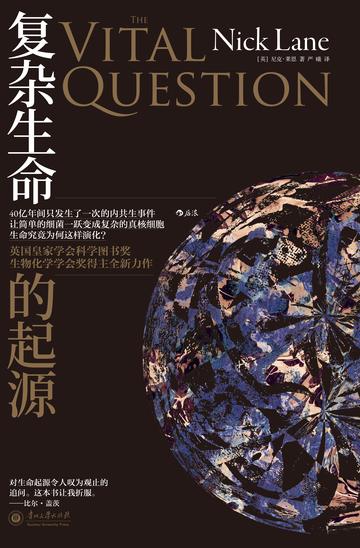
This book talks about the origin of life. All complex organisms on the earth have a common ancestor, which evolved from bacteria. However, we are not very clear about this process. If we can understand this problem, many of the problems we encounter now can also be solved. For example, why are humans attacked by viruses? Why do we exist? Are alien life forms just like us? This book explores what life is, the energy at the origin of life, and the complexity of life. The content is a bit profound, and people with some basic knowledge of biology will probably be able to read it relatively easily.
It can be said to be a superb synthesis of the new theory of life. From a novel perspective, it explains why life on earth appeared about 500 million years after the formation of the earth. However, within 2 billion years after that, life has been stagnant at the level of simple bacteria. We are worlds apart from mushrooms, yet the cells we see under a microscope are so similar. Why is life like this? A breathtaking inquiry into the origins of life. I was very shocked after reading it.
When I was a child, I was very curious, where did we humans come from? Why do we live so impartially on this blue planet? Are there any creatures like us on other planets? With this question in mind, I found this book. The origin of complex life is a complex issue that is still under scientific research. Although we do not yet fully understand how life originated, scientists have proposed a number of hypotheses and theories in an attempt to explain the origin of complex life. One widely accepted theory is that life on Earth originated in the primitive ocean environment of the early Earth. This theory is called "protozoa" or "chemical evolution." Although there is currently no conclusive evidence to prove how the origin of complex life occurred, scientists are constantly working to unravel this mystery through laboratory simulations, chemical synthesis and the study of existing life.
The origin of life has always been curious and explored by many scientists. From creationism to cell theory, human beings have been exploring life for a long time. In the 1670s, when Dutch scientist Antony Leeuwenhoek discovered microorganisms under a homemade microscope, life was redefined. The vibrant "micro-animals" under the lens made many people unbelievable at the time. This book starts from the origin of life and systematically reveals the mysteries of life.
Wow, this book really opened my eyes! It tells about the origin and evolution of life, like I am exploring a mysterious world. I especially like the endosymbiosis event mentioned in the book. It reminds me of the cells in our body. It turns out that they have such wonderful stories! This book gave me a deeper understanding of the mysteries of life and made me more curious and in awe of the world. I think everyone should read it, you will definitely gain a lot!
This life has many enlightenments for us to understand life
I don't understand it a bit, but I like it
A very beautiful and thought-provoking book.
Great, I wonder if the author of my review can see it?
This book narrates the mystery of the origin of life in detail. It explains the important results of biology so far, full of useful information, endless fun and fascinating.