Stats
5.8Score
Synopsis
No synopsis yet.
We haven’t got an English blurb for this one. It appears once the source description has been translated.
We haven’t got an English blurb for this one. It appears once the source description has been translated.
The content of this book is very good. I did it when I was in my third year of high school. It included a test question, a reading comprehension, and a relatively in-depth interpretation of what the teacher said. However, I think the teacher interpreted it from the perspective of getting more points. He did not give an in-depth interpretation of the quinoa fragment in the book. Coincidentally, I then reviewed the questions on my own and came across a fragment of the book. The fragment I came across made me do another reading comprehension test. He talks about the post-truth era in which people are misled by fragmented truths. I'm really interested in this. But high school is busy. I was able to read it when I had time after I got to college. This book combines examples such as world wars and alliances between countries and other interest relationships, etc. There are more elegant historical stories, there are also some novel stories about imitating other painters and selling them to museums, and there are also some well-known stories about the blind man and the elephant. It truly achieves the appreciation of both refined and popular tastes. Bright spring and white snow, the common union of Lower Riba people. After reading this book, people will no longer blindly believe in other people's words. Well, it's human nature to selectively say things that benefit you. ' ֊ 'Those elements and doctrines that are popular online and in reality may be just propaganda made by some wealthy people for their own purposes: emphasizing one part of the truth and hiding another part of the truth. This book is wise. And promote good things. I have only been ups and downs with learning for more than ten years, and I am short of words. Read good books and read well. It is the way for me to enrich my personality. The above is just my own reading experience. Thousands of people have thousands of opinions. A benevolent person sees kindness, and a wise person sees wisdom.
One comment stated that this book transformed a conspiracy theorist into a person who the author said in the book believes in competing truths and accepts the beautiful changes brought about by competing truths. On the contrary, this book turned me from a "rabble" to a doubter. I will no longer be impassioned for the "truth" that deliberately arouses people's emotions. I have become indifferent because I don't want to be manipulated by others to achieve some purpose I don't know. Except for the country, I am stingy with my emotions and words. I feel that more and more organizations are telling stories, expressing feelings, and using "competing truths" to attract people's emotions. I hope everyone can keep their eyes open and not become pawns in the conspiracy of others' achievements.
This book is the first book I choose to read based on my own needs. Recently, I often feel that my heart is shrouded in conspiracy theories, and it is always easy to conspiratorialize some of other people's actions, but I do not accept myself thinking in this way. What are people thinking when they do certain things? This question drove me to understand what the so-called truth actually is. The process of reading this book was a bit difficult for me. There was a lot of knowledge involved in the book that I had never understood before. I often realized after reading it that I was just reading in my mind, and then I had to read the content again, and so on. However, fortunately, the core idea of this book is very clear, so it still has important inspiration for me to some extent. There is not only one truth, it depends on how we view the world. So you might as well boldly trust, question, verify, and express. Anyway, the world is so rich and we are never afraid of being explored.
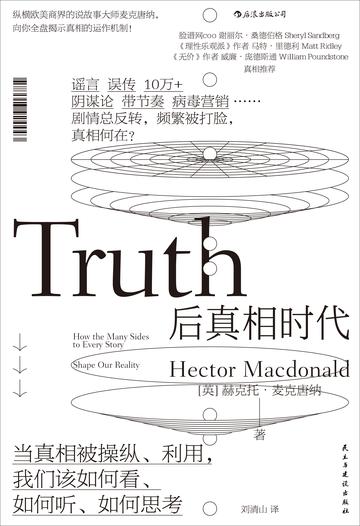
"Post-truth" refers to "a situation in which truth and logic are ignored in the process of information dissemination, and emotion incites and dominates public opinion." This book is the author's reflection on the black swan events that shocked the Western world, such as Brexit and Trump's election. Perhaps we can also add the COVID-19 epidemic that broke out in 2020, during which rumors were flying everywhere and people were constantly incited by various emotions. As the author points out, in the post-truth era, we need to improve our information literacy in order to obtain the truth in the era of information explosion.
Massive information, various social media, deliberate marketing, confused audiences... Various factors are mixed together, which are enough to complicate simple things, and "independent thinking" seems to have become a difficult skill. We know that we need to be rational, think critically, and look at the world from multiple perspectives, but how should we do this in a complex contemporary society? Hector Macdonald, a master storyteller who has provided business consulting to the world's top companies, summarizes the common tactics of misleads based on a large number of examples, telling us how to use competing truths more efficiently to prove points and unite people's hearts. He uses vivid stories to show us how the truth is dismembered, distorted and covered up by the message communicators.
This book can allow a person to have a better understanding of the truth. In the post-truth era, it is important to have the ability to judge the truth for yourself. Only by understanding the truth will you not be led away by public opinion. Although it is difficult for us to understand the whole situation, we can first question things and then make our own judgments based on existing clues, rather than making our own judgments based on the truth given by others. Things always have two sides. What others give may be the truth, but it is not necessarily the "truth." What is beneficial to your own point of view is the truth, and what is detrimental to your point of view is also the truth. The truth sent by others is often the truth they want you to see. I believe people who have debated must know this. When the evidence is too one-sided, don't jump to conclusions. If possible, it's best to ask others not to jump to conclusions. But if they still make one-sided judgments based on one-sided evidence after persuading them, then it's better to give up. "Good words can't save a damn ghost." Finally, I hope that everyone who does not know enough about the truth can read this book. I also hope that you can have a more objective judgment, not be deceived by the "truth", not be dominated by the "truth", and have a better life.
This is a book about information authenticity and public perception. The book creatively puts forward the concept of "post-truth", that is, in the process of information dissemination, truth and logic are ignored, and emotional incitement becomes the dominant public opinion. This phenomenon is widespread in politics, media, and business. In this book, Hector Macdonald shows us through vivid stories how the truth is dismembered, distorted and covered up by the messengers. Based on a large number of examples, he summarizes the common tricks of misleads and tells us how to use competing truths more efficiently to prove points and unite people's hearts.
I really like this quote: We may not instinctively believe something unknown, but if we live long enough in a group that believes it, their truth becomes our truth.
The thought is very profound, and it provides a theoretical and practical explanation of the competitive truth. It is worth reading! With the explosive development of Internet technology and self-media, the expansion of information has amplified not only the abdication of facts and truth, but also the arrival of a post-truth era dominated by emotions.
Although the viewpoint is not new, the blind man feels the elephant, sees the leopard in the tube, sits in the well and looks at the sky... Basically express the same meaning, but in practice, most people can rarely draw inferences, but this book explains it with many examples, which is impressive.
Conspiracy theories, rhythm, viral marketing... In this era of fake news and alternative facts, many times the information we receive has been dismembered, distorted and covered up by the messengers, that is, post-truth. Vocabulary. The so-called "post-truth" refers to a situation where truth and logic are ignored in the process of information dissemination, and emotional incitement dominates public opinion. In this book, the author summarizes the common tactics of misleaders based on a large number of examples, and also tells us how to use competing truths more efficiently to prove points and unite people's hearts.
As a child I thought about the truth. Children have learned how to choose words that suit them to avoid punishment, and students also know how to choose to tell someone's deeds to affect others' evaluation and impression of that person... So, what is the truth? When I read this book, I felt like I was being struck. Many of the methods mentioned in the book are familiar, and I sometimes use them myself. For example, when writing novels, I choose truths with different emphasis for people from different positions, and use "unreliable narratives" to package an unjust case. Today, many social phenomena require us to take action. Just like the stigmatization of women, just like the fight for workers' rights... If we also have the weapon to influence reality with the truth, why not use it? The future is long, let's encourage each other. I believe this is a good book that more people should read.
"Post-truth" was once selected as the word of the year by the Oxford Dictionary. The emergence of this term is closely related to the emergence of mass media. How much of the information we see is true when the information is not what we see with our own eyes? The author used rich examples to analyze how information is distorted and spread, letting me know how to identify false information. Although post-truth is hard to guard against, we must learn to identify it so that we can stay calm in the post-truth era and not follow what others say.
I found this book today. It is a very valuable book.
After reading it, I have no doubts. It is a valuable book.
The book also shows through many cases how people use the truth to mislead others, which makes me understand more that I need to be vigilant and not believe all information easily. I love how the book talks about how we can choose to use the truth in more constructive ways, which will make the world a better place.
Taught, admirable.
Worth reading again and again.
It will help me reduce the deception of the truth and teach me how to use the truth to deceive to achieve my own goals.
It's a good book, worth reading several times
Everyone is right and everyone is wrong. Get out of your comfort zone and learn from practice.
It's a masterpiece. I listened to it twice but there are still many parts I don't understand, so I continue to listen.
This book has changed many of my views on modern information and made me think more before trusting information.
It's suitable to be kept in mind for reflection at any time. There are too many competing truths in real life.
A valuable book
Worth thinking over and over again
It may be a little boring, but it has practical uses
And when you add present intention, you can shape the past into almost any form.
When facing unreasonable truths, you need to have a questioning attitude instead of blindly following them. Remember not to fall into the vortex of competing truths carefully woven by others, and maintain the spirit of seeking verification!
The language is concise and powerful, and the thoughts are consistent with Marxism. The combination of real cases increases the persuasiveness and makes the article not boring. It is a great book.