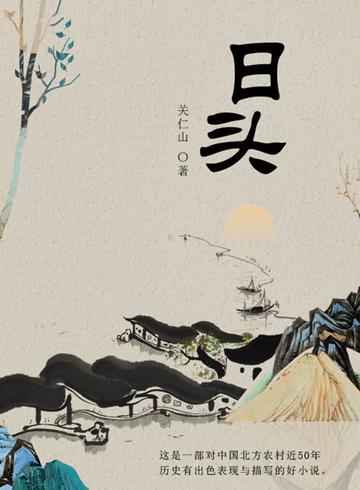
"The Sun" is the final work of Guan Renshan's "Trilogy on the Destiny of Chinese Farmers" ("The Sky is Deep", "Maihe" and "The Sun"). The novel describes the dramatic changes in Ritou Village in the Jidong Plain in the past half century. Through the intricate and entangled relationships between the Jin family, the Quan family, the Wang family, and the Du family, it vividly reproduces the colorful and shocking picture of life in the northern countryside during the period of China's social transformation. The works have a rich flavor of life, real and rich details, solid and agile brushwork, full and sharp style, deep and profound, elegant and magnificent, and have high aesthetic value.
Reader comments
Halfway through the book, I wondered why this book is so long. There are still half of the chapters that I haven't read yet, but each section feels like there is a lot written in it.
There are many characters in the story of this book, and the content of the story is also diverse. Each section is coherent and coherent, making people want to read on. It is realistic and contemporary. It is narrated section by section and closely follows historical development. It writes about how the farmers in Ritou Village went from farming and working to now living in high-rise buildings and working in the city. Seeing the big from the small, the development of the entire Ritou Village is related to the national and social development, and economic development affects the political outlook.
In the book, the stories of Lao Zhentou, Jin Muchao, Quan Guojin and his father, Huo Miaoer, and the miracle doctor who is proficient in Taoism are very strong in the following chapters, and their final endings are all unforgettable. I feel that the ending should be more different, with a different ending, and I still have more to say!
Touching and wonderful, worth watching
This book is very life-like, the plot is real and rich, and it reminds me of the people and things in my hometown. I especially like the description of Ritou Village. It feels very real, just like what happened around me. Moreover, the dialogues between the characters in the book are also very interesting. For example, the dialogue between Du Boru and Quan Sangma reminded me of the dialogue between my uncle and the village cadres, which was very resonant. This book is really good and worth reading.
Halfway through the book, I wondered why this book is so long. There are still half of the chapters that I haven't read yet, but each section feels like there is a lot written in it. There are many characters in the story of this book, and the content of the story is also diverse. Each section is coherent and coherent, making people want to read on. It is realistic and contemporary. It is narrated section by section and closely follows historical development. It writes about how the farmers in Ritou Village went from farming and working to now living in high-rise buildings and working in the city. Seeing the big from the small, the development of the entire Ritou Village is related to the national and social development, and economic development affects the political outlook. In the book, the stories of Lao Zhentou, Jin Muchao, Quan Guojin and his father, Huo Miaoer, and the miracle doctor who is proficient in Taoism are very strong in the following chapters, and their final endings are all unforgettable. I feel that the ending should be more different, with a different ending, and I still have more to say!
Touching and wonderful, worth watching
This book is very life-like, the plot is real and rich, and it reminds me of the people and things in my hometown. I especially like the description of Ritou Village. It feels very real, just like what happened around me. Moreover, the dialogues between the characters in the book are also very interesting. For example, the dialogue between Du Boru and Quan Sangma reminded me of the dialogue between my uncle and the village cadres, which was very resonant. This book is really good and worth reading.
Like this very much