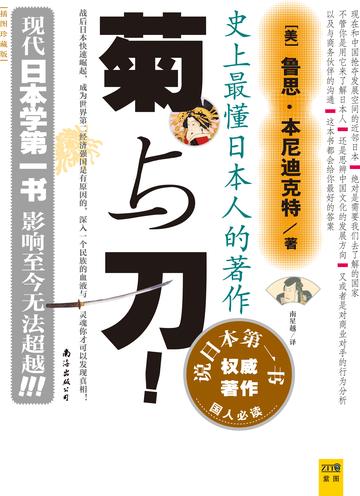
"The Chrysanthemum and the Knife" was published in 1946. It is a research report completed by American anthropologist Ruth Benedict after World War II and was commissioned by the US government. The U. S. Government at the time was eager to formulate policy regarding postwar Japanese political theory. At that time, the U. S. Government was eager to formulate policies on the governance of post-war Japan. It needed to understand two major questions: First, would the Japanese government surrender? Are the Allies going to use the same method they used to deal with Germany to attack Japan? Second, if Japan surrenders, should the United States retain Japanese government institutions and the emperor? Based on the theory of cultural types, Benedict used the method of cultural anthropology to investigate the Japanese detained in the United States during the war. He also collected a large number of literary and artistic academic works about Japan, completed the report, and concluded that: the Japanese government will surrender; the United States cannot rule Japan in a direct way; the United States needs to preserve and use Japan's original government institutions. After the war, her foresight and suggestions were confirmed and adopted.
After Benedict compiled and published the report in 1946, it received a strong response in Japan. In 1951, this book was included in Japan's "Modern Education Library" and is recognized as a classic work on Japanese studies. When naming this book, Benedict used "chrysanthemum" and "sword" to symbolize the contradictory characters of the Japanese: "chrysanthemum" is the emblem of the Japanese royal family, and "sword" is the symbol of bushido. The two embody the duality of Japanese culture - gentle and aggressive, beauty-loving and martial, polite and arrogant, fickle and stubborn. Solid, tame and arbitrary, loyal and rebellious, brave and cowardly... In the book, the author also analyzes the Japanese social hierarchy and the custom of "keeping oneself in line", explaining that the discontinuity between Japanese early childhood education and adult education is the reason for the formation of dual personalities, and summarizes this culture as "shame culture". This book has been highly praised by all walks of life, and its great influence continues to this day.
Reader comments
This book perfectly illustrates one aspect of Japanese culture. Through this book, we can almost understand some of the characteristics of Japanese culture. Everyone wants to make progress, so where does this point of progress and this down-to-earth come from? Just imitate. Nowadays, it is no longer shameful to study. Our motherland can also learn from Japan in some aspects of humanities, politics, and management. The biggest saving grace of Japan, for us people, is its excessive cleanliness. But what does neatness in our eyes mean to the Japanese? Then learn about it through this book.
Ruth Benedix is a famous female anthropologist in the United States. She once studied cultural anthropology at Columbia University. She focused on the investigation and research of primitive cultures throughout her life. "The Japanese are extremely aggressive yet docile by nature; they are militaristic yet love beauty; they are conceited yet unruly yet polite; stubborn yet cunning; docile yet unwilling to be manipulated; loyal yet rebellious; brave yet cowardly; conservative yet conservative. Eager to be trendy. "The author uses the feeling of American culture to learn and explore the behavioral habits and ideological roots of other countries. This is an extremely narrow and selfish behavior. Compared with the Japanese's own description, it is more objective and comprehensive, allowing us to see a more real Japan.
It pays equal attention to theory and knowledge, uses concrete examples to demonstrate Japan's deep national character, vividly displays a more comprehensive Japanese culture, satisfies the curiosity of readers, and looks at the differences between different ethnic groups more rationally and objectively, so as to seek common ground while reserving differences. It is very enjoyable.
The book "The Chrysanthemum and the Sword" was written at the end of World War II and shows us a different Japan. Measures that may seem harsh or even paranoid to us were seen as nothing more than loyalty to the emperor. I believe many people have heard of the Japanese saying of committing seppuku. Although the number of people who can actually commit seppuku is probably in the single digits historically, because they will endure immeasurable pain. So we should try to understand the social background behind such extreme Japanese people. I think this book can give you a good answer. This book is written by American cultural anthropologist Benedict. His explanation of the title is as follows: "Chrysanthemum" is originally the emblem of the Japanese royal family, and "sword" is the symbol of samurai culture.
American cultural anthropologist Ruth Benedict starts with her views on war, then talks about the Meiji Restoration, and then discusses Japanese customs, habits, and moral concepts. The book contains narratives and discussions, sharply pointing out that Japan's superstition of hierarchical culture led it to try to import this hierarchical concept when it invaded foreign countries. This unique Japanese ethical system is of course difficult for other countries to accept and digest. To compensate for their extreme moral code, which often puts their lives in a state of high tension, Japanese culture is surprisingly tolerant of sensual pleasures.
It took me several years to finish reading this book. This book is a research report completed by American anthropologist Ruth Benedict after World War II and was commissioned by the US government. At that time, the U. S. Government was eager to formulate policies on the governance of post-war Japan. It needed to understand two major questions: First, would the Japanese government surrender? Are the Allies going to use the same method they used to deal with Germany to attack Japan? Second, if Japan surrenders, should the United States retain Japanese government institutions and the emperor? The book's authors surveyed Japanese interns in the United States during the war to try to find answers to these questions.
The depiction of the Japanese nation is extremely detailed, the summary of Japanese culture is very accurate, and the judgment of the world situation is also relatively accurate. The flaw is that the description of Japan is a bit arrogant.
It is very objective and tells the historical facts of Japan and the true psychology and behavior of the Japanese people.
I especially like the interpretation of the "shame culture" in Japanese culture in the book, which I find very enlightening. Moreover, the author's research methods are also very rigorous, and the content in the book is of great reference value. All in all, I think this is a good book worth reading!
This is the first book to introduce Japanese people.

This book perfectly illustrates one aspect of Japanese culture. Through this book, we can almost understand some of the characteristics of Japanese culture. Everyone wants to make progress, so where does this point of progress and this down-to-earth come from? Just imitate. Nowadays, it is no longer shameful to study. Our motherland can also learn from Japan in some aspects of humanities, politics, and management. The biggest saving grace of Japan, for us people, is its excessive cleanliness. But what does neatness in our eyes mean to the Japanese? Then learn about it through this book.
Ruth Benedix is a famous female anthropologist in the United States. She once studied cultural anthropology at Columbia University. She focused on the investigation and research of primitive cultures throughout her life. "The Japanese are extremely aggressive yet docile by nature; they are militaristic yet love beauty; they are conceited yet unruly yet polite; stubborn yet cunning; docile yet unwilling to be manipulated; loyal yet rebellious; brave yet cowardly; conservative yet conservative. Eager to be trendy. "The author uses the feeling of American culture to learn and explore the behavioral habits and ideological roots of other countries. This is an extremely narrow and selfish behavior. Compared with the Japanese's own description, it is more objective and comprehensive, allowing us to see a more real Japan.
It pays equal attention to theory and knowledge, uses concrete examples to demonstrate Japan's deep national character, vividly displays a more comprehensive Japanese culture, satisfies the curiosity of readers, and looks at the differences between different ethnic groups more rationally and objectively, so as to seek common ground while reserving differences. It is very enjoyable.
The book "The Chrysanthemum and the Sword" was written at the end of World War II and shows us a different Japan. Measures that may seem harsh or even paranoid to us were seen as nothing more than loyalty to the emperor. I believe many people have heard of the Japanese saying of committing seppuku. Although the number of people who can actually commit seppuku is probably in the single digits historically, because they will endure immeasurable pain. So we should try to understand the social background behind such extreme Japanese people. I think this book can give you a good answer. This book is written by American cultural anthropologist Benedict. His explanation of the title is as follows: "Chrysanthemum" is originally the emblem of the Japanese royal family, and "sword" is the symbol of samurai culture.
American cultural anthropologist Ruth Benedict starts with her views on war, then talks about the Meiji Restoration, and then discusses Japanese customs, habits, and moral concepts. The book contains narratives and discussions, sharply pointing out that Japan's superstition of hierarchical culture led it to try to import this hierarchical concept when it invaded foreign countries. This unique Japanese ethical system is of course difficult for other countries to accept and digest. To compensate for their extreme moral code, which often puts their lives in a state of high tension, Japanese culture is surprisingly tolerant of sensual pleasures.
It took me several years to finish reading this book. This book is a research report completed by American anthropologist Ruth Benedict after World War II and was commissioned by the US government. At that time, the U. S. Government was eager to formulate policies on the governance of post-war Japan. It needed to understand two major questions: First, would the Japanese government surrender? Are the Allies going to use the same method they used to deal with Germany to attack Japan? Second, if Japan surrenders, should the United States retain Japanese government institutions and the emperor? The book's authors surveyed Japanese interns in the United States during the war to try to find answers to these questions.
The depiction of the Japanese nation is extremely detailed, the summary of Japanese culture is very accurate, and the judgment of the world situation is also relatively accurate. The flaw is that the description of Japan is a bit arrogant.
It is very objective and tells the historical facts of Japan and the true psychology and behavior of the Japanese people.
I especially like the interpretation of the "shame culture" in Japanese culture in the book, which I find very enlightening. Moreover, the author's research methods are also very rigorous, and the content in the book is of great reference value. All in all, I think this is a good book worth reading!
This is the first book to introduce Japanese people.