Stats
9.2Score
17Chapters
Tags
Synopsis
Reader comments
In booklists 2





Books for General Knowledge About Medicine, Physics, Chemistry, Literature, Etc.
I would like to read a book similar to "Knowing All Geography".
695.4kViews216Books7dUpdated





Encyclopedia of Learning Categories
Ask the boss to recommend the book. I want books about learning, major subjects, minor subjects, hobbies, etc., But I don't know what to look for.
248.1kViews437Books3dUpdated
So am I really the only one watching this?
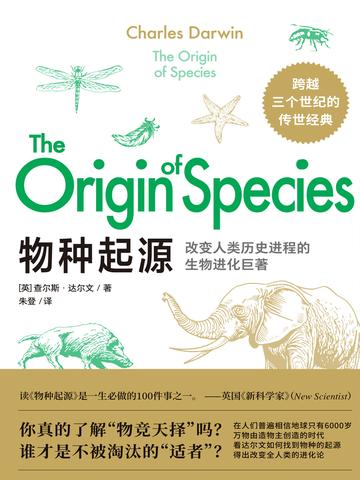
Darwin was the founder of modern Western biological science; the proposition that we are all too familiar with today, that all life has only one ancestor, was a ground-breaking assertion at the time. From the perspective of creationism, this was a humiliation to human nature. Some church priests even ridiculed Darwin himself as a monkey. However, the views expounded by Darwin in this book and the examples he cited were actually a proud response to them. Yes, nature selects the fittest and my ancestor is a monkey.
Darwin's "On the Origin of Species" is considered one of the cornerstones of modern biology. This book presents the theory of evolution, explains the origin and evolution of biological species, and proposes natural selection as the mechanism driving evolution. Darwin proposed that species originated from a common ancestor and gradually evolved into different forms and characteristics through genetic variation and adaptive selection. Natural selection as the primary driver of evolution. Depending on environmental pressure and competition for resources, differences between individuals will lead to certain characteristics that are more conducive to survival and reproduction, and thus gradually passed on in the population. This book provides a wealth of observations and evidence to support the evolutionary perspective and provides an in-depth understanding of the origin and development of life.
Darwin's masterpiece influenced the course of world history. In this book, Darwin proposed the theory of biological evolution, which subverted previous ideas and caused great changes in science starting from biology. The beginning of this book is not a straightforward presentation of his own ideas, but a literature review before "The Origin of Species". Darwin's ideas are not obtained by patting his head on his head, but are proposed on the basis of past research. There is a rich research foundation. This also reminds us that our research must be well-founded and we must sort out previous research.
Nature and life on the entire earth are operating stably following certain laws. This law is beautiful and has great inspiration for the development of human beings. At the beginning of the formation of human society, we should have paid attention to these other ways of life. Unfortunately, we have not yet achieved a deep understanding of this. There are still wars and riots, famine and poverty happening on this planet. Before humans reach a consensus, I think we will never dare to say that we are the masters of this planet!
Where do we come from and where are we going! It was originally a philosophical question, but Lao Da insisted on turning it into a scientific question. "Tao produces one, produces two, two produces three, and three produces all things." Evolution should be correct, but in the origin, I feel that there is more than one "one". "One" is composed of many points. These points can be arranged and combined, and there should be countless beginnings... Humans are humans, monkeys are monkeys (apes), humans evolved from "humans", they did not originate from apes, they just have some similar traits... Lao Da said in the book that Newton once sent him a leg of a red-footed pheasant that was injured and unable to fly. Of course, this was one of his many emails. From this point of view, Lao Da was a rag collector like me, but it was not the same level: Lao Da did it for science, and I collected those rags just to comfort the dust... Natural selection is a slow process. As the saying goes, "three feet of ice does not freeze in a day"... This also provides us with a methodology...
I'm reading it too, but now the theory of evolution is indeed being questioned. Because if humans evolved from ancient apes, then this evolution would be too fast, too incredible, and too unimaginable. After all, it only took humans tens of thousands of years to develop modern technology. However, the development of modern technology is limited to humans. Why other biological animals have not developed civilization is very questionable.
Just like the domestic animals and cultivated plants around us, they have undergone great changes through human cultivation and selection. This reminds me of some examples in life, such as the diversity of pet species, which are the result of human selection and breeding. Moreover, the book also mentioned the impact of living conditions on biological variation, which also reminded me of the impact of the environment on people. In short, this book not only gave me a deeper understanding of biological evolution, but also made me think a lot about the relationship between humans and nature. Have you read this book? I think it's worth reading!
A science book that kills philosophy