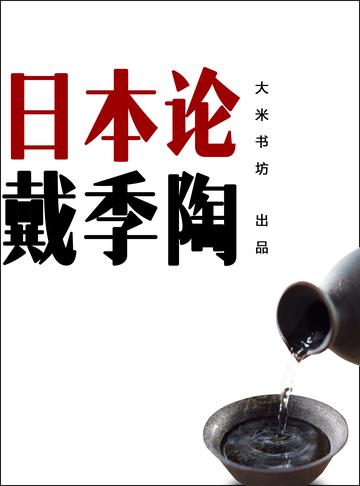
In China, almost all those who study Japan are familiar with "The Chrysanthemum and the Sword" by American scholar Ruth Benedict. However, knowledgeable people in Japan believe that among the Japanese cultural works written by foreigners, there is "On Japan" by Dai Jitao, and their understanding of Japan is more profound than "The Chrysanthemum and the Sword". Dai Jitao, like most young Chinese elites of that era, studied in Japan and then became a revolutionary. His long-term experience in Japan and his extensive and in-depth relationships with all walks of life in Japan, coupled with the unique sensitivity of China and Japan being in the same cultural circle, were beyond the reach of Benedict, who only relied on second-hand information for a few months to understand. Especially for Chinese people who need to understand Japan and modern Sino-Japanese relations, "On Japan", which covers a large number of little-known facts about modern Sino-Japanese relations, is worth reading again and again.
Dai Jitao studied in Japan for a long time, and later visited Japan with Mr. Sun Yat-sen many times, so he had a relatively comprehensive understanding of Japanese culture. His book "On Japan" was published in 1928 and was once regarded by academic circles as an important reference work for studying Japan. Even today, more than seventy years after it was written, the book is still helpful to Chinese readers in understanding Japan's national conditions, national character, and customs.
Comments on this book
1. The first book that Chinese people know about Japan.
2. It is called by Japanese people as "the best and most profound book introducing Japan so far."
3. "On Japan" has fluent writing and plain language. It has a profound and concise understanding of Japan. The text is broad and profound, without the harshness and difficulty of academic books. It has been praised by people in the industry.
4. A must-read to understand the unknown Japan.
Reader comments
I commented after reading it. It talked about the historical facts and famous figures of the Meiji Restoration, and talked about Japan's social atmosphere. Most of the space talks about the better parts of Japanese culture, but there is no kneeling gesture. After reading it, you can be inspired for your own life. But it feels unrealistic, and there is less space to explain the shortcomings. Maybe he wrote this book to awaken the Chinese people at that time.
Moreover, the Japanese of that time were very different from those of today, so it cannot be used as information for a complete understanding of Japan. I also finished reading The Chrysanthemum and the Knife, and I felt it was better than that book.
As long as the study of Japanese literary works is involved in China, this book about the Japanese will definitely be involved. The author's portrayal of the Japanese is very subtle, and the author, like most young people at that time, chose to stay in Japan. Having carried out long-term revolutionary work in Japan, the author relied on the profound and simple explanations of some things and experiences he experienced in Japan, and then relied on the unique way of thinking and keen thinking possessed by the Chinese to describe the various lifestyles of the Japanese in detail.
This is a must-read publication for anyone who studies Japanese culture in China; from Japan's social classes and feudal system to samurai life and its connection with militarism; these institutional aspects are also closely related to Japanese culture: characteristics such as poetry and music. One of the reasons why Japanese aesthetics is mysterious and charming is its affinity with death and sex. The author discusses the past and present of Japanese culture in detail in this book, which is a comprehensive view of Japan.
Among the professional books on Japan, in addition to "Chrysanthemum and Sword", there is also "Japanese Theory". In this book, the author conducts research from different disciplines and perspectives such as politics, economics, sociology, history, and cultural studies, including observation and understanding of Japan's political system, economic development, social structure, cultural traditions, and international status. Through in-depth research and analysis of Japan, people can better understand and understand Japan's development and characteristics, thereby enhancing understanding and communication about this country.
What kind of transition is Japan? This is a book that explores Japanese culture and society. The author provides an in-depth understanding of Japan through research on Japanese traditional values, history, politics, and economy. The book provides a detailed analysis of Japan's unique social structure, cultural customs and values, revealing its origins and evolution. At the same time, this book also explores the relationship between Japan and other countries, which has important implications for understanding Japan's status and influence on the international stage. For readers interested in Japanese culture and society, this book is a read full of insights and perspectives.
This "On Japan" is really good! The author Dai Jitao has a very profound understanding of Japan. As the title of the book says, it is an important book for Chinese people to understand Japan. Moreover, his writing style is smooth, his language is plain, and it is not obscure at all when reading. It reminds me of "The Chrysanthemum and the Sword", but "On Japan" has a more profound analysis of Japan, and also mentions many facts about modern Sino-Japanese relations that we don't know. I think whether you want to understand Japanese culture or study Sino-Japanese relations, you can read this book.
Living and studying in Japan, I am also a social activist and politician. I can have a deeper insight into the underlying causes of Japan. I was deeply inspired after reading it. 👍👍👍
Rather than talking about Japan, it should be called a discussion about the connection and influence of Japan and other countries on China... The author is full of joy in the Three People's Principles, advocating self-confidence, self-reliance, and self-reliance... The words are full of urgency and worry (◍••)
I commented after reading it. It talked about the historical facts and famous figures of the Meiji Restoration, and talked about Japan's social atmosphere. Most of the space talks about the better parts of Japanese culture, but there is no kneeling gesture. After reading it, you can be inspired for your own life. But it feels unrealistic, and there is less space to explain the shortcomings. Maybe he wrote this book to awaken the Chinese people at that time. Moreover, the Japanese of that time were very different from those of today, so it cannot be used as information for a complete understanding of Japan. I also finished reading The Chrysanthemum and the Knife, and I felt it was better than that book.
As long as the study of Japanese literary works is involved in China, this book about the Japanese will definitely be involved. The author's portrayal of the Japanese is very subtle, and the author, like most young people at that time, chose to stay in Japan. Having carried out long-term revolutionary work in Japan, the author relied on the profound and simple explanations of some things and experiences he experienced in Japan, and then relied on the unique way of thinking and keen thinking possessed by the Chinese to describe the various lifestyles of the Japanese in detail.
This is a must-read publication for anyone who studies Japanese culture in China; from Japan's social classes and feudal system to samurai life and its connection with militarism; these institutional aspects are also closely related to Japanese culture: characteristics such as poetry and music. One of the reasons why Japanese aesthetics is mysterious and charming is its affinity with death and sex. The author discusses the past and present of Japanese culture in detail in this book, which is a comprehensive view of Japan.
Among the professional books on Japan, in addition to "Chrysanthemum and Sword", there is also "Japanese Theory". In this book, the author conducts research from different disciplines and perspectives such as politics, economics, sociology, history, and cultural studies, including observation and understanding of Japan's political system, economic development, social structure, cultural traditions, and international status. Through in-depth research and analysis of Japan, people can better understand and understand Japan's development and characteristics, thereby enhancing understanding and communication about this country.
What kind of transition is Japan? This is a book that explores Japanese culture and society. The author provides an in-depth understanding of Japan through research on Japanese traditional values, history, politics, and economy. The book provides a detailed analysis of Japan's unique social structure, cultural customs and values, revealing its origins and evolution. At the same time, this book also explores the relationship between Japan and other countries, which has important implications for understanding Japan's status and influence on the international stage. For readers interested in Japanese culture and society, this book is a read full of insights and perspectives.
This "On Japan" is really good! The author Dai Jitao has a very profound understanding of Japan. As the title of the book says, it is an important book for Chinese people to understand Japan. Moreover, his writing style is smooth, his language is plain, and it is not obscure at all when reading. It reminds me of "The Chrysanthemum and the Sword", but "On Japan" has a more profound analysis of Japan, and also mentions many facts about modern Sino-Japanese relations that we don't know. I think whether you want to understand Japanese culture or study Sino-Japanese relations, you can read this book.
Living and studying in Japan, I am also a social activist and politician. I can have a deeper insight into the underlying causes of Japan. I was deeply inspired after reading it. 👍👍👍
Rather than talking about Japan, it should be called a discussion about the connection and influence of Japan and other countries on China... The author is full of joy in the Three People's Principles, advocating self-confidence, self-reliance, and self-reliance... The words are full of urgency and worry (◍••)
Good and insightful work