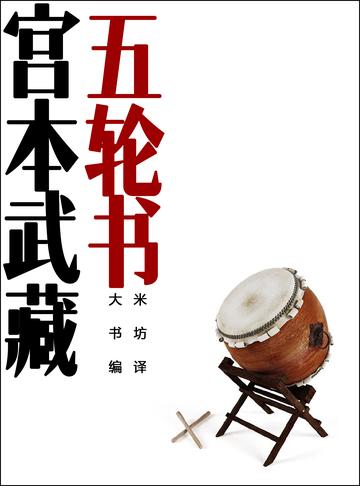
Miyamoto Musashi, known as Japan's number one swordsman, never lost in a competition in his life. "The Book of Five Rings" is the kendo master's final summary of his life's decisive battle experience. It integrates Japanese kendo, bushido, Zen and other cultural spirits. Therefore, it is not only a complete collection of military strategies, but also an encyclopedia of Japanese culture. It is the first book to explore the true origin of the Japanese spirit.
The most important role that "The Book of Five Rings" gives us is the enlightenment of swordsmanship on modern competition for survival. The theme of "Book of Five Wheels" is about how to win in competition. From the "Book of Five Rings", we can get a glimpse of the spiritual pillar of the Japanese people. Facing the cruel competition and finding ways to win is the fundamental spirit of Japanese Kendo. As Musashi said, "The true art of war is applicable to all fields." Therefore, it is also a required book recommended by Harvard Business School, West Point Military Academy, and Japanese companies, and has been listed on the bestseller lists of the New York Times, Wall Street Journal, and Business Week.
In the history of Japanese swordsmen, there is probably no one as legendary as Miyamoto Musashi. He was a swordsman, military strategist, and artist from the late Warring States Period to the early Edo Period in Japan. When he was young, he learned the art of war with his father Shinmonmuji. From the age of 13, he started competing with Shinto-ryu Arima Ki in martial arts until he was 28 years old. During this period, he competed with other schools more than 60 times, and it is said that he never lost once. When Musashi was twenty-nine years old, he dueled with Sasaki Kojiro, a world-famous swordsman at the time, on Ganliu Island. He killed Kojiro with a homemade four-foot-two-inch wooden sword and became famous in the first battle. When he was more than 20 years old, Musashi established his own school with "Yuanming first-class". And in the 10th year of Qingchang (1605), he wrote the swordsmanship book "Mirror of the Art of War". But he was always dissatisfied with his swordsmanship and thought it had not reached the extreme level. After the age of 30, Musashi continued his training, and finally mastered the swordsmanship of using two large and small swords (i. E. One and two swords) when he was about 50 years old, which is also known as the "two-day first class".
Reader comments
Throughout the book, Miyamoto Musashi explains his martial arts and his tactics of war - the shots must be ruthless, the pace must be steady, the mind must be calm, the observation must be sharp, and the vision must be broad. The specific sword technique is just a subordinate part of his thoughts. As he said, he looks at things from a higher perspective.
I am honored to see this kind of military strategy that has reached a philosophical level in my lifetime. It can definitely be used next time!
It was written very concretely and was very practical for that era.
Miyamoto Musashi, one of the best in the world, unparalleled [Cool][Cool][Cool]
It makes sense and is inspiring.
Look at this book from the perspective of Miyamoto Musashi, who has been dueling with people since he was a child and never lost. But he didn't know why, so he kept looking for others to compete with, and as he got older and older, he began to think about why he won. Therefore, he emphasizes mentality, change, awareness, and how to apply to various situations, etc.
Through the description in this book, he probably has the following advantages:
1. He has very fine control over his body. He can realize how to use his toes to move. He can use two fingers to chop people with a knife.
2. He can keenly grasp the opponent's psychology and exploit him.
3. He has nothing else in mind but victory.
4. He can clearly see the environment without moving his eyes and make good use of it.
5. He is very skilled in various schools of martial arts and knows how to deal with them.
Etc.
If we want to make an analogy, it's like Enichi Tsukuni in "Demon Slayer: Kimetsu no Yaiba". He was born with a clear understanding of the world, and every move of others was clearly visible to him, so no one was his opponent. Only later did he realize that the world he saw was different from others, so he had this book.
I hope that friends who have read this book can use their own unique "tactics of war" to win every day's competition!
I feel that the "two-day first-class" art of war is not only applicable to swordsmanship, but also has great enlightenment on our lives. Just like a friend of mine, he encountered a lot of competition at work, but he was never afraid, always worked hard to learn and improve himself, and finally succeeded. This book reminded me of him and made me understand the key to winning in competition. Moreover, the book also incorporates Japanese cultural spirit, which is very interesting to read.
Is there a paper version of this translation? A certain treasure cannot be found! Where to buy
There is a mentality as steady as the earth, adaptable to changes like flowing water, high-spirited fighting like fire, unconventional like wind, and finally reach the realm of emptiness. Not only swordsmanship and art of war, but also inspiration for learning various skills
Very useful, very reasonable, worthy of being a sword master.
Well, there are also many one-sided ideas, but I think for the purpose of this book, he is very good
Reminds me of Japanese samurai
The integration of practice and philosophy
Great, needless to say
Miyamoto Musashi understood Buddhism
In some theories, it is similar to Bruce Lee. It is recommended to compare it with Bruce Lee's martial arts [eating melon]
The insights of a person who seriously thinks about practice,
Useful and inspiring
It is worth studying carefully, it is simple and clear, and it is not an introductory book.
It's very inspiring and has great guiding significance for some of my current problems.
The man and the sword are united, and the body and mind are at peace.
Benefits of Japan for people
It's about swords, knives
In fact, we can draw inferences from one instance and learn everything from one instance to another.
The most important thing is to be simple, strive for excellence, there is no trick to win, there is always a trick to adapt to the ever-changing situation.
No less than Sun Tzu's Art of War, it can be said to further present the essence of Sun Tzu's Art of War, in which the spirit of fighting for the first step and perseverance is displayed to the fullest.
Throughout the book, Miyamoto Musashi explains his martial arts and his tactics of war - the shots must be ruthless, the pace must be steady, the mind must be calm, the observation must be sharp, and the vision must be broad. The specific sword technique is just a subordinate part of his thoughts. As he said, he looks at things from a higher perspective. I am honored to see this kind of military strategy that has reached a philosophical level in my lifetime. It can definitely be used next time!
It was written very concretely and was very practical for that era.
Miyamoto Musashi, one of the best in the world, unparalleled [Cool][Cool][Cool]
It makes sense and is inspiring.
Look at this book from the perspective of Miyamoto Musashi, who has been dueling with people since he was a child and never lost. But he didn't know why, so he kept looking for others to compete with, and as he got older and older, he began to think about why he won. Therefore, he emphasizes mentality, change, awareness, and how to apply to various situations, etc. Through the description in this book, he probably has the following advantages: 1. He has very fine control over his body. He can realize how to use his toes to move. He can use two fingers to chop people with a knife. 2. He can keenly grasp the opponent's psychology and exploit him. 3. He has nothing else in mind but victory. 4. He can clearly see the environment without moving his eyes and make good use of it. 5. He is very skilled in various schools of martial arts and knows how to deal with them. Etc. If we want to make an analogy, it's like Enichi Tsukuni in "Demon Slayer: Kimetsu no Yaiba". He was born with a clear understanding of the world, and every move of others was clearly visible to him, so no one was his opponent. Only later did he realize that the world he saw was different from others, so he had this book.
I hope that friends who have read this book can use their own unique "tactics of war" to win every day's competition!
I feel that the "two-day first-class" art of war is not only applicable to swordsmanship, but also has great enlightenment on our lives. Just like a friend of mine, he encountered a lot of competition at work, but he was never afraid, always worked hard to learn and improve himself, and finally succeeded. This book reminded me of him and made me understand the key to winning in competition. Moreover, the book also incorporates Japanese cultural spirit, which is very interesting to read.
Is there a paper version of this translation? A certain treasure cannot be found! Where to buy
There is a mentality as steady as the earth, adaptable to changes like flowing water, high-spirited fighting like fire, unconventional like wind, and finally reach the realm of emptiness. Not only swordsmanship and art of war, but also inspiration for learning various skills
Very useful, very reasonable, worthy of being a sword master.
Well, there are also many one-sided ideas, but I think for the purpose of this book, he is very good
Reminds me of Japanese samurai
The integration of practice and philosophy
Great, needless to say
Miyamoto Musashi understood Buddhism
In some theories, it is similar to Bruce Lee. It is recommended to compare it with Bruce Lee's martial arts [eating melon]
The insights of a person who seriously thinks about practice,
Useful and inspiring
It is worth studying carefully, it is simple and clear, and it is not an introductory book.
It's very inspiring and has great guiding significance for some of my current problems.
The man and the sword are united, and the body and mind are at peace.
Benefits of Japan for people
It's about swords, knives In fact, we can draw inferences from one instance and learn everything from one instance to another.
The most important thing is to be simple, strive for excellence, there is no trick to win, there is always a trick to adapt to the ever-changing situation.
No less than Sun Tzu's Art of War, it can be said to further present the essence of Sun Tzu's Art of War, in which the spirit of fighting for the first step and perseverance is displayed to the fullest.