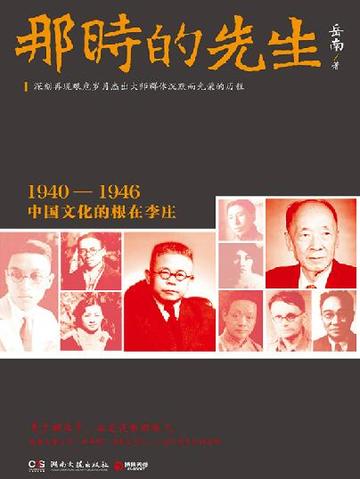
The Marco Polo Bridge Incident broke out on July 7, 1937, and a large number of scholars, teachers and students from academic education institutions were forced to migrate to Changsha, Chongqing, Kunming and other regions. In 1940, due to the intensification of the war, teachers and students of Tongji University moved to Lizhuang, an ancient town in southern Sichuan. Subsequently, institutions such as the Academia Sinica, the Preparatory Office of the Central Museum, the Institute of Liberal Arts of Peking University, and the Chinese Architecture Society came one after another. For a time, many first-class scholars and a large number of precious cultural relics and ancient books gathered in Lizhuang - a place that Fu Sinian called "a place that cannot be found on the map."
The work uses documentary techniques, deep emotions, and smooth writing to panoramically reproduce the arduous life and academic journey of the scholars in Lizhuang, highlighting the domineering scholar leader Fu Sinian, the upright archaeological master Li Ji, and the painstaking construction work. The distinctive personalities of the architectural master Liang Sicheng, the stoic poet Lin Huiyin, the aloof talented woman You Shou, the academically persistent Dong Zuobin and Liang Siyong, as well as their spirit of helping each other in the face of poverty, disease, banditry and even death threats, the poor and the strong spirit. During the six most difficult years in China, they stayed true to their motherland, burning ashes and keeping the sundial, spreading their legacy widely. They won world-wide honors in the field of humanities and continued to develop the lifeline of Chinese culture.
The work also focuses on a detailed exploration of the truth of historical events such as the "Institute Cannibalism Incident", the conflict between Fu and Li, the dispute between the Tongji president and professors, and the robbery of national treasures. It also conducts a profound analysis of the personnel disputes and the systems of the institute and the university. At the same time, it also describes the legendary history, customs and customs of Lizhuang Town, as well as the different life destinies of local bureaucrats and gentry before and after the Anti-Japanese War. It also discloses in detail the characters and events that have been covered up for many years. It makes people feel nostalgic and sigh when reading.
Reader comments
This book truly reproduces the hard life and academic spirit of scholars during that special period, which touched me very much. Just like what is said in the book, "A nation declines and mountains and rivers are broken." In such a difficult environment, they can still persist in research. This spirit is really worth learning. I was reminded of a friend of mine who was also working hard in difficult circumstances to pursue his dreams. This book made me admire him more and appreciate my current life more.

This book truly reproduces the hard life and academic spirit of scholars during that special period, which touched me very much. Just like what is said in the book, "A nation declines and mountains and rivers are broken." In such a difficult environment, they can still persist in research. This spirit is really worth learning. I was reminded of a friend of mine who was also working hard in difficult circumstances to pursue his dreams. This book made me admire him more and appreciate my current life more.
Yes, my knowledge has improved.