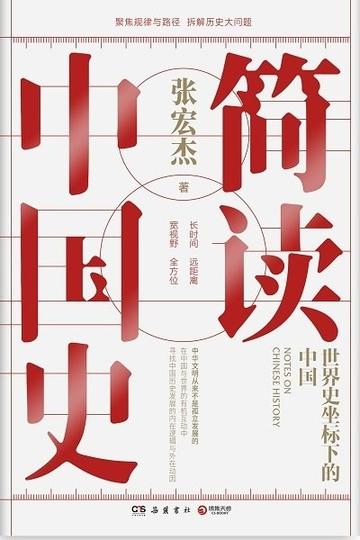
A Brief Reading of Chinese History: China in the Context of World History
简读中国史:世界史坐标下的中国
- Status
- Completed
- Source
- Fanqie
Stats
9.5Score
64Chapters
Tags
Synopsis
Reader comments
In booklists 6
Books That Students Should Read, In-Volume Essentials
Mathematics, Chinese, English, chemistry, physics, biology, geography, history, ancient poetry...
128.3MViews931Books17hUpdated

Nobel Prize for Literature, Mao Dun Literature Prize, Lu Xun Literature Prize and Other Literary Works
I want to read a book similar to "One Sentence is Worth Ten Thousand Sentences: Collector's Edition".
122.5MViews725Books2dUpdated
Now I Am so Broken That I Read the "Marrow Cleansing Sutra"...
Are there any particularly boring novels? Please, the child really can't sleep😫
25.2MViews212Books1dUpdated

A Book for Late-Night Study
15.1MViews1kBooks1dUpdated
Must-Have Books for Kings of Scrolls
2.6MViews1.2kBooks3dUpdated
A Must-Have Book for In-Volume Studies on Any Subject
Looking for books that can help me learn knowledge. When school starts, I want to trick my classmates to death.
46.8kViews150Books16dUpdated
Don't hesitate to praise! A very thought-provoking book. It is not as boring as chronicle writing, but like an argumentative essay, first put forward the theme, and then find evidence to prove it. Looking at history from a God's perspective, there is a sense of a broad pattern.
Teacher Zhang, this book is so wonderful. I have been studying and understanding some Chinese history, that is, the history of our country, but I have never understood much about world history. I only have a brief understanding of world history. After I read this book, I always applauded it. It was a very enlightening and enlightening moment. It allowed us to understand ourselves and the Western world more correctly. This book is so wonderful. Every time I read it, I sometimes frowned and sometimes burst into laughter. I feel that I have gained too much.
As someone who has read history books since I was 6 years old, this book resonated with me a lot. There are many historical laws that I have felt before when I read General History, but as soon as the author explained them, the vague feeling suddenly became clear.
The Chinese nation has a long tradition of five thousand years and is a model of agricultural civilization. How can it be so easy to understand? This brief history of China is an introductory book. It adopts a bird's-eye view of the narrative and tries to answer the changes in China from enfeoffment to feudalism and then to the evolution of modern systems: literary and military strategies, Wang Cheng and generals. People who are interested in China's traditional political system can pick up this book; internal and external troubles, fighting against foreign aggression and internal peace, and those who are interested in China's diplomacy and wars can also read this book. In short, as a popular historical science book, this book is still very successful.
History is an ancient and important science. As the only country among the four ancient civilizations whose civilization has never been interrupted, being familiar with its own history is of extraordinary significance to Chinese people. Compared with ordinary Chinese history books, this book is different in that the author understands Chinese history from the perspective of world history, rather than treating it as a blind spot of civilization that developed in isolation. In this way, a connection can be established between China and world civilizations in different periods that can be compared and referenced, allowing us to have a continuous understanding of China's position in the world and international relations.
This book is about the history of China. But civilization never develops in isolation. From the moment it arises, it is influenced by factors from other civilizations in the world. This book puts Chinese history into the context of world history, clarifies the development of Chinese history, and helps readers establish an overall concept of Chinese history in a short period of time. The author has a strong understanding of Chinese history, and describes each historical turning point very smoothly. At the same time, he uses a "long-term, long-distance, and wide-field" interpretation method to comprehensively present the internal logic and external motivations behind the cycle of chaos in Chinese history.
History is an ancient and important science. As the only country among the four ancient civilizations whose civilization has never been interrupted, being familiar with its own history is of extraordinary significance to Chinese people. Compared with ordinary Chinese history books, this book is different in that the author understands Chinese history from the perspective of world history, rather than treating it as a blind spot of civilization that developed in isolation. In this way, a connection can be established between China and world civilizations in different periods that can be compared and referenced, allowing us to have a continuous understanding of China's position in the world and international relations.
"If you don't read Chinese history, you don't know the greatness of China; if you don't read world history, you don't know the characteristics of China." In other words, only by stepping out of a specific perspective can you discover the true face of China in history. This book is a general history book that analyzes the general context of Chinese history from the perspective of the world. A history book with a broad context. The author uses global thinking and looks at China from the world's perspective from a macro perspective. He also looks at the world from China's perspective. He compares China to an individual and the world to a group. How an individual's development appears in a group and how it affects the group, and how the group in turn affects the individual are all shown in this book.
I feel that this book focuses a bit on the comparison between modern Western democratically elected and parliamentary systems and China's autocratic system. It focuses more on the impact of geography on nations and countries, while ignoring the impact of the evolution of Chinese and Western cultures on a nation and even a country. For example, the Western Renaissance and the Chinese Hundred Schools of Thought are the background of these two societies. However, based on the author's in-depth research on Chinese and Western history and his interpretation from a relatively novel perspective, it is still a rare and good book for every reader who wants to have a deeper understanding of Chinese and Western history.
I learned a few things I didn't understand: Huang Yanpei's Law, Hu Huanyong Line, Leviathan... This book showed many aspects that were unexpected and ignored by me. For example, the achievements of Emperor Wu of the Han Dynasty were based on the number of people lost; for example, the turmoil in the West and China in certain periods actually promoted population growth; for example, China's invasion by the West also brought some positive aspects. The biggest feeling is that only when you are strong can you have dignity, and the broad masses are the real history. Reading history is to understand the ups and downs, summarize the past, and improve the present.
Very unique perspective. Many people may feel uncomfortable or disagree with it after reading it, but I think no matter what, it is still a perspective on history that is worth learning from. In general, the views of this book are very sharp, but it can only be compared with the current environment. Of course, this part can only be made up by your own mind.
This book is about the history of China. But civilization never develops in isolation. From the moment it arises, it is influenced by factors from other civilizations in the world. This book puts Chinese history into the context of world history, clarifies the development of Chinese history, and helps readers establish an overall concept of Chinese history in a short period of time. The author has a strong understanding of Chinese history, and describes each historical turning point very smoothly. At the same time, he uses a "long-term, long-distance, and wide-field" interpretation method to comprehensively present the internal logic and external motivations behind the cycle of chaos in Chinese history.
This book is suitable for people with a certain historical foundation. I have always believed that one should read historical facts first and then historical theory, because reading the former will naturally lead to thinking about history, and this kind of thinking is precious in reading historical theory. For example, reading historical facts is equivalent to backward countries in modern times developing their own industries (assuming they can). Not only can they satisfy the domestic market and promote their own development, they can also resist foreign invasions and accelerate their own modernization process. The benefits are obvious. If you want to read world history, my suggestion is "A General History of the World" by Stavrianos
This book is very interesting. It puts Chinese history in a world context and gave me a clearer understanding of Chinese history. I particularly like Teacher Zhang Hongjie's explanation method, which is easy to understand and interesting. Moreover, the uniqueness of Chinese civilization mentioned in the book also resonated with me. Thinking of the traditional culture around me deepened my understanding of Chinese history. Recommended to friends who are interested in history!
Great, refreshing. I used to think that the cyclical collapse theory is a land and population problem. I also thought about the problem of walking very fast on one leg and being prone to self-destruction. I didn't combine the two. After reading it, I have a feeling that the golden mean is the universal truth for long-term development. I stick to both ends and use it. Walking on one leg and relying on self-restraint cannot fundamentally solve the problem. If you go right, you will die quickly if you go wrong.
It is relatively objective, but the data is not very convincing, but I feel that I have benefited a lot after reading it. In the face of the contemporary phenomenon of class fixed telephone, it introduces us to another kind of thinking that goes deep into everyone's heart from the perspective of history and system formation.
Through the comparison of the systems established by Eastern and Western countries, it clearly explains the reasons for the formation of different cultures between the East and the West, and explains the historical phenomena that occurred under various systems. The structure is tight and the veins are clear.
This book is clearly organized and has well-founded theory. It compares Chinese and Western historical, cultural and geographical factors to more clearly present the historical and cultural differences. It is said that comparison is harmful, and makes the cultural and historical system more three-dimensional.
A very good book with many novel viewpoints and sharp angles. The arguments are very sufficient, reasonable, well-founded and convincing. Only by looking at China in the world can we see China more clearly.
The content of this book is not like a brief reading of Chinese history, but more like a summary after a brief reading of Chinese history. What's more, after reading this book, I have the impression that it criticizes the shortcomings of the East and praises the advantages of the West. As for the shortcomings of the West and the advantages of the East, there is not much mention. Why is it written like this? Who knows?
The author uses comparisons of political and economic aspects of different national systems in the same period to inspire our thinking. After reading it, I covered it up and meditated, and benefited a lot. I recommend this book to my children and anyone who will listen to me.
This is a small book that tries to understand the historical context, but it still has a lot of preset conclusions. Because human society is too complex, and the complexity of human interaction far exceeds three entities (billions of entities), it is difficult to avoid bias when trying to use existing abstract and inductive methods to summarize historical laws. There are hundreds of research books on the issue of the Industrial Revolution alone, and there is no conclusion yet. The author is generally neutral and objective, at least trying in this direction.
This book sorts out the development of the Chinese nation from a broader perspective and from a higher perspective, which is eye-opening and refreshing. The text is easy to understand and the organization is clear and clear. It is suitable for the public to read and will benefit a lot.
The viewpoints are novel and the perspective is unique. Many views break through the shackles of tradition and are deeply inspiring.
It is particularly good. This book provides a very in-depth perspective on understanding Chinese history. The histories I read before were all simple chronicles based on time and events. This book is a study of Chinese history. It is very exciting and shows a very different history. It is thought-provoking.
The book's viewpoints are novel and proven by many examples, making it highly readable.
The concept is interesting and the point of view is unique. It is a book that I like to read.
A brief history, written in a natural and smooth way, and more enjoyable to read. The light thoughts and historical views are also easy to accept. It's very good. It's really good.
If what is said above is true, then it will increase your knowledge.
This book lays out a clear line of national prosperity.