Stats
5.8Score
Synopsis
No synopsis yet.
We haven’t got an English blurb for this one. It appears once the source description has been translated.
We haven’t got an English blurb for this one. It appears once the source description has been translated.

Through this book, I realized that my biggest problem is that I pay too much attention to input and ignore output. As a result, I have learned a lot of knowledge, but when I talk about it, my mind is blank. I feel like I should be full of ink, but when it comes to outputting knowledge, I find that it is just a fool. I hope that other readers who read this book can also use this book to find their own shortcomings, correct their shortcomings, and become a better version of themselves.
I hope that with more than a hundred days left, I can use these methods to learn, to achieve my goals, and to have no regrets.
The content of the whole book is not very long, but it is very informative. I listened to it three times at the beginning and slowly began to appreciate it. I couldn't read it at first, but then I became interested in it and started to prepare to take a look. The overall logic is very smooth. It is a closed-loop management from the beginning to the end. Start learning. Learning itself is not the problem, the problem is the wrong method, so I highly recommend this book. School is about to start, so let's start implementing the plan.
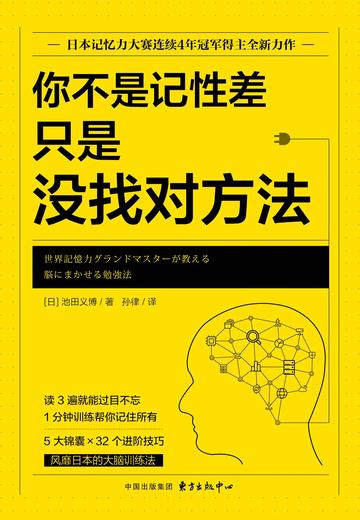
After reading the entire book, I feel that the content is very informative and very helpful to us. However, we still need to practice the methods taught in the book and then slowly master them. This book mainly talks about the memory training experience of the author Yoshihiro Ikeda, and provides 5 tips and 32 advanced techniques for improving memory. With a large number of cases, it can help us improve memory in daily life. It is highly recommended that everyone study together. I always thought that my memory was poor, but it turned out that I didn't find the right method.
This book is really a treasure, perfect for people with poor memory like me! This book talks about many ways to improve memory, such as "developing brain power through visual deception", making the brain jealous, making the brain lonely, and making the brain emotional. There is also the "homophonic method", which can use numbers and foreign language homophonics to memorize; or the "three circles repeated shorthand method" and other methods. It is recommended that students read this book. Reciting and memorizing articles will no longer be a problem. They no longer need to memorize by rote and always forget like before.
There are too many places in life that require memorization and recitation. Whether it is preparing for exams or studying, good memory can make things twice the result with half the effort. This book made me understand that memory is not only input, but also requires output. Memory must be turned into procedural knowledge and mobilized in time when needed. Therefore, when memorizing, you need to concentrate, mobilize your brain, and consolidate repeatedly. After reading this book, I started to use it immediately when memorizing English words. As expected, I got twice the result with half the effort. I obviously felt that the method was correct. My memory was much better than before, and I felt that I had become smarter.
To answer the previous question, whether it is useful or not is second. I think the first thing is to sort out some principles so that we can better understand the brain and learn better. This makes me clearer and more motivated, instead of blindly believing in IQ and age.
It coincides with the college entrance examination month, and many people who are looking forward to next year's college entrance examination have begun a new round of preparations. Friends who study liberal arts have begun to have headaches again. How can we improve the efficiency of memory? This book gives a solution. Everyone has different memory methods and preferences. Some people may be more comfortable with visual memory, while others are better at auditory memory. Therefore, when we feel that our memory is not good enough, we can try different learning methods, such as making mind maps, using memory cards, explaining to others, etc., To find the memory skills that suit us.
In an extremely short chapter, we are introduced to many methods of concentration. The surrounding information signals are complicated, how to remove the rough and select the essential, and remove the false and retain the true. It is not only the talent of our brain, but more acquired training will make it stronger. In this book, the author introduces several ways to "cheat" the brain so that we can focus more on memory work; however, no matter how many methods we master, if we don't practice diligently, our memory may not get better. Methods such as graffiti and 30-minute speed reading can improve our memory.
I hope the child's memory will improve and he will learn some methods
In real life, when faced with a large amount of information, we often lose track of everything, and even attribute it to our poor memory. However, the author tells us in this book that this is not actually a poor memory, but that we have not found a suitable memory method for ourselves. In this book, the author organizes and demonstrates in detail the techniques and their practice and application for improving memory ability. He mainly teaches readers memory methods through methods such as "cheating the brain and making the brain jealous", increasing "repetitions", and injecting "emotion".
I especially like what he said, "Memory is not about talent, but about skills." It gave me confidence to improve my memory. The examples in the book are also very vivid, such as the 3 circle memory method, which makes it easy to remember. I think this book is not only suitable for students, but also for us housewives. After learning these methods, we can remember various things in life more easily!
After reading it, I found it very useful, but I still need to apply it in real life to see if it works for me. Of course, this book is also very well written👌🏻
It's really good, give it a five-star rating! Three steps: first, concentrate, second, mobilize the brain, and third, repeat and consolidate
I think it's a good book, but it says in the book that in order to ensure learning speed, you should look at the answers immediately when you see a math problem, which I feel is a bit unacceptable.
After reading it, I still gained something.
I feel that the method inside is quite good and practical!
The biggest feeling is that cold digital words are transformed into images and experiences; the memory palace assists memory.