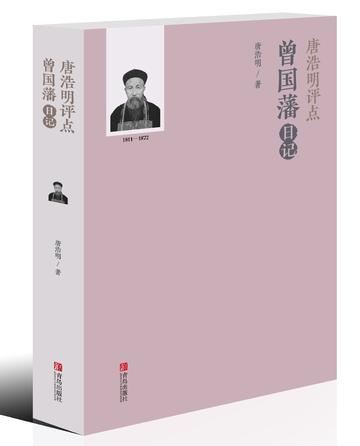
The author selected more than 300 entries from a large number of diaries passed down by Zeng Guofan, divided into eight categories: "cultivation", "enlightenment", "reading", "state affairs", "family affairs", "writing", "appreciation" and "dreams". Each category begins with a general comment and comments on the selected diaries one by one. Its greatest feature is its short length and relaxed writing style. It explores Zeng's inner world from the outside to the inside and expresses the author's understanding of history. Through each living concrete example, readers can appreciate Zeng Guofan's life wisdom and political wisdom, and at the same time feel the ups and downs of politics in the late Qing Dynasty. It can not only make people intellectually enlightened and understand things clearly, but also make people cultivate their moral character with pleasure. It is a rare work that combines literature, history and philosophy in one furnace.
Reader comments
Mr. Zeng Guofan has made certain contributions to China's progress. During the Qing Dynasty, he initiated the construction of China's first ship, established the first military engineering school, and arranged for the first batch of Chinese students to study in the United States. Writer Tang Minghao selected 300 articles from Zeng Guofan's diary, divided them into eight parts: self-cultivation, enlightenment, reading, state affairs, family affairs, writing, appreciation, and dreams, and commented on them one by one. Let us have a deeper understanding of Master Zeng Guofan's concern for the country and the people. This book is short in length and has excellent writing style. It allows readers to experience the unpredictable changes in the Qing Dynasty and also allows readers to appreciate Mr. Zeng Guofan's life wisdom and political wisdom. It is worth reading.
Mr. Tang Haoming got connected with history and based on historical facts, he vividly and objectively described Zeng Guofan's magnificent and ups and downs life. With more than a million words, it is vast and full of wit and humor. It is one of the rare biographies of outstanding figures that I have ever read. Among them, the various poetry and prose works left by Zeng Guofan and his staff are even more memorable. A boy from a farm family in Heyetang, Xiangxiang, Hengyang, relied entirely on his own ability and knowledge to become a prince. This really provided a good example for us poor scholars born in farm families.
The author Tang Haoming conducted an in-depth interpretation and analysis of Zeng Guofan's diary, and explored Zeng Guofan's thoughts, political views, cultural feelings and other aspects. The comments in the book are of high academic value and can help readers gain a deeper understanding of Zeng Guofan's thoughts and historical status, thereby gaining a deeper understanding of modern Chinese history. The book also touches on some profound historical and philosophical issues to enhance readers' knowledge and thinking level.
Zeng is a person who values "Tao" very much. What is "Tao"? This is a concept that is difficult to explain clearly, so Lao Tzu said: "Tao is a thing, but it is in a trance." However, the ancient Chinese liked to use this word most in the context of it. Generally speaking, "Tao" mainly refers to two aspects, one refers to laws and regulations, and the other refers to methods and approaches. Through the things and phenomena we experience and see, we can understand the rules and laws contained in them, or explore the methods and approaches revealed in them. This is a high-end thinking of human beings.
The book also talks about how he cultivated himself, which is very inspiring to us. I have a relative who has also been determined to be talented since he was a child, studied hard, and finally succeeded. We should all learn from him, constantly improve ourselves, and pursue a better life. This book made me understand that self-cultivation is the basis for success.
Mr. Zeng Guofan has made certain contributions to China's progress. During the Qing Dynasty, he initiated the construction of China's first ship, established the first military engineering school, and arranged for the first batch of Chinese students to study in the United States. Writer Tang Minghao selected 300 articles from Zeng Guofan's diary, divided them into eight parts: self-cultivation, enlightenment, reading, state affairs, family affairs, writing, appreciation, and dreams, and commented on them one by one. Let us have a deeper understanding of Master Zeng Guofan's concern for the country and the people. This book is short in length and has excellent writing style. It allows readers to experience the unpredictable changes in the Qing Dynasty and also allows readers to appreciate Mr. Zeng Guofan's life wisdom and political wisdom. It is worth reading.
Mr. Tang Haoming got connected with history and based on historical facts, he vividly and objectively described Zeng Guofan's magnificent and ups and downs life. With more than a million words, it is vast and full of wit and humor. It is one of the rare biographies of outstanding figures that I have ever read. Among them, the various poetry and prose works left by Zeng Guofan and his staff are even more memorable. A boy from a farm family in Heyetang, Xiangxiang, Hengyang, relied entirely on his own ability and knowledge to become a prince. This really provided a good example for us poor scholars born in farm families.
The author Tang Haoming conducted an in-depth interpretation and analysis of Zeng Guofan's diary, and explored Zeng Guofan's thoughts, political views, cultural feelings and other aspects. The comments in the book are of high academic value and can help readers gain a deeper understanding of Zeng Guofan's thoughts and historical status, thereby gaining a deeper understanding of modern Chinese history. The book also touches on some profound historical and philosophical issues to enhance readers' knowledge and thinking level.
Zeng is a person who values "Tao" very much. What is "Tao"? This is a concept that is difficult to explain clearly, so Lao Tzu said: "Tao is a thing, but it is in a trance." However, the ancient Chinese liked to use this word most in the context of it. Generally speaking, "Tao" mainly refers to two aspects, one refers to laws and regulations, and the other refers to methods and approaches. Through the things and phenomena we experience and see, we can understand the rules and laws contained in them, or explore the methods and approaches revealed in them. This is a high-end thinking of human beings.
The book also talks about how he cultivated himself, which is very inspiring to us. I have a relative who has also been determined to be talented since he was a child, studied hard, and finally succeeded. We should all learn from him, constantly improve ourselves, and pursue a better life. This book made me understand that self-cultivation is the basis for success.