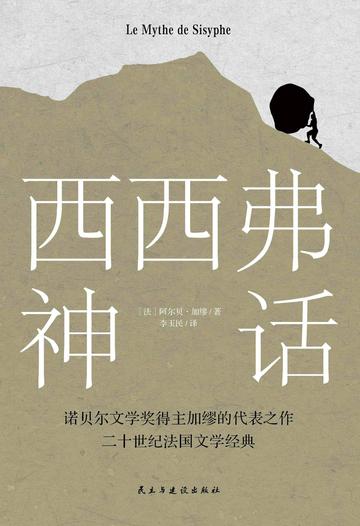
The Myth of Sisyphus
西西弗神话
- Status
- Completed
- Length
- 71k Words
- Updated
- 5y ago
- Source
- Fanqie
Stats
203Reads
9.3Score
18Chapters
15Listens
31.5kReads · all time
Tags
Synopsis
Reader comments
In booklists 2


Does Tomato Have Any Philosophy Books?
I have become more interested in philosophy recently. Are there any high-quality introductory books on philosophy? : D
4MViews362Books1dUpdated



Asking for Study Materials
Now I'm in the second grade of junior high school. I can't memorize the physics formulas but I'm not familiar with it. My English is a mess and my brain is confused when I see English. In the third grade of junior high school, I have to learn chemistry again and I'm asking for information! I am an average student, so I am under a lot of pressure 😢
4.9kViews69Books3moUpdated
Camus attributed the emergence of the sense of absurdity to the "separation of man and stage." When a person loses hope and sees himself as a stranger, he will definitely feel that life is absurd and not worth experiencing, and he will choose to commit suicide. In other words, the sense of absurdity determines and controls death. It is conceivable that a person sentenced to life imprisonment has lost all hope of returning to his hometown and all possibilities in life. Life in prison is boring. Whenever he thinks that he will spend the rest of his life in this small space, such a loneliness that is not difficult to accept becomes a great suffering. For him, continuing to live is meaningless, hopeless, and absurd, and suicide is what he yearns for. As Camus said, "The end of a work is already contained in its beginning." The title "The Myth of Sisyphus" has determined the spiritual backbone of the article: although life is absurd, we still have to fight to the end, just like Sisyphus pushing the boulder up the mountain.
Sisyphus was the king of Corinth who was known for his cunning and deception. According to myth, he committed many crimes and even cheated Death. As punishment, he is forced to perform this never-ending mission where he needs to push a boulder up the top of a mountain, but every time he is about to succeed, the boulder rolls down the hillside, forcing him to start over without being able to escape. The author believes that even if Sisyphus could not complete his task of pushing the boulder to the top of the mountain, in the process of performing the task, he completed the confrontation with the stone and himself, and this is the meaning.
Sisyphus is an absurd hero. Facing his doomed fate, he endlessly repeats impossible activities, pushing boulders up mountains, but he can never reach the end and cannot stop. After reading it, I felt sad. When passion meets a desolate and meaningless world, it cannot be solved and can only be wrapped in absurdity. However, Camus believes that there is no need to place hope in eternity. As long as we reject the "future" and focus on the present, life can expand, and its own absurdity is eliminated.
It's pretty good, but I can't understand a lot of philosophies. I haven't reached that level yet, and I can't understand the various ideas that come from that level.
Camus uses elegant language to explain absurdity, which is endlessly memorable and fruitful. Here's a quote from the book: "In a life that is limited but full of possibilities, the absurd man is unpredictable in everything except being awake. This is a major characteristic of the absurd man."
When I was very young, I have been listening to adults tell the story of the myth of Sisyphus. When I grew up, I learned more about the relevant details and the absurdity and torture behind the story of Sisyphus. This story mainly explores one of the core concepts of existentialism - the absurdity and meaninglessness of human existence. The main character in the book, Sisyphus, is a character from ancient Greek mythology who was punished in hell by pushing a boulder up a mountain, but every time he pushed the boulder to the top, it would roll back down and Sisyphus needed to start pushing again. I hope none of us will become Sisyphus.
I don't quite understand it, but it really makes people think.