Stats
5.8Score
51Chapters
Synopsis
Reader comments
In booklists 3
Nobel Prize for Literature, Mao Dun Literature Prize, Lu Xun Literature Prize and Other Literary Works
I want to read a book similar to "One Sentence is Worth Ten Thousand Sentences: Collector's Edition".
122.5MViews725Books2dUpdated
Have You Ever Read a Book That Made You Want to Study Hard?
Save the children who don't want to study😭
21.1MViews348Books1dUpdated
The Book That Saved History and Geography
I want to read a book similar to "A Half-Hour Comic History of China (Five Volumes)". Similar to this
5.2MViews492Books2dUpdated
I actually had tears in my eyes several times, feeling unjust for Su Shi, moved by the kindness and gratitude of the people, heartbroken by the sad experiences of these benevolent people in ancient times, and sad for the system of feudal rule... The author narrates Su Shi's experience like a storyteller, and the words are plain, not exaggerated, simple and touching. It is worth recommending and worth reading again and again. . .
He is upright and virtuous, but he is always out of place. The literary style is sad and moving, and it is indeed free, easy, indifferent and open-minded. A bamboo stick and mango shoes can beat a horse. Who is afraid of spending his whole life in the misty rain?
Su Shi was so talented and sharp that he was jealous and framed by Zhang and other villains. However, he was not passive. Instead, he worked for the benefit of the people wherever he went. He was a good official loved by the people and liked Su Shi's personality charm and talent.
It is good-looking and easy to understand. It vividly shows Su Shi's life to the world. Although his official career was bumpy and he was killed by traitors and exiled to various places, his talent is well known. He cares about the people and the court. It's just that he was born at the wrong time! However, Su Shi's family was happy and harmonious, and his three wives were knowledgeable and courteous. The whole family worked together to give Su Shi more encouragement and comfort, and his catchy and familiar poems found their source in the book. If you were born in a prosperous age, you would definitely do something great!
We have been aggrieved by Su Shi's experience several times. A great man of the era was repeatedly frustrated in the feudal autocratic monarchy system and failed to display his talents in the court. If Su Shi could be reused, we don't know what the Song Dynasty would be like. But what we do know is that he was everywhere he went in the past, and he also left for future generations a splendid speech that shines with the sun and the moon.
The book is very interesting. You can read the story while learning poetry. I just don't understand why the author only uses one surname for several characters. There are only two "kings" in the book. It's hard to tell them apart. Why not write their full names?
After reading this book, I feel that being a human being is not easy and life is full of hardships. Even a person as knowledgeable and talented as him cannot escape the tricks of fate. What's more, it's not that easy for ordinary people to achieve happiness! Look down on the gains and losses in life, accept the imperfections in life, and work hard to live a happy life every day!
Su Shi's life can be described as ups and downs, with ups and downs. When things went well, Su Shi was as high-spirited and heroic as ordinary people like us. When things went south, he was depressed and lamented like ordinary people. But more often than not, he was optimistic. Everyone has an optimistic side and a negative side. Ordinary people may get 70 points, but Su Shi can get 90 points. Through reading, I also recognized Su Shi again. Su Shi was not only a writer, but also an official who thought about the people and the court. In the local area, he asked for orders for the people, dredged water conservancy, and built embankments and dams. In the court, he could also objectively state the pros and cons of the reform, no matter he was a good writer. He is also a business master.
A bold poet, a dashing essayist, an innovative calligrapher and painter, a happy gourmet, a compassionate philanthropist, a good minister who cares about the country and the people, a fair and honest official, an engineer who can dredge and control rivers, a warm and frank friend, and an open-minded and down-and-out person - Su Shi
In the poetic life, the romance of a jealous boy emerges, but it also creates unforgettable life pain. Should I look northwest and shoot at the wolf, or should I not think about it and forget it? Since ancient times, people have always hated the water and always hated the east. Opening this hot historical book will inevitably leave the joys and sorrows of the Song Dynasty and the beautiful young man riding a horse in Bianjing for a day in the historical bookmarks. Closing the book will also leave endless loneliness and melancholy in life's encounters.
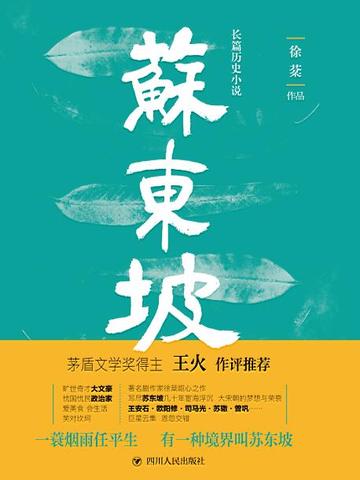
This book tells the life story of Su Shi, one of the Eight Great Masters of Tang and Song Dynasties. Su Shi was a generalist and a pioneer in poetry, lyrics, literature, calligraphy and painting. His prose and Ouyang Xiu were both called "Ou Su". His official career was bumpy. He served as a Hanlin bachelor, went to Hangzhou and Yingzhou, and became the Minister of Rites. Later he was demoted to Huizhou and Danzhou. Later, because he opposed Wang Anshi's new law, he was detained in the capital and imprisoned for writing a poem "slandering the imperial court" after only three months in Huzhou. In his later years, he was demoted to Huizhou and Danzhou, and died of illness in Changzhou. This book mainly focuses on the interpersonal disputes between Su Dongpo, Wang Anshi and the five emperors.
Thanks to the author for carefully creating such a literary and historical "Su Dongpo". With admiration and adoration, I read such a biography of Su Dongpo that I have long wanted to read. During the author's story-telling process as smoothly as flowing water, my eyes were blurred with tears several times. This is a novel. What a long-standing, persevering and unyielding writer who is diligent in politics, loves the people, and has extraordinary governance. His tortuous life has been persecuted and tortured by treacherous people, but he is still persevering, unyielding, open-minded and unrestrained. It is really heartbreaking and sincerely admirable! Especially when I saw that in the Wutai Poetry Case, Su Shi was ordered to investigate by Shenzong, and was detained by Jiang Hu on his way back. He was tied up and paraded through the streets. The sadness and heartache in my heart could no longer be suppressed, and tears ran wildly... After reading the complete book, I am still lingering in Su Shi's life experience. This book is worth reading again and again!
I know Su Shi, whose poetry is heroic, his fate is ill-fated, his painting is outstanding, and he is versatile. He stayed away from the capital due to the political reform, but he didn't know that the factional disputes caused him to suffer a lot and become homeless. A gentleman is magnanimous, but a villain is always worried. Mr. Su, cheers for your life!
I just wanted to know more about Su Shi's life and deeds, and I happened to come across this book. God helped me. What's more, the author also writes very well, which is really a blessing for me, thank God.
The revelation of human nature is more profound. The encounters of the characters vividly reflect the magic of fate. For example, when Su was transferred from Huangzhou to Changzhou and passed to Jinling to meet Wang Anshi, and when Wang Yu died of illness the following year, it was very touching and admirable! Read on and compare with the previous article - the entanglements and encounters of several emperors, empresses and some major figures are simply embarrassing! Let's take a look at this phenomenon - Wang Anshi and Su Shi, this pair of political and cultural celebrities who are both political enemies and friends, also have a mysterious numerical connection (this word means supplementary relationship, omitted). That is to say: when it comes to birth, they are fifteen years apart in age; when it comes to passing the imperial examination, they are fifteen years apart; when it comes to death, they are fifteen years apart. Moreover, both of them also lived to be sixty-six years old. There are three different "fifteen" numbers and one identical "sixty-six" number. In addition, they both advocated reform, but each of their opinions failed to achieve their wishes. This seems to be the "destiny" of the two of them. While lamenting the fate of the two sages, one can't help but wonder about it. He wrote a small poem with three perspectives, which came into being in an instant. There may be fallacies, but I didn't think about it carefully! As follows: Destiny Young people don't believe in fate, but middle-aged people try to clarify their doubts: one part is talent and learning, three parts is understanding and ignorance; three parts is diligence and laziness, and one part is hard to know. ||Ten points know the general situation, nine points focus on cognition; eight points gain diligent understanding, seven points maintain the mind and nature; six points gain collective equanimity; five points believe in the branch; four points three plus two, it is rare to have one day. ||The weather is in the same place, plus one or two geographical advantages; the people and the people are four, five, and six, and they accumulate fifteen trends; the momentum comes like thunder, with seven or eight sounds; it will be perfect in nine years, and it will be difficult to wait for ten minutes! ||There may be ambiguities, but the understanding lies with you! ——Ren Yin's Summer Night Reading, Essays on the Liang Xi
Su Dongpo is my favorite poet, bar none. Su Dongpo had a difficult life. He was imprisoned several times and experienced pain and sorrow that many others had never experienced. But it was in this pain and sorrow that he created an open-mindedness and optimism that no one else had. "The bamboo stick and mango shoes beat the horse, who is afraid? You can live your whole life in the mist and rain." These two sentences describe his attitude towards the ups and downs and pain of life, and boldly experience life without fear or fear.
It's very good. The words he wrote are also perfectly displayed in the context of the time. You can fully understand Su Shi's life and the words he wrote. Gradually, I came to understand his words that I learned when I was in school.
Xu Fen asked me to reread "Su Dongpo" Feng's life path is characterized by detached and broad-minded feelings. Looking back on Su Shi's life, there are two key words - financial relegation. When he was nineteen years old (1056, the first year of Jiayou), Su Shi left Sichuan for the first time to go to Beijing to take the imperial examination. In 1057, he took part in the imperial examination and won the Jinshi in one fell swoop. With his impressive literary talent, he was appreciated by Ouyang Xiu, a literary master at the time, and thus entered the officialdom. However, his straightforward personality, clear distinction between likes and dislikes, and his character of never following the crowd destined that his future journey as a scholar would be extremely bumpy and difficult. Because his political views were inconsistent with Wang Anshi, who was promoting the reform at that time, and because of his upright character, he was involved in one after another turmoil again and again, and became a victim of the internal political struggle in the court. As a result, he was demoted three times, first to Huangzhou because of the Wutai Poetry Case; then to Huizhou after being suppressed by the reformists; and finally to Xiuzhou when he launched an all-round and large-scale attack on the old faction. For a person with such a high starting point, who started at the peak, being hit and fallen again and again, and such a huge gap in life, would cause Su Shi to experience so much pain and struggle in his heart.
Su Dongpo's life was full of ups and downs. He was demoted to remote areas many times because of his outspoken appeals. His official career was full of twists and turns. However, his optimism and open-mindedness are very admirable. He readily accepts changes in circumstances and adapts to the times and society with his own will. He was also a great poet who cared about the world and described the hard life and displacement of the people. He was very passionate about food and created some delicacies that were passed down to future generations.
Just like my friends who are working hard to get out of the mountains, Su Dongpo has been pursuing his dreams. Moreover, there are many poems by Su Dongpo in this book, which made me understand him better. I think this book is not only suitable for people who are interested in Su Dongpo, but also for people like me who want to understand history.
Even if the fate is bad, the original intention has not been lost at all. After being displaced many times, the heart is still concerned about everyone and the family. Even if a genius comes from the sky, he still knows how to sublimate himself. Living in this life is enough~~Fortunate~~
What a Su Xiancai, what a ten years of life and death. Without thinking, this author has literary talent!
The life of Su Shi, one of the Eight Great Masters of the Tang and Song dynasties, can be summarized as "one demotion after another". Su Shi was a generalist and a pioneer in poetry, lyrics, literature, calligraphy and painting. His prose and Ouyang Xiu were both called "Ou Su". His official career was bumpy. He served as a Hanlin bachelor, went to Hangzhou and Yingzhou, and became the Minister of Rites. Later he was demoted to Huizhou and Danzhou. Later, because he opposed Wang Anshi's new law, he was detained in the capital and imprisoned for writing a poem "slandering the imperial court" after only three months in Huzhou. In his later years, he was demoted to Huizhou and Danzhou, and died of illness in Changzhou. This book mainly focuses on the interpersonal disputes between Su Dongpo, Wang Anshi and the five emperors.
Except for some minor flaws in some places, for example, some names are not given. Wang should be Wang Anshi's only son Wang Yu, Zhang should be Zhang Dun, etc. Because one word is missing, the reader is confused. Everything else is very good, especially the portrayal of the characters, which are lifelike.
This book is written to a very high standard. I will make a long review after I finish reading it and publish it in "Today's Toutiao".
This book is wonderful and has profound literary foundation. It allows people to understand everyone's moral integrity, not to be afraid of changes in the situation in times of crisis, and to face life with an optimistic attitude. It also allows future generations to understand the partiality of those in power, the treacherous ministers in power, the persecution of good ministers, and the instability of the political situation. Ultimately, it shows that good and evil are rewarded, and both good and evil are passed down!
A book worth recommending! Indomitable spirit! No matter how bad things happen, no matter how bad the environment is! There is still a cheerful heart! This mentality is full of positive energy [Like]
Regardless of whether it's true or not, it looks good, has a beginning and an end, and writes a person's life vividly. I like it, it's interesting, and it's finished! I feel that the author is also a kind-hearted and optimistic person. Most of the characters are positive and good people, so I admire them! As the saying goes: "It's always cold at high places." Life is not easy, but do it and cherish it!
After reading the full text, I feel that there are too many injustices for Su Shi, including being framed by traitors, balancing interests, and not using the important ones. However, history will wash away all the yellow sand, and we will eventually be able to remember that there was such a dazzling gold in the history of the Song Dynasty. Hangzhou's Sudi, Huizhou's Second Bridge, Xuzhou's ancient city, Bianjing's lanterns, Mizhou's abandoned babies, Dingzhou's city walls, Fengxiang's "Ya Qian Service", Huangzhou's "Dongpo Meat", Guangzhou's "Tap Water", Danzhou's "Juanlang Nunnery"... Mr. Su, please wait for me, I will come to see you in each period.
Read them carefully one by one. Reading history books and biographies can actually connect ancient and modern times. Understanding the life story of such a great writer whom I have always admired, I no longer need to worry about all the difficulties encountered in this life! I hope that people will live long and share the beauty of the moon thousands of miles apart.