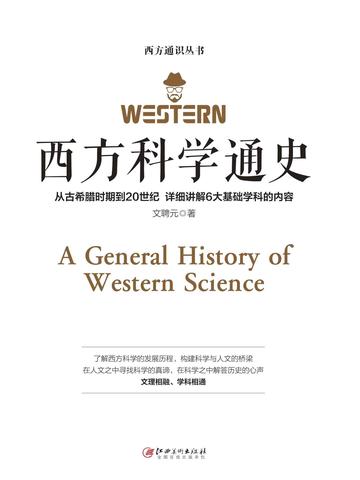
The book "General History of Western Science" presents the development process of Western science and the wonderful lives of great scientists in front of readers in six fields: astronomy, mathematics, physics, chemistry, earth science and biology. Let people comprehensively understand our world from astronomy to geography, from macro to micro. In addition, the book also records anecdotes about great scientists, such as Archimedes, Euler, Newton, Darwin, Marie Curie, Einstein and others. The author uses rich subject classics, interesting biographies, and easy-to-understand texts to sort out the subject history of Western science, making the development of the entire social sciences clearer.
Reader comments
The content is good, but there are no pictures, and a lot of content is missing and needs to be improved.
This book helped me understand the development of Western science, and also reminded me of some of my observations and thoughts while delivering express delivery. For example, the idea of "chanting grass turns into fireflies" mentioned in the book reminded me that we cannot blindly believe in some traditional concepts and must use scientific methods to explore the essence of things. At the same time, the stories of the great scientists introduced in the book are also very inspiring. Their persistence and spirit of exploration inspired me very much. I think this book can not only increase knowledge, but also provide people with a deeper understanding of science.
Follow the history of the West and explore the glorious course of human wisdom.
From the origins of science in ancient Greece to the vigorous development of modern science, this book tells the story of the development of science in many subject areas.
Pythagoras of ancient Greece emphasized the importance of mathematics and believed that the nature of the universe could be expressed using mathematics;
Aristotle made extensive observations and classifications of the natural world, and his views on physics and biology have influenced Western academic circles for a long time.
Although the scientific research during this period was deeply influenced by philosophical ideas, it laid the foundation for subsequent scientific development.
The development of science in Europe in the Middle Ages was relatively slow, but the Arab world made important achievements in fields such as mathematics and astronomy.
They preserved and translated a large number of ancient Greek scientific works, providing valuable resources for the subsequent scientific revival in Europe.
During the Renaissance, science ushered in a new dawn.
Copernicus proposed the heliocentric theory, which challenged the traditional geocentric concept and triggered a scientific revolution;
Kepler discovered the three laws of planetary motion through long-term observations and research on the motion of celestial bodies;
Galileo pioneered modern physics based on experiments. His telescope observations and free-fall experiments provided new methods and ideas for scientific research.
From the 17th to the 18th century, the emergence of Newton pushed Western science to a new peak.
His law of universal gravitation and the three laws of motion unified the mechanics of heaven and earth and laid the foundation for classical physics.
During this period, scientific research methods gradually matured, and experiments and mathematical reasoning became important means of scientific research.
In the 19th century, the field of science ushered in comprehensive development: major breakthroughs were made in electromagnetism, chemistry, biology and other disciplines.
Maxwell's electromagnetic theory unified the phenomena of electricity, magnetism, and light;
Darwin's theory of evolution changed people's understanding of the origin and development of life.
Since the 20th century, modern science has entered a stage of rapid development.
The birth of relativity and quantum mechanics completely changed people's understanding of space, time and matter;
The rise of emerging disciplines such as computer science and molecular biology has provided new tools and methods for humans to solve various complex problems.
...
Science is the crystallization of human wisdom and the result of continuous exploration and innovation.
The development of science not only promotes technological progress, but also changes people's way of thinking and lifestyle.
However, there are twists and turns and difficulties in the process of scientific development. Even though the development of science and technology in today's era is changing with each passing day, people still need to be unafraid of difficulties and have the courage to explore, constantly promote innovation and progress in science and technology, and create a better life for the future of mankind.
Content Sharing
1. From Thales to Pythagoras, the ancient Greeks began to explore nature. They tried to use reason to understand the world. This spirit laid the foundation for the subsequent development of Western science.
2. Archimedes was not only a great mathematician, but also an outstanding physicist. His law of buoyancy is still widely used today.
3. Copernicus' heliocentric theory challenged the traditional geocentric concept and triggered a scientific revolution.
4. Newton's law of universal gravitation and the three laws of motion opened up a new path for the development of physics.
5. Einstein's theory of relativity completely changed people's understanding of time and space.
I prefer this kind of narration of scientific history
After reading it, the six basic disciplines of Western natural sciences are well sorted out.




The content is good, but there are no pictures, and a lot of content is missing and needs to be improved.
This book helped me understand the development of Western science, and also reminded me of some of my observations and thoughts while delivering express delivery. For example, the idea of "chanting grass turns into fireflies" mentioned in the book reminded me that we cannot blindly believe in some traditional concepts and must use scientific methods to explore the essence of things. At the same time, the stories of the great scientists introduced in the book are also very inspiring. Their persistence and spirit of exploration inspired me very much. I think this book can not only increase knowledge, but also provide people with a deeper understanding of science.
Follow the history of the West and explore the glorious course of human wisdom. From the origins of science in ancient Greece to the vigorous development of modern science, this book tells the story of the development of science in many subject areas. Pythagoras of ancient Greece emphasized the importance of mathematics and believed that the nature of the universe could be expressed using mathematics; Aristotle made extensive observations and classifications of the natural world, and his views on physics and biology have influenced Western academic circles for a long time. Although the scientific research during this period was deeply influenced by philosophical ideas, it laid the foundation for subsequent scientific development. The development of science in Europe in the Middle Ages was relatively slow, but the Arab world made important achievements in fields such as mathematics and astronomy. They preserved and translated a large number of ancient Greek scientific works, providing valuable resources for the subsequent scientific revival in Europe. During the Renaissance, science ushered in a new dawn. Copernicus proposed the heliocentric theory, which challenged the traditional geocentric concept and triggered a scientific revolution; Kepler discovered the three laws of planetary motion through long-term observations and research on the motion of celestial bodies; Galileo pioneered modern physics based on experiments. His telescope observations and free-fall experiments provided new methods and ideas for scientific research. From the 17th to the 18th century, the emergence of Newton pushed Western science to a new peak. His law of universal gravitation and the three laws of motion unified the mechanics of heaven and earth and laid the foundation for classical physics. During this period, scientific research methods gradually matured, and experiments and mathematical reasoning became important means of scientific research. In the 19th century, the field of science ushered in comprehensive development: major breakthroughs were made in electromagnetism, chemistry, biology and other disciplines. Maxwell's electromagnetic theory unified the phenomena of electricity, magnetism, and light; Darwin's theory of evolution changed people's understanding of the origin and development of life. Since the 20th century, modern science has entered a stage of rapid development. The birth of relativity and quantum mechanics completely changed people's understanding of space, time and matter; The rise of emerging disciplines such as computer science and molecular biology has provided new tools and methods for humans to solve various complex problems. ... Science is the crystallization of human wisdom and the result of continuous exploration and innovation. The development of science not only promotes technological progress, but also changes people's way of thinking and lifestyle. However, there are twists and turns and difficulties in the process of scientific development. Even though the development of science and technology in today's era is changing with each passing day, people still need to be unafraid of difficulties and have the courage to explore, constantly promote innovation and progress in science and technology, and create a better life for the future of mankind. Content Sharing 1. From Thales to Pythagoras, the ancient Greeks began to explore nature. They tried to use reason to understand the world. This spirit laid the foundation for the subsequent development of Western science. 2. Archimedes was not only a great mathematician, but also an outstanding physicist. His law of buoyancy is still widely used today. 3. Copernicus' heliocentric theory challenged the traditional geocentric concept and triggered a scientific revolution. 4. Newton's law of universal gravitation and the three laws of motion opened up a new path for the development of physics. 5. Einstein's theory of relativity completely changed people's understanding of time and space.
I prefer this kind of narration of scientific history
After reading it, the six basic disciplines of Western natural sciences are well sorted out.