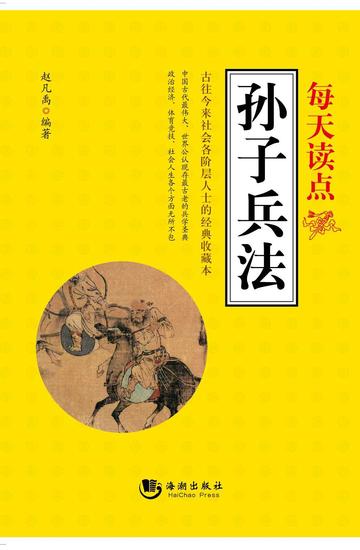
"Sun Tzu's Art of War" is concise, concise and highly philosophical. Except for a few chapters that talk about specific war issues, the rest can be regarded as "principles". Today, people not only rely on its guidance during war operations, but also get inspiration from it when conducting various activities such as politics, economics and even sports competitions.
This book selects nearly a hundred far-reaching and meaningful sentences from "The Art of War", divided into chapters such as war, generals, military management, strategy, offense and defense, victory, change, virtual reality, etc., And analyzes Sun Tzu's wisdom. It includes original texts, translations, quotes from past dynasties, notes on the art of war, and life insights, allowing everyone to understand Sun Tzu's thoughts more clearly.
Reader comments
When it comes to "The Art of War", both Chinese and foreigners are full of praise for it. It has a wide range of applications, not only in combat, but also in competitive sports and management enterprises. You can find good methods from it. Unfortunately, I didn't do well in classical Chinese in middle school, so I found this book and read it as a bedtime story every day. It helps me sleep, and I can also learn life skills from it. "Being able but not being able in life is an art of pretending to be confused." This sentence is the author's introduction to the chapter on strategy, but it touched me deeply. Understanding and applying this principle to my work has reduced my stress and made my cooperation with others smoother.
Even if you are a primary school student or a reader without a high level of knowledge, you must know the saying "Thirty-six strategies, walking is the best strategy." It can be seen that the Thirty-six Stratagems have a profound impact on us Chinese people. Indeed, Thirty-Six Strategies, as a masterpiece of ancient Chinese military art and wisdom, has indeed influenced many people. You will definitely benefit a lot from reading it. In this book, the author has re-integrated the Thirty-Six Strategies and made many corrections, which can be said to be very careful. Reading and studying this book carefully will definitely bring you a lot of gains and benefits.
I have read many books about Sun Tzu's Art of War before, but I still feel that I can't integrate the ideas into reality. This book solves my problem very well. The author interprets and explains the original text of the classic Art of War and combines his own insights and experience to give examples and application scenarios related to real life. This allows us to better understand the core principles of "Sun Tzu's Art of War" and apply them to daily life and work. In addition, this book allows readers to learn by reading a little bit every day. This segmented approach is very helpful for us to think deeply and absorb the content in the book.
Gao Qiqiang in "Hurry" reads Sun Tzu's Art of War, bringing this classic book back to the public's attention. Looking back, from ancient times to the present, Sun Tzu's Art of War has been applied in officialdom, business, war, and diplomatic negotiations from the outside in. This book selects nearly a hundred far-reaching and meaningful sentences from "The Art of War" and analyzes Sun Tzu's wisdom in chapters such as war, generals, military management, strategy, offense and defense, victory, change, and reality. It includes the original text and translation, as well as quotations from past dynasties, notes on the art of war, and life insights, allowing everyone to understand Sun Tzu's thoughts more clearly.
Recommended by Brother Qiang from "Cyclonus". The theory in the original version is very abstract, highly philosophical and in the form of classical Chinese, making it a bit awkward to read. I searched and compared many simplified versions on the Internet and found that this version is the most suitable and the one that makes people read the most. It selects the most far-reaching sentences to interpret Sun Tzu's wisdom from chapters such as war, generals, military management, strategy, offense and defense, victory, change, and reality. Each sentence is paired with several short stories, which is very interesting. I originally bought the book following the trend, but I actually read it and benefited a lot. It is worth recalling every day.
Very good book, I learned a lot.
The classic masterpiece will be passed down for future generations and benefit countless people!
When it comes to "The Art of War", both Chinese and foreigners are full of praise for it. It has a wide range of applications, not only in combat, but also in competitive sports and management enterprises. You can find good methods from it. Unfortunately, I didn't do well in classical Chinese in middle school, so I found this book and read it as a bedtime story every day. It helps me sleep, and I can also learn life skills from it. "Being able but not being able in life is an art of pretending to be confused." This sentence is the author's introduction to the chapter on strategy, but it touched me deeply. Understanding and applying this principle to my work has reduced my stress and made my cooperation with others smoother.
Even if you are a primary school student or a reader without a high level of knowledge, you must know the saying "Thirty-six strategies, walking is the best strategy." It can be seen that the Thirty-six Stratagems have a profound impact on us Chinese people. Indeed, Thirty-Six Strategies, as a masterpiece of ancient Chinese military art and wisdom, has indeed influenced many people. You will definitely benefit a lot from reading it. In this book, the author has re-integrated the Thirty-Six Strategies and made many corrections, which can be said to be very careful. Reading and studying this book carefully will definitely bring you a lot of gains and benefits.
I have read many books about Sun Tzu's Art of War before, but I still feel that I can't integrate the ideas into reality. This book solves my problem very well. The author interprets and explains the original text of the classic Art of War and combines his own insights and experience to give examples and application scenarios related to real life. This allows us to better understand the core principles of "Sun Tzu's Art of War" and apply them to daily life and work. In addition, this book allows readers to learn by reading a little bit every day. This segmented approach is very helpful for us to think deeply and absorb the content in the book.
Gao Qiqiang in "Hurry" reads Sun Tzu's Art of War, bringing this classic book back to the public's attention. Looking back, from ancient times to the present, Sun Tzu's Art of War has been applied in officialdom, business, war, and diplomatic negotiations from the outside in. This book selects nearly a hundred far-reaching and meaningful sentences from "The Art of War" and analyzes Sun Tzu's wisdom in chapters such as war, generals, military management, strategy, offense and defense, victory, change, and reality. It includes the original text and translation, as well as quotations from past dynasties, notes on the art of war, and life insights, allowing everyone to understand Sun Tzu's thoughts more clearly.
Recommended by Brother Qiang from "Cyclonus". The theory in the original version is very abstract, highly philosophical and in the form of classical Chinese, making it a bit awkward to read. I searched and compared many simplified versions on the Internet and found that this version is the most suitable and the one that makes people read the most. It selects the most far-reaching sentences to interpret Sun Tzu's wisdom from chapters such as war, generals, military management, strategy, offense and defense, victory, change, and reality. Each sentence is paired with several short stories, which is very interesting. I originally bought the book following the trend, but I actually read it and benefited a lot. It is worth recalling every day.
Very good book, I learned a lot.
The classic masterpiece will be passed down for future generations and benefit countless people!