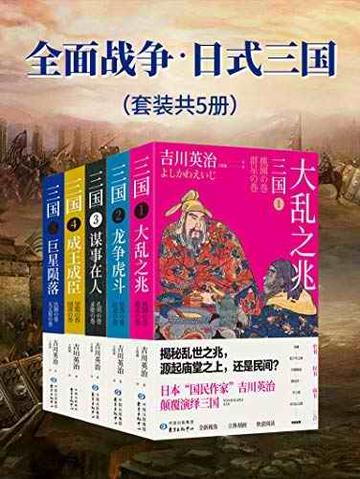
I did not choose to rewrite or abbreviate the novel, but boldly tried to recreate this work in a format most suitable for a long-form newspaper serial novel, and added my own understanding and creativity to Liu Bei, Cao Cao, Guan Yu, Zhang Fei and other major characters. The phrases and dialogues that are not found in the original work can be seen everywhere in the book, which are my touches. ——Eiji Yoshikawa "Three Kingdoms" is the pinnacle work of Eiji Yoshikawa, and it is also the ultimate work of the blend of Chinese culture and Japanese temperament. In Japan, there are countless historians, politicians, entrepreneurs, writers and artists influenced by "Three Kingdoms". They regard "Three Kingdoms" as a historical masterpiece, a comprehensive collection of political strategies, a business war manual and an inspirational book, and learn from it history and culture, ways of success, methods of doing things, leadership theories, etc.
Reader comments
The Three Kingdoms in vernacular is pretty good.
For readers who like history and war themes, this book is a classic that cannot be missed. This is a classic historical novel that takes the political struggles and military wars of the Three Kingdoms period as the background and tells the story of the intrigues, wisdom, courage, and heroic deeds between the countries. The author shows the historical features and the fate of the characters during the Three Kingdoms period through rich characters and complex plots. The book incorporates wisdom and military strategy, and deeply depicts the rise and fall of the heroes of the Three Kingdoms and the complexity of human nature.
Japanese scholar Yoshikawa Eiji is very interested in the history of the Three Kingdoms in ancient China. He re-created "The Romance of the Three Kingdoms" in his own language. The novel is vivid and interesting. Using easy-to-understand language, it vividly depicts the images of historical figures such as Cao Cao, Liu Bei, and Sun Quan, and explains the different spirits and values they represent, helping us better understand the history and culture of this era. Looking at the Three Kingdoms from the perspective of Japanese scholars, there are many different feelings. You can find it and read it.
The beginning of this version of "Three Kingdoms" is childish and disgusting, with some Japanese-specific rigidity about etiquette. It gets better after that, and it's relatively easy to read. It's a pretty good vernacular book. Compared with China's "Three Kingdoms", it's definitely not comparable, but it's written by a foreigner, and it has a different flavor. The characters are colorful and dynamic, and the psychological description is quite good. The translation is a bit jerky, but it is obvious that the author is understanding the Japanese Bushido culture in the Three Kingdoms. The secondary creation does give the author a lot of room for development.
The story of "Three Kingdoms" is well-known in China. This is also the first time I have seen "Three Kingdoms" written by a foreign author. It is novel and I am also very curious about how different the story is. After reading the whole story, I feel pretty good. The author Yoshikawa Eiji has a strong foundation in Chinese literature and has written "Three Kingdoms" from a Japanese perspective. The plot is very faithful and basically unchanged. The historical details are handled more meticulously and vividly. It is deeply rooted in people's hearts and is an easy-to-understand popular book. You can read it in your spare time.
Not bad, it has a different flavor
Okay, it's worth reading! It is easy to understand and the person who wrote this book deserves praise. Admire!
It's written in vernacular, simple and clear, and you can read it.
Simple and clear.
It's wonderful, it's hard to believe it was written by a Japanese.
Understand the history and culture of the Three Kingdoms from another perspective
The sweet dream of Huangliang shines upon the King of Han, and the princes of the Three Kingdoms have many talented men.
Liu Zhang, Sun Cao and Sima competed in the Spring and Autumn Period before and in the Tang Dynasty.
The Three Kingdoms in vernacular is pretty good.
For readers who like history and war themes, this book is a classic that cannot be missed. This is a classic historical novel that takes the political struggles and military wars of the Three Kingdoms period as the background and tells the story of the intrigues, wisdom, courage, and heroic deeds between the countries. The author shows the historical features and the fate of the characters during the Three Kingdoms period through rich characters and complex plots. The book incorporates wisdom and military strategy, and deeply depicts the rise and fall of the heroes of the Three Kingdoms and the complexity of human nature.
Japanese scholar Yoshikawa Eiji is very interested in the history of the Three Kingdoms in ancient China. He re-created "The Romance of the Three Kingdoms" in his own language. The novel is vivid and interesting. Using easy-to-understand language, it vividly depicts the images of historical figures such as Cao Cao, Liu Bei, and Sun Quan, and explains the different spirits and values they represent, helping us better understand the history and culture of this era. Looking at the Three Kingdoms from the perspective of Japanese scholars, there are many different feelings. You can find it and read it.
The beginning of this version of "Three Kingdoms" is childish and disgusting, with some Japanese-specific rigidity about etiquette. It gets better after that, and it's relatively easy to read. It's a pretty good vernacular book. Compared with China's "Three Kingdoms", it's definitely not comparable, but it's written by a foreigner, and it has a different flavor. The characters are colorful and dynamic, and the psychological description is quite good. The translation is a bit jerky, but it is obvious that the author is understanding the Japanese Bushido culture in the Three Kingdoms. The secondary creation does give the author a lot of room for development.
The story of "Three Kingdoms" is well-known in China. This is also the first time I have seen "Three Kingdoms" written by a foreign author. It is novel and I am also very curious about how different the story is. After reading the whole story, I feel pretty good. The author Yoshikawa Eiji has a strong foundation in Chinese literature and has written "Three Kingdoms" from a Japanese perspective. The plot is very faithful and basically unchanged. The historical details are handled more meticulously and vividly. It is deeply rooted in people's hearts and is an easy-to-understand popular book. You can read it in your spare time.
Not bad, it has a different flavor
Okay, it's worth reading! It is easy to understand and the person who wrote this book deserves praise. Admire!
It's written in vernacular, simple and clear, and you can read it. Simple and clear.
It's wonderful, it's hard to believe it was written by a Japanese.
Understand the history and culture of the Three Kingdoms from another perspective
The sweet dream of Huangliang shines upon the King of Han, and the princes of the Three Kingdoms have many talented men. Liu Zhang, Sun Cao and Sima competed in the Spring and Autumn Period before and in the Tang Dynasty.