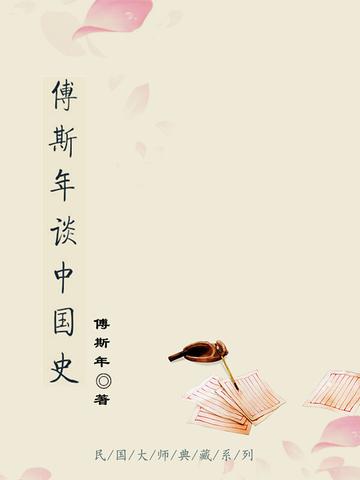
Fu Sinian (March 26, 1896 - December 20, 1950), originally known as Menghan and later as Mengzhen, was a native of Liaocheng, Shandong. Famous historian, classical literature research expert, educator, and academic leader. One of the student leaders of the May 4th Movement and the founder of the Institute of History and Linguistics, Academia Sinica. Fu Sinian served as acting president of Peking University and president of National Taiwan University. The principle he put forward, "Go to poverty and fall to hell, use your hands and feet to find something" has a profound influence. He was a student of Hu Shi, who commented that he was "one of the rarest geniuses in the world."
"Fu Sinian Talks about the History of China" includes classic historical treatises such as the theory of Yi and Xia East and West, Jiang Yuan, Zhou Dongfeng and the survivors of the Yin Dynasty, the theory of Dadong and Xiaodong - it also discusses the Lu, Yan and Qi who were first granted in the southeast of the Zhou Dynasty and then moved eastward, the so-called fifth-class nobility, and the discussion of ancient history books with Gu Jiegang.
Reader comments
This book is very inspiring! Mr. Fu Sinian has conducted very in-depth research on the ancient Chinese nation and cultural history. His research method of "looking for things with hands and feet" has a great influence. This reminds me of Mr. Qian Mu's "Outline of National History". They both explore Chinese history from a historical perspective and are both pioneering. I especially like the part about the Jiang family lineage in the book. It made me think more deeply about the similarities and differences between ancient peoples.

This book is very inspiring! Mr. Fu Sinian has conducted very in-depth research on the ancient Chinese nation and cultural history. His research method of "looking for things with hands and feet" has a great influence. This reminds me of Mr. Qian Mu's "Outline of National History". They both explore Chinese history from a historical perspective and are both pioneering. I especially like the part about the Jiang family lineage in the book. It made me think more deeply about the similarities and differences between ancient peoples.