Stats
5.8Score
Synopsis
No synopsis yet.
We haven’t got an English blurb for this one. It appears once the source description has been translated.
We haven’t got an English blurb for this one. It appears once the source description has been translated.


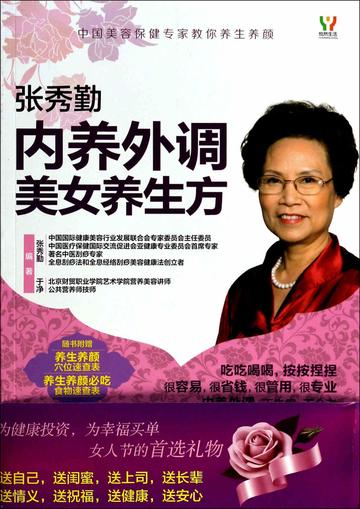
The book "Health Prescriptions for Nourishing Beauty Internally and Externally" gave me the opportunity to re-recognize myself and understand female beauty. The book uses Yi Shu's words: "A woman should be responsible for her own appearance after the age of 25." As a starting point, the book starts a discussion of women's inner and outer health care. This book successfully combines ancient health care concepts with modern life to create a comprehensive health care guide for women. It reminds us that health care is not only external maintenance, but more importantly, internal maintenance. Only with healthy internal organs, sufficient qi and blood, and smooth meridians can we maintain a beautiful appearance, a good figure, and a healthy and long life. The author Zhang Xiuqin and others rely on their unique insights and high-level literary skills to guide readers to achieve a transformation from superficial to deep, and from external to internal in the process of pursuing beauty. They let us understand that even if we encounter difficulties in life, we should not let ourselves appear embarrassed, but should maintain a quiet and graceful feeling like the fragrance of tea. This is a book worthy of in-depth reading by all women. No matter what age you are, you can find a regimen that suits you and achieve beauty from the inside out.
The famous female writer Yi Shu once said: "A woman should be responsible for her own appearance after the age of 25." This means that you are responsible for the appearance given to you by your parents until you are 25 years old. After that, what your appearance shows depends on your own cultivation. Because at a certain age, the metabolism of a woman's skin and body will slow down, the Qi and blood bank will begin to be overdrawn, and there will not be enough nutrients to nourish the skin. At this time, most of the body's nutrients are obtained from special external supplies, so women should take extra care of them. This book meets this need. Starting from the physiological characteristics of middle-aged and elderly people, this book mainly introduces the nutrition and health of middle-aged and elderly people, nutrition and health care, nutrition and health preservation, nutrition and longevity, nutrition and common diseases, as well as food selection contained in each article. More importantly, the book adds content that is rarely or almost never mentioned in other books, such as novel content on the relationship between nutrition and sleep, nutrition and psychology, nutrition and exercise.
With a complete meridian conditioning plan and professional nutritionist Yu Jing's scientific diet plan, this book comprehensively analyzes the characteristics of women's menstrual cycles and gives corresponding dietary conditioning suggestions in various scenes of women's daily lives, making women healthier, slimmer, and more beautiful from the inside out. If a woman wants to be healthy and beautiful, she must pay attention to the combination of internal and external conditioning. Favoring one thing more than another is not worth the loss. The superposition of internal and external effects makes the beauty plan more complete, more effective, and healthier. This book is divided into six chapters, which provide scientific meridian conditioning and scientific diet plans from the aspects of regulating qi and blood, regulating the five internal organs, unblocking the meridians, strengthening the six internal organs, caring for the ovaries, warming the body and mind, and adjusting the appearance and skin details.
After reading "Health Prescriptions for Nourishing Internally and Externally Adjusting Beauty", I was attracted by its deep and broad vision. The book uses Yi Shu's words as an introduction, pointing out that women need to start taking responsibility for their own appearance after the age of 25, and further elaborates on how women can discover and maintain their inner beauty through self-care. Zhang Xiuqin and others made us feel the profoundness of Chinese tradition by quoting the beauty secrets in the "Huangdi Neijing". The concept of internal nourishment and external regulation proposed by them emphasizes that women should take healthy internal organs, sufficient qi and blood, and unobstructed meridians as beauty standards. This is a new challenge and broadening of modern aesthetics, allowing us to re-examine the definition of female beauty. What I saw in this book was a self-centered concept of female self-love. In the process of adapting to and fighting physiological changes, women need to make self-care a priority, not just to satisfy the aesthetics of others. This idea profoundly challenged my understanding of beauty and the role of women. I believe that both female and male readers will benefit greatly from this book.
This book is very practical! From the perspective of health preservation, it introduces a lot of knowledge about nutrition and health for middle-aged and elderly people, and also adds novel content such as the relationship between nutrition and sleep, psychology, and exercise. The book says, "Qi and blood understand their needs and can provide them with nutrients that they can directly absorb and utilize." This sentence really makes sense. We can't just rely on external maintenance, but also pay attention to internal maintenance. This book teaches us how to take care of ourselves from the inside out. It's worth reading!
Yi Shu once said: "A woman should be responsible for her own appearance after the age of 25." I still agree with this sentence. Before the age of 25, collagen may slowly appear on everyone's face, but as time goes by, if you want to maintain good external conditions, moderate exercise and healthy eating and resting habits will become more and more important. This book is designed to help women learn to nourish their bodies internally and regulate their bodies externally. It introduces us to the reasons and methods of the necessity of regulating women's internal bodies and external bodies. It is easy to understand and worth reading.