Another feature of "The Complete Collection of Bingjian" is its full integration of classic cases of identifying talents in ancient China. The number of cases is unprecedented in similar books. For example, Confucius discerned human nature by listening to cries, Peng Xuan recognized Wang Mang's evil spirit, Yuan Tiangang recognized Wu Zetian, Sima Zhao recognized Wei Shu Yu Hanwei, and Zeng Guofan recognized Jiang Zhongyuan and Liu Mingchuan.
Reader comments
Each category of talent has its pros and cons. A Jieqing person has great virtues and good appearance. He is already eye-catching before he is used. His way is smooth and enlightening. Therefore, before he is obvious, everyone is willing to recommend him. After he became prominent, everyone respected him. The merit is enough to arouse the turbidity and raise the purity, and the virtue is enough to set an example for others. This kind of situation is harmless and can be manifested for a long time, so it is respected by the world. These people are known for their high moral character and good conduct. They behave in a dignified and respectful manner, in line with etiquette and law. They are a symbol of national etiquette and virtue, an example for Chinese people to learn from, and the embodiment of traditional virtues. They are all upright, and they have the air of being an expert from a great country. His high moral character and integrity are enough to influence people who lack morality and etiquette, and he can serve as a role model for educating society and correcting the world's customs by "being upright and not doing what he is told".
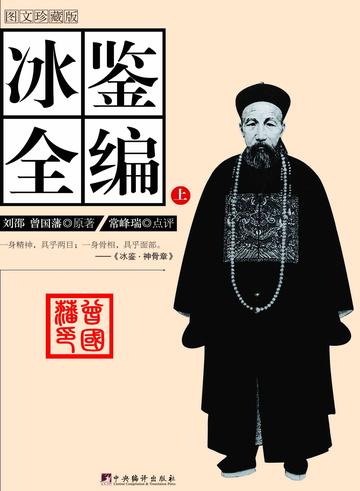
A book on "Physiognomy". The ice means clarity, and the observer means a mirror. The title of the book "Bingjian" means to see clearly and gain insight into the inner situation. Zeng Guofan, the author of the original book, summarizes his experience in getting to know people. The book is divided into seven chapters, namely, the divine bones chapter, the firmness and softness chapter, the appearance chapter, the mood chapter, the eyebrows chapter, the voice chapter, and the complexion chapter. It summarizes a person's character traits, personality quality, inner activities, mental outlook, and life experience, and then summarizes a person's future and destiny. It plays an important role in understanding the ancient physiognomy culture.
This book is very interesting! It teaches us how to identify talents through many ancient cases, and also talks about the relationship between the strong and soft qualities of yin and yang and the human spirit. But I hate Wang Mang in the book the most. The part where Yuan Tiangang recognized Wu Zetian was quite impressive to me. The author Liu Shao is very good, and he explains such complicated principles quite clearly. I feel like this book is also helpful for finding a partner, haha!
After reading it, I think it is a very practical reference book that can teach readers some methods and techniques of recognizing people. Although times have changed, it still has reference significance today. Unlike other books of the same type, or full-text chicken soup, there is no dry information or no organization. This book mainly introduces the method adopted by Zeng Guofan from the outside in, combining movement and stillness, and comprehensively explains his experience in knowing and employing people. The author will tell the readers the method of knowing and appraising people. The content of this book is very comprehensive and systematic, the analysis is thorough, and it is of great reference value.
The golden mean requires a person to be strong and soft at the same time. It is not enough for a person to be too strong. This will lead to bad things. People who have too many opinions often lead to disharmony in the team and unnecessary disputes with others. But it is not good for a person to be too gentle. Being too gentle will lead to one's own opinions not being adopted, one's own feelings not being understood, and one's own value being underestimated. Therefore, a person must not only learn to stick to his own opinions, but also learn to make some concessions, tolerance and understanding appropriately.
Each category of talent has its pros and cons. A Jieqing person has great virtues and good appearance. He is already eye-catching before he is used. His way is smooth and enlightening. Therefore, before he is obvious, everyone is willing to recommend him. After he became prominent, everyone respected him. The merit is enough to arouse the turbidity and raise the purity, and the virtue is enough to set an example for others. This kind of situation is harmless and can be manifested for a long time, so it is respected by the world. These people are known for their high moral character and good conduct. They behave in a dignified and respectful manner, in line with etiquette and law. They are a symbol of national etiquette and virtue, an example for Chinese people to learn from, and the embodiment of traditional virtues. They are all upright, and they have the air of being an expert from a great country. His high moral character and integrity are enough to influence people who lack morality and etiquette, and he can serve as a role model for educating society and correcting the world's customs by "being upright and not doing what he is told".
A book on "Physiognomy". The ice means clarity, and the observer means a mirror. The title of the book "Bingjian" means to see clearly and gain insight into the inner situation. Zeng Guofan, the author of the original book, summarizes his experience in getting to know people. The book is divided into seven chapters, namely, the divine bones chapter, the firmness and softness chapter, the appearance chapter, the mood chapter, the eyebrows chapter, the voice chapter, and the complexion chapter. It summarizes a person's character traits, personality quality, inner activities, mental outlook, and life experience, and then summarizes a person's future and destiny. It plays an important role in understanding the ancient physiognomy culture.
This book is very interesting! It teaches us how to identify talents through many ancient cases, and also talks about the relationship between the strong and soft qualities of yin and yang and the human spirit. But I hate Wang Mang in the book the most. The part where Yuan Tiangang recognized Wu Zetian was quite impressive to me. The author Liu Shao is very good, and he explains such complicated principles quite clearly. I feel like this book is also helpful for finding a partner, haha!
After reading it, I think it is a very practical reference book that can teach readers some methods and techniques of recognizing people. Although times have changed, it still has reference significance today. Unlike other books of the same type, or full-text chicken soup, there is no dry information or no organization. This book mainly introduces the method adopted by Zeng Guofan from the outside in, combining movement and stillness, and comprehensively explains his experience in knowing and employing people. The author will tell the readers the method of knowing and appraising people. The content of this book is very comprehensive and systematic, the analysis is thorough, and it is of great reference value.
The golden mean requires a person to be strong and soft at the same time. It is not enough for a person to be too strong. This will lead to bad things. People who have too many opinions often lead to disharmony in the team and unnecessary disputes with others. But it is not good for a person to be too gentle. Being too gentle will lead to one's own opinions not being adopted, one's own feelings not being understood, and one's own value being underestimated. Therefore, a person must not only learn to stick to his own opinions, but also learn to make some concessions, tolerance and understanding appropriately.
Good book, worth reading.