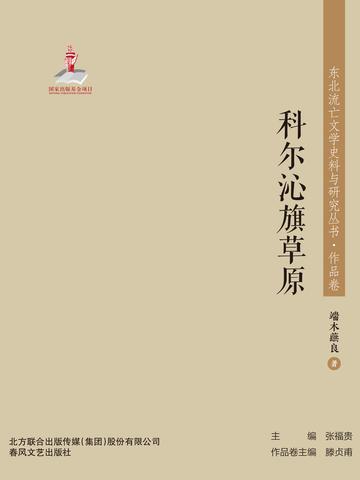
"Horqin Banner Grassland" is a long masterpiece by the famous writer Duanmu Hongliang. It is included in the volume of the "Northeast Exile Literature Historical Materials and Research Series" edited by Zhang Fugui. The book has nineteen chapters in total, with the Horqin Banner grassland as the background, telling the story of the fateful changes of several generations of the Ding family in Erluhu Village. The protagonist Ding Ning in the novel left his hometown in an era of great changes. After receiving unprecedented scientific and cultural education, he returned to his hometown full of enthusiasm and determined to carry out transformation. In the conflict with the traditional ideas of the old era, Ding Ning soon fell into an inextricable contradiction. At the same time, he also saw that his hometown on the grassland contained profound vitality, but the resistance to untying this knot came precisely from his own family. After going through various tests, Ding Ning gained a profound and true understanding, and also experienced renewed growth from the inside out. The work uncovers the trauma of thousands of years of spiritual slavery for the people at the bottom of society, and vividly reveals the subtle psychology of various characters.
Reader comments
It is a history of men.
After seeing this, I was very annoyed by Ding Ning. It cannot be said that he was not responsible for Lingzi's death. The love between master and slave was more harmful than the love between teacher and student, but Ding Ning actually did not love Lingzi.
There is also Shuishui, the daughter of a fisherman, even if she enters Ding's house, the outcome will not be good.
Ding Ning's lover and wife will eventually be a female student in Shanghai.
The female characters are all cannon fodder, and the most vital female characters are actually villains, such as the mistress, the thirty-third aunt, and the wife, who is considered to have vitality. Although she is very sick, she still fights to the end.
The most distinctive dialogue, the one that impressed me the most, was the part where the mistress wanted to capture the mountain. It was like a rolling river, pouring down, and it was the words of a living person.
There are too many long sentences, which makes reading tiring.
Many languages do not conform to modern reading habits and require effort to think about.
The customs of that era described are quite interesting, such as Taisheng Qin, Yangei Tang, and Zidi Shu.
This book takes the Horqin Banner grassland as the background, describes the changes in fate of the Ding family, and shows the trauma of spiritual slavery of the people at the bottom. The storyline is engaging and the characterization is nuanced. Among them, I was deeply impressed by the image of the Fourth Master. His calmness and inner shock while sitting at the tea table formed a sharp contrast, which made me feel his complicated psychology. This book reveals social reality and is worth reading.
It is a history of men. After seeing this, I was very annoyed by Ding Ning. It cannot be said that he was not responsible for Lingzi's death. The love between master and slave was more harmful than the love between teacher and student, but Ding Ning actually did not love Lingzi. There is also Shuishui, the daughter of a fisherman, even if she enters Ding's house, the outcome will not be good. Ding Ning's lover and wife will eventually be a female student in Shanghai. The female characters are all cannon fodder, and the most vital female characters are actually villains, such as the mistress, the thirty-third aunt, and the wife, who is considered to have vitality. Although she is very sick, she still fights to the end. The most distinctive dialogue, the one that impressed me the most, was the part where the mistress wanted to capture the mountain. It was like a rolling river, pouring down, and it was the words of a living person. There are too many long sentences, which makes reading tiring. Many languages do not conform to modern reading habits and require effort to think about. The customs of that era described are quite interesting, such as Taisheng Qin, Yangei Tang, and Zidi Shu.
This book takes the Horqin Banner grassland as the background, describes the changes in fate of the Ding family, and shows the trauma of spiritual slavery of the people at the bottom. The storyline is engaging and the characterization is nuanced. Among them, I was deeply impressed by the image of the Fourth Master. His calmness and inner shock while sitting at the tea table formed a sharp contrast, which made me feel his complicated psychology. This book reveals social reality and is worth reading.