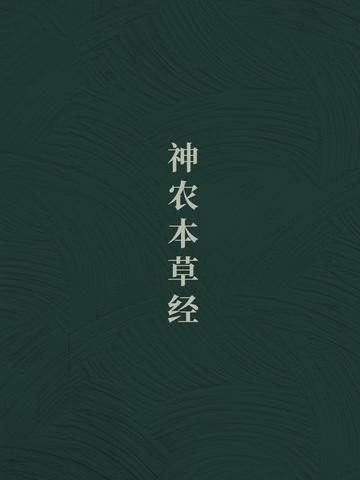
"Shen Nong's Materia Medica", also known as "Ben Cao Jing" or "Ben Jing", was written under the name "Shen Nong" and was actually written in the Han Dynasty. It is one of the four classic works of traditional Chinese medicine and the earliest known work on traditional Chinese medicine. "Shen Nong's Materia Medica" is divided into three volumes and contains 365 kinds of medicines. It is divided into upper, middle and lower grades according to the three-grade classification method. The text is simple and simple, which has become the essence of traditional Chinese medicine theory. "Shen Nong's Materia Medica" records the curative effects of 365 kinds of drugs, most of which are true and reliable and are still commonly used in clinical medicine. It puts forward the idea of syndrome differentiation and drug use, and the drugs discussed can be suitable for more than 170 kinds of diseases. There are specific regulations on the dosage and time of drug use, which also plays a foundational role in traditional Chinese medicine.
Reader comments
Although "Compendium of Materia Medica" has profound records and is of great reference value, it is full of fallacies. Scholars must combine the experience and practice of later generations before they can rely on it.
This book contains the wisdom of ancient saints. We, the younger generation, may not be able to understand it by devoting all our energy to studying and studying it.
I think it's a bit like the Compendium of Materia Medica, which is all about herbal medicine. I especially like the part about the classification of medicines, and also talks about the kings, ministers and assistants who use medicines. It's so interesting! It reminds me of the imperial doctors in the TV series. Do they refer to these when prescribing treatments? But it's hard to remember the names of these herbs. It would be great if a character could help me remember them.
Yes, there is a lot of knowledge that cannot be learned in books.
It's worth a look, and you'll be blessed to see more!
Good book, I gained a lot of knowledge after reading it.
Although "Compendium of Materia Medica" has profound records and is of great reference value, it is full of fallacies. Scholars must combine the experience and practice of later generations before they can rely on it.
This book contains the wisdom of ancient saints. We, the younger generation, may not be able to understand it by devoting all our energy to studying and studying it.
I think it's a bit like the Compendium of Materia Medica, which is all about herbal medicine. I especially like the part about the classification of medicines, and also talks about the kings, ministers and assistants who use medicines. It's so interesting! It reminds me of the imperial doctors in the TV series. Do they refer to these when prescribing treatments? But it's hard to remember the names of these herbs. It would be great if a character could help me remember them.
Yes, there is a lot of knowledge that cannot be learned in books.
It's worth a look, and you'll be blessed to see more!
Good book, I gained a lot of knowledge after reading it.
It's okay, but I don't know the real thing
Study hard and make progress every day