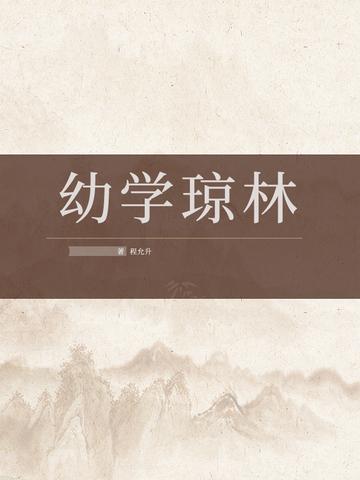
"Young Learning Qionglin" is an enlightening children's book in ancient China. The author is Cheng Dengji, whose courtesy name is Yunsheng, who was born in Xichang in the late Ming Dynasty. This book was originally titled "Instructions for Preschool Education", also known as "Idiom Test" and "Story Source Search". Qiu Rui, a Jinshi during the Jingtai period of the Ming Dynasty, Zou Shengmai during the Jiaqing period of the Qing Dynasty, Fei Yourong, Ye Pusun and Cai Dongfan during the Republic of China were added. "Young Learning Qionglin" is written in parallel prose. The whole book is written in dual sentences, which is easy to read and remember. The content of the book is extensive and all-encompassing, and it is called the encyclopedia of ancient China. People say that "you can speak after reading "Zengguang", and you can read after reading "Youxue"." The book provides many introductions to the origins of many idioms. Readers can master many idiom allusions. In addition, they can also learn about famous figures in ancient China, astronomy and geography, rules and regulations, customs and etiquette, birth, old age, illness and death, weddings and funerals, birds and animals, flowers and trees, court civil and military affairs, food and drink utensils, palace treasures, cultural subjects, Buddhism, Taoism, ghosts and gods, etc. There are many aphorisms and aphorisms in the book that are still recited today. However, there are also some feudal views in the book that are difficult for modern people to agree with. The great man Mao Zedong was able to memorize "Young Learning Qionglin" by heart, which shows the extent of this book's influence on the world.
Reader comments
There is a saying that goes, "You will be able to speak after reading "Zengguang Xianwen", and you will be able to travel around the world after reading "Young Learning Qionglin"." Before reading this book, I thought this sentence was too exaggerated. After reading this book, I found that this sentence is still conservative. This book is rich in content, including natural knowledge, historical legends, common sense of life, etc. At that time, showing ancient society clearly and in detail to future generations. It can be said to be a miniature encyclopedia. After reading the complete text, you will not only have a profound understanding of ancient society and history, but also cultivate your sentiments and learn the integrity of ancient people.
My father told me some of these stories when I was a child. It can be said that the book "Young Learning Qionglin" is my book of historical enlightenment. However, when my father told it, I listened to it as a bedtime story. But when I read it myself, I truly understood some of the principles of how to behave, and also learned and understood the essence of traditional culture. I learned about many historical figures and learned the heroic spirit of Xiang Yu who shamelessly committed suicide in the face of the Jiangdong elders. I also learned Tao Yuanming's integrity of not bending down for five buckets of rice...
What teaching aids did ancient children have? Zengguang Xianwen is one of them, and Kindergarten Qionglin is one of them. Starting from the beginning of chaos and the founding of heaven and earth, Qiu Shengmai, a native of Xichang in the late Ming Dynasty, presented an encyclopedia including daily necessities of human relations and dietary utensils to the children at that time. Looking back at that era now, we will be surprised to find that despite the ups and downs, the spirit of human cultural heritage remains unchanged, and it is the infinite thirst for knowledge and truth that has helped our people to continue their culture for thousands of years.
After reading this book, I was attracted by the author's in-depth thinking on the importance and methods of education. This is an ancient education classic that brings together the wisdom and educational concepts of ancient educators. The author provides valuable educational guidance for future generations by discussing educational methods and educational objectives. The book covers all aspects of children's education, from learning methods to moral character, and provides in-depth guidance and suggestions. This is not only an ancient educational classic, but also a treasure trove of educational concepts and methods. Through the discussion of educational goals and methods, the author shows his concern and responsibility for the cultivation of the next generation.
A book worth reading!
A great book worth reading more.
This book "Young Learning Qionglin" is really rich in content, like an ancient encyclopedia. I especially like the aphorisms and mottos in it, which are very helpful for children's education. You can also learn about ancient Chinese culture and history. When you read it with your children, they can also learn a lot of knowledge. While some of the points may be outdated, overall it's well worth reading.
I finally finished copying it. It would be better if I phonetic notated some rare words.
Common sense of life, old way of reading the calendar.
There is a saying that goes, "You will be able to speak after reading "Zengguang Xianwen", and you will be able to travel around the world after reading "Young Learning Qionglin"." Before reading this book, I thought this sentence was too exaggerated. After reading this book, I found that this sentence is still conservative. This book is rich in content, including natural knowledge, historical legends, common sense of life, etc. At that time, showing ancient society clearly and in detail to future generations. It can be said to be a miniature encyclopedia. After reading the complete text, you will not only have a profound understanding of ancient society and history, but also cultivate your sentiments and learn the integrity of ancient people.
My father told me some of these stories when I was a child. It can be said that the book "Young Learning Qionglin" is my book of historical enlightenment. However, when my father told it, I listened to it as a bedtime story. But when I read it myself, I truly understood some of the principles of how to behave, and also learned and understood the essence of traditional culture. I learned about many historical figures and learned the heroic spirit of Xiang Yu who shamelessly committed suicide in the face of the Jiangdong elders. I also learned Tao Yuanming's integrity of not bending down for five buckets of rice...
What teaching aids did ancient children have? Zengguang Xianwen is one of them, and Kindergarten Qionglin is one of them. Starting from the beginning of chaos and the founding of heaven and earth, Qiu Shengmai, a native of Xichang in the late Ming Dynasty, presented an encyclopedia including daily necessities of human relations and dietary utensils to the children at that time. Looking back at that era now, we will be surprised to find that despite the ups and downs, the spirit of human cultural heritage remains unchanged, and it is the infinite thirst for knowledge and truth that has helped our people to continue their culture for thousands of years.
After reading this book, I was attracted by the author's in-depth thinking on the importance and methods of education. This is an ancient education classic that brings together the wisdom and educational concepts of ancient educators. The author provides valuable educational guidance for future generations by discussing educational methods and educational objectives. The book covers all aspects of children's education, from learning methods to moral character, and provides in-depth guidance and suggestions. This is not only an ancient educational classic, but also a treasure trove of educational concepts and methods. Through the discussion of educational goals and methods, the author shows his concern and responsibility for the cultivation of the next generation.
A book worth reading!
A great book worth reading more.
This book "Young Learning Qionglin" is really rich in content, like an ancient encyclopedia. I especially like the aphorisms and mottos in it, which are very helpful for children's education. You can also learn about ancient Chinese culture and history. When you read it with your children, they can also learn a lot of knowledge. While some of the points may be outdated, overall it's well worth reading.
I finally finished copying it. It would be better if I phonetic notated some rare words.
Common sense of life, old way of reading the calendar.