Mr. Hu, like other great people, is approachable. "Gentle yet sharp" is the best way to describe it. I never saw him get angry or domineering. He always treated young people, subordinates, and servants with a smile. Even when he was frustrated and insulted, he remained true to himself.
"His heart is calm and his face is calm." - Liang Shiqiu
Hu Shi was an enlightening master who carried on the past and opened up the future during the development process of "traditional China" into "modern China". ——Tang Degang
Mr. Shizhi's door was tightly closed, and a small note was taped on the door saying: "There are no weapons inside, so please don't worry." This can certainly be true, but some people - at least people like me - sometimes can't help but think sideways. ——Lu Xun
Missing Hu Shi, China missed 100 years... Hu Shi was not only John Christophe, but also Olivier. He was an army of ideas, not an army of violence. He was ignored, but no one could ever break him. ——Xiong Peiyun
About the author: Hu Shi (December 17, 1891 - February 24, 1962), pen name Hu Shi, courtesy name Shizhi; a famous thinker, writer, and philosopher; a native of Jixi, Huizhou, famous for advocating "vernacular Chinese" and leading the New Culture Movement. Hu Shi's academic activities throughout his life were mainly in the fields of literature, philosophy, history, textual criticism, education, and red studies. His major works include "Outline of the History of Chinese Philosophy" (Part 1), "History of Vernacular Literature" (Part 1), and "Hu Shi's Wencun". His greatest academic influence is his advocacy of the academic approach of "bold assumptions and careful verification".
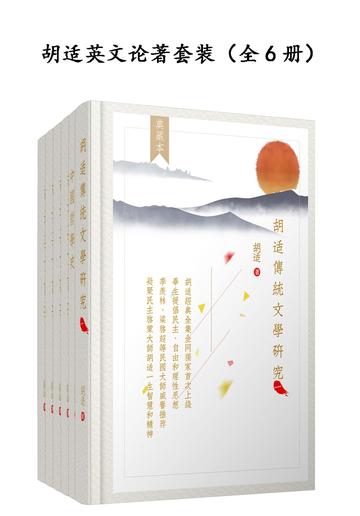
Introduction: Mr. Hu Shi is a famous Chinese thinker, writer, and philosopher, and one of the most influential scholars in China in the last century. Mr. Hu Shi has advocated democracy, freedom and rational thought throughout his life. It is this kind of thought that has helped many young people establish independent and free personalities, form independent thinking and respect for facts, and become people with democratic and scientific literacy. Mr. Hu Shi wrote extensively throughout his life, especially in the fields of literature, philosophy, history, textual criticism, education, and red studies. He wrote many excellent works. This series of books is reorganized according to academic categories, such as philosophy, literature, history, English works, diaries, letters, etc., Totaling 44 volumes. All published works in each category are arranged according to the time of publication. Works that are unpublished or whose exact time is not identified will be disposed of as appropriate.
"Hu Shi's English Works" consists of 6 volumes, including the history of Chinese philosophy, Chinese literature, Chinese ideological history, Chinese diplomacy, Chinese sociology and Chinese national crisis. Mainly includes Hu Yong's speeches and papers published in English. These treatises are evidence of Hu Shi's efforts to let the world understand Chinese culture, history and diplomacy.
Reader comments
Mr. Hu Shi's analysis of Chinese culture, history and diplomacy is very profound. Some of the views in the book made me think more deeply about Chinese tradition and modernity. I especially like his discussion of the national crisis in the book. His unique insights gave me a more comprehensive understanding of China at that time. In short, this is a very valuable set of books, I recommend you read it!
Mr. Hu Shi's analysis of Chinese culture, history and diplomacy is very profound. Some of the views in the book made me think more deeply about Chinese tradition and modernity. I especially like his discussion of the national crisis in the book. His unique insights gave me a more comprehensive understanding of China at that time. In short, this is a very valuable set of books, I recommend you read it!