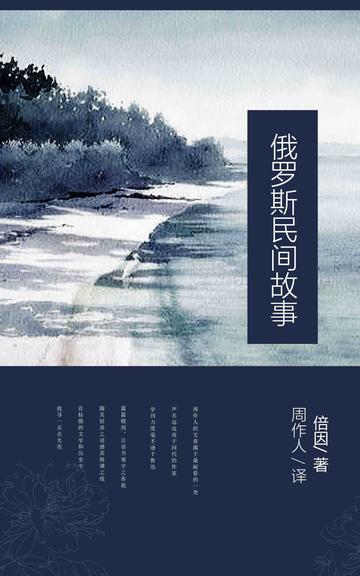
This book is based on "Russian Fairy Tales" (1901) compiled by the British R. N. Bain, but the Chinese and English names are easy to misunderstand and are not very applicable. The Chinese fairy tale seems to refer to children's books, but in fact it is not. The original English meaning is the story of the Yunxian family, but this kind of little fairy does not appear in other places except Western Europe. Bein is based on P. N. Polevoi's "Russian Folk Tales" (Narodhuiya Russkiya Skazki), which is also used today.
Russian folktales had been collected in the previous century, and were edited by Afanasiev, who was famous all over the world. Berlevi selected thirty-six of them and compiled them into a volume, which was published in 1874 for easy reading. Bein selected twenty-four more from them, and the twelve stories collected in this book are exactly half of them. One-third of what is said in Bai Liwei's book has not been translated into English. I don't know how it is. But if we are talking about Bein's book, the twelve pieces translated here can be said to be the essence, which is enough to represent the benefits of this kind of story. Bein once said that scholars who are equally familiar with the Germanic Märchen and the Russian Skazki all praise the latter far above the former when it comes to the fantasy and fun of the story. This is very true.
Folktales are the product of old times and old societies, and there are often remnants of religious and feudal elements in them. However, the gods in the stories are often just spoken words, which can be replaced by justice or justice. Nobles and wealthy businessmen are the targets of defeat. The tsars are almost all vulgar and ridiculous. If folktales are not modified and modified by scribes, their soundness still exists. This can be seen more clearly in Slavic stories.
Reader comments
Is it because my own knowledge is not enough? Why can't I understand the translated text? ?
The advanced culture of Russia is undoubtedly the most advanced and noble.
This book is very good! The stories inside are full of imagination and fun, reminding me of the time I spent telling stories to children when I was a child. I particularly like those witty and brave characters who always overcome difficulties. I also kinda hate the cunning villains, though. This reminds me that there are always some unlikable people in life. Overall, this book is not only entertaining but also relatable and well worth reading.
Is it because my own knowledge is not enough? Why can't I understand the translated text? ?
The advanced culture of Russia is undoubtedly the most advanced and noble.
This book is very good! The stories inside are full of imagination and fun, reminding me of the time I spent telling stories to children when I was a child. I particularly like those witty and brave characters who always overcome difficulties. I also kinda hate the cunning villains, though. This reminds me that there are always some unlikable people in life. Overall, this book is not only entertaining but also relatable and well worth reading.
The author is Zhou Zuoren. . .
Children like it very much