Reciting a poem will make you fall in love with a thousand-year-old classic; singing a poem will make your lips and teeth fill with fragrance, and it will also make your breath linger in your heart. Sometimes delicate and ethereal, sometimes majestic, he uses his singing to take us through the long river of history, to touch the dazzling classics of the ancients, and to strengthen the heart of today's people to inherit culture. ——Media evaluation of CCTV's classic chanting column group
"Classics Chanting and Spreading" is based on the positioning of "recreating current popularity and future classics", realizing the integration of literature and music into one, taking the form of combining stars and elements, old and young on the same stage, and integrating Chinese and foreign countries, to elevate the spread and inheritance of traditional culture to the height of national participation and the depth of aesthetic guidance. The program's solid works, diverse guests, meticulous creation, and sincere performances made every poem and song leave a deep impression on people and spread quickly. ——"People's Daily"
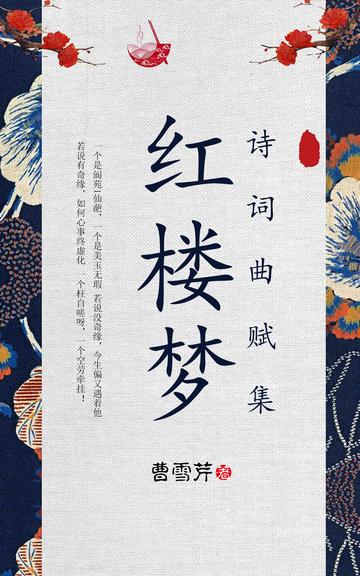
Content introduction: "A Dream of Red Mansions", as the first of the four classic Chinese classics, is a human love novel with world influence. It is universally recognized as the pinnacle of Chinese classical novels, an encyclopedia of Chinese feudal society, and a master of traditional culture. The poems and songs in it also have extraordinary achievements. The author Cao Xueqin wrote many poems in different styles based on different characters in the book. This book collects all the poems, lyrics, music and verses in Dream of Red Mansions, among which the more famous ones include "Ode to Burial Flowers", "Wan Ning Mei", "Elegance of Lotus Daughter", etc.
About the author (Qing Dynasty) Cao Xueqin (Qing Dynasty) Gao E. Cao Xueqin (about May 28, 1715 - about February 12, 1763), whose surname was Zhan, also named Mengruan, also known as Xueqin, also known as Qinxi and Qinpu, was the author of the Chinese classic "A Dream of Red Mansions". His ancestral home was Tieling, Liaoning Province. He was born in Nanjing and moved back to Beijing when he was about thirteen years old. Cao Xueqin was born in the Zhengbai Banner wrapping family of the Ministry of Internal Affairs of the Qing Dynasty. He was the grandson of Cao Yin, a weaver in Jiangning, and the son of Cao Yong. Gao E (1758-about 1815), also known as Yunshi, also known as Qiufu, also known as Lanshu, Xingyi and Honglouwaishi. In the Qing Dynasty, he was a member of the Ministry of Internal Affairs of the Xianghuang Banner of the Han Army. His native place was Santaizi, Shenyang. He was also affiliated with Tieling Gao'e and Fengtian Gao'e. His ancestors lived in Beijing in the early Qing Dynasty.
Reader comments
This book contains all the poems, lyrics, and music in "A Dream of Red Mansions". It's really great! Cao Xueqin's writing style is delicate and nuanced, and every poem seems to allow me to see the fate and emotions of the characters in the book. I particularly like Lin Daiyu. Her "The Burial of Flowers" made me feel her sadness and talent. This book is not only a literary classic, but also a treasure of traditional Chinese culture, worthy of our careful appreciation.
After reading your novel, I don't have to worry about my Chinese homework anymore.
The red building is full of colorful clouds and jade.
Comment after reading it
I really enjoyed reading The Story of the Stone
Why is it not rising, but falling?
It's just that there are very few gold coins. It sounds really good. I remember reading the novel when I was a kid. It was really good.
It's really for teachers, students don't have such a cheap store.
The content is comprehensive and I really like the five-star review. The activity is real and effective. I would like to thank the teacher on the platform for helping a poor family.


This book contains all the poems, lyrics, and music in "A Dream of Red Mansions". It's really great! Cao Xueqin's writing style is delicate and nuanced, and every poem seems to allow me to see the fate and emotions of the characters in the book. I particularly like Lin Daiyu. Her "The Burial of Flowers" made me feel her sadness and talent. This book is not only a literary classic, but also a treasure of traditional Chinese culture, worthy of our careful appreciation.
After reading your novel, I don't have to worry about my Chinese homework anymore.
The red building is full of colorful clouds and jade.
Comment after reading it
I really enjoyed reading The Story of the Stone
Why is it not rising, but falling?
It's just that there are very few gold coins. It sounds really good. I remember reading the novel when I was a kid. It was really good.
It's really for teachers, students don't have such a cheap store.
The content is comprehensive and I really like the five-star review. The activity is real and effective. I would like to thank the teacher on the platform for helping a poor family.