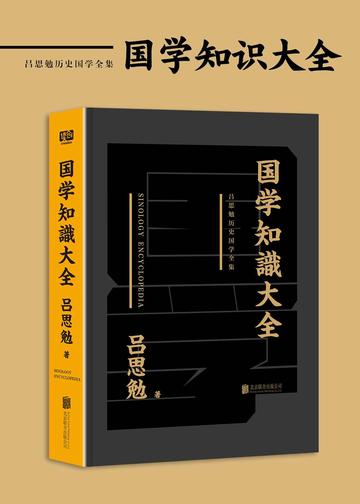
This book includes Mr. Lu Simian's "Introduction to Chinese Studies", "An Explanation of Jingzi", "Introduction to Pre-Qin Academics", "Outline of Neo-Confucianism", "History of Chinese Culture", "Historical Research Methods", "History and Historical Books", and "How to Read Chinese Historical Books". It is the most comprehensive guide to teach introductory steps to Chinese studies so far.
Reader comments
Very good, a book similar to a literature review. Mr. Lu Simian is a master of Chinese studies. This set of books contains many Chinese studies books such as "Introduction to Chinese Studies" and "Jingzi's Answers to Problems". The content is very rich. However, Chinese studies have a certain threshold, not to mention that this book is almost all-inclusive. From the perspective of an ordinary reader, this book is a bit discouraging. First, the book is extremely professional and cannot be read without a foundation. Second, the book contains too much content and the focus is not clear enough. It is better not to choose this book for beginners. This book is more suitable for researchers to read.
Mr. Lu Simian is a famous Chinese scholar in my country. This book collects several of his important works on Chinese studies, systematically displays the old man's research results on Chinese history and the essentials of classics, and can be used as an introductory work for readers to understand and learn Chinese studies. When we read these words today, we can still feel something about the old man's mood, which is to arouse the people's confidence in history and traditional culture and inject spiritual power into the great rejuvenation of the Chinese nation. Everyone's thoughts during the Republic of China are worth picking up and re-study.
The system of this book is very complete. This book takes the four aspects of "thought", "culture", "history" and "art" as the main lines, and organically combines the contents of each aspect to form a complete system. Not only that, this book is also divided into twelve parts, covering all aspects of traditional Chinese culture, such as "Classics and Common Sense", "Literature and Art", "Ancient History", etc. The content of each part is classified and summarized in detail to allow readers to better understand and absorb. Finally, the language of this book is concise and easy to understand.
Chinese scholars are a kind of knowledge in our country's past. It includes the nature and changes of Chinese academics, rather than being absolutely different from foreign academics. An ancient proverb from the Han Dynasty in our country goes: "What you see rarely is what you find strange. When you see a camel riding a horse, it sounds like a horse has a swollen back." In the old days, our country regarded outsiders who came to China as ignorant of their learning. As you advance further, you will learn one or two aspects of it. If you go further, you will realize that it has its own scholarship, which is completely different from that of our country. However, from what we have seen now, we know that China and foreign countries are actually very similar. Among the various tribes in ancient times, there were some who knew how to build boats and others who knew how to make chariots. Each had its own abilities and some did not know. This book includes Mr. Lu Simian's introduction to Chinese studies, Jingzi's problem solving, pre-Qin academic introduction, Neo-Confucianism outline, Chinese cultural history, historical research methods, historiography and historical books, and reading methods of Chinese historical books. It is the most comprehensive guide to teach introductory Chinese studies to date.
"Encyclopedia of Chinese Studies Knowledge" can be described as a rare collection of Chinese studies. When reading this book, I found that the language is very concise and clear. The author does not use too many gorgeous rhetoric or uncommon and difficult vocabulary, but uses easy-to-understand language to explain every concept very clearly. This kind of writing style is capable, intuitively presenting the knowledge that the author wants to convey to readers, realizing the interconnection of knowledge, and at the same time, it also has a certain positive effect in promoting Chinese traditional culture.
This book is rich in content, covering all aspects of Chinese academics. The author, Mr. Lu Simian, is knowledgeable and explains in simple terms. By reading this book, I have a clearer understanding of the development of Chinese academics. Especially the parts about the pre-Qin scholars and Wei and Jin metaphysics gave me a deeper understanding of the thoughts of that period. All in all, this is a great book worth reading!
Very good, a book similar to a literature review. Mr. Lu Simian is a master of Chinese studies. This set of books contains many Chinese studies books such as "Introduction to Chinese Studies" and "Jingzi's Answers to Problems". The content is very rich. However, Chinese studies have a certain threshold, not to mention that this book is almost all-inclusive. From the perspective of an ordinary reader, this book is a bit discouraging. First, the book is extremely professional and cannot be read without a foundation. Second, the book contains too much content and the focus is not clear enough. It is better not to choose this book for beginners. This book is more suitable for researchers to read.
Mr. Lu Simian is a famous Chinese scholar in my country. This book collects several of his important works on Chinese studies, systematically displays the old man's research results on Chinese history and the essentials of classics, and can be used as an introductory work for readers to understand and learn Chinese studies. When we read these words today, we can still feel something about the old man's mood, which is to arouse the people's confidence in history and traditional culture and inject spiritual power into the great rejuvenation of the Chinese nation. Everyone's thoughts during the Republic of China are worth picking up and re-study.
The system of this book is very complete. This book takes the four aspects of "thought", "culture", "history" and "art" as the main lines, and organically combines the contents of each aspect to form a complete system. Not only that, this book is also divided into twelve parts, covering all aspects of traditional Chinese culture, such as "Classics and Common Sense", "Literature and Art", "Ancient History", etc. The content of each part is classified and summarized in detail to allow readers to better understand and absorb. Finally, the language of this book is concise and easy to understand.
Chinese scholars are a kind of knowledge in our country's past. It includes the nature and changes of Chinese academics, rather than being absolutely different from foreign academics. An ancient proverb from the Han Dynasty in our country goes: "What you see rarely is what you find strange. When you see a camel riding a horse, it sounds like a horse has a swollen back." In the old days, our country regarded outsiders who came to China as ignorant of their learning. As you advance further, you will learn one or two aspects of it. If you go further, you will realize that it has its own scholarship, which is completely different from that of our country. However, from what we have seen now, we know that China and foreign countries are actually very similar. Among the various tribes in ancient times, there were some who knew how to build boats and others who knew how to make chariots. Each had its own abilities and some did not know. This book includes Mr. Lu Simian's introduction to Chinese studies, Jingzi's problem solving, pre-Qin academic introduction, Neo-Confucianism outline, Chinese cultural history, historical research methods, historiography and historical books, and reading methods of Chinese historical books. It is the most comprehensive guide to teach introductory Chinese studies to date.
"Encyclopedia of Chinese Studies Knowledge" can be described as a rare collection of Chinese studies. When reading this book, I found that the language is very concise and clear. The author does not use too many gorgeous rhetoric or uncommon and difficult vocabulary, but uses easy-to-understand language to explain every concept very clearly. This kind of writing style is capable, intuitively presenting the knowledge that the author wants to convey to readers, realizing the interconnection of knowledge, and at the same time, it also has a certain positive effect in promoting Chinese traditional culture.
This book is rich in content, covering all aspects of Chinese academics. The author, Mr. Lu Simian, is knowledgeable and explains in simple terms. By reading this book, I have a clearer understanding of the development of Chinese academics. Especially the parts about the pre-Qin scholars and Wei and Jin metaphysics gave me a deeper understanding of the thoughts of that period. All in all, this is a great book worth reading!
Waiting patiently, I understand!